
Improving observational skills Math Worksheets for Ages 7-8
3 filtered results
Difficulty Level
Grade
Age
-
From - To
Subject
Activity
Standards
Enhance your child's observational skills with our engaging Math Worksheets designed specifically for ages 7-8. These printable resources focus on honing critical thinking and attention to detail through various interactive exercises. Kids will enjoy solving problems that challenge their ability to recognize patterns, compare quantities, and interpret data visually. Our worksheets make learning fun while developing essential skills that are foundational for future math success. Perfect for both classroom and home use, these materials encourage curiosity and independent thinking. Explore our collection today and give your child the tools they need to excel in mathematics and beyond!
Favorites
With answer key
Interactive
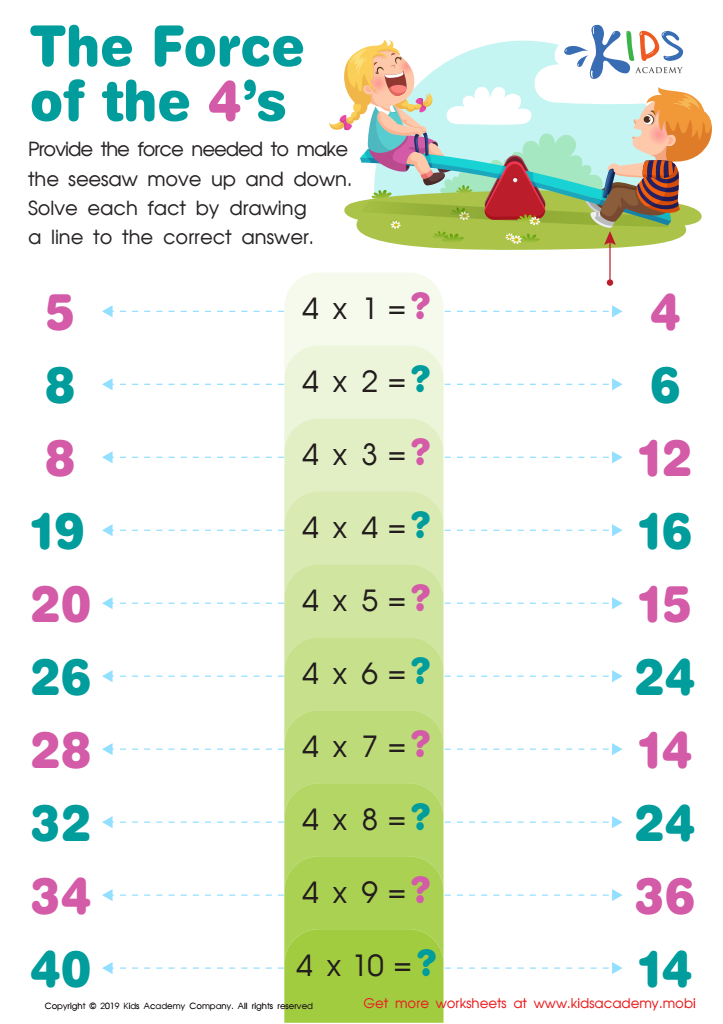
The Force of the 4's Worksheet
Ride a seesaw with your child and explore the physics behind it! Explain how it needs two people and how force makes it go up and down. Use the memories of the pleasurable experience to teach your kid a lesson in force. Show them how to solve the worksheet by drawing a line to the correct answer. This way, they'll learn the force needed for the seesaw to move.
 Assign to My Students
The Force of the 4's Worksheet
Worksheet
Join Kids Academy for Free
Who is primarily going to use this learning content?








Improving observational skills in math for ages 7-8 is crucial for nurturing critical thinking and problem-solving abilities. At this developmental stage, children are beginning to understand abstract concepts and mathematical relationships. By enhancing their observational skills, they can better identify patterns, analyze data, and make connections between different mathematical ideas.
Engaging children in observational tasks helps them develop a richer understanding of shapes, measurements, and spatial relationships. For instance, by observing objects or the environment, children can learn to compare sizes, recognize symmetry, and comprehend geometric shapes, all of which are foundational for higher-level math.
Moreover, observational skills promote a love for learning. When children learn to observe closely, they become more curious and motivated to explore mathematical concepts in real-world contexts. This interactive approach can make math feel more relevant and fun.
For parents and teachers, fostering these skills is beneficial as it lays a solid foundation for future math success. Strong observational skills lead to improved academic performance and foster skills needed for everyday problem solving. Ultimately, investing time in developing children’s observational math skills builds confidence and supports lifelong learning.








