Learning number patterns Math Worksheets for Ages 7-8
4 filtered results
-
From - To
Unlock the power of number patterns with our "Learning Number Patterns Math Worksheets for Ages 7-8" from Kids Academy! Specifically designed to engage young minds, these worksheets help children identify, understand, and extend various number sequences. With fun and interactive exercises, students will hone their critical thinking and problem-solving skills while discovering the magic of math. Perfect for classroom or at-home learning, these worksheets ensure students master foundational concepts through practice and repetition. Start exploring the world of numbers today and watch your child's confidence soar as they recognize and create patterns!
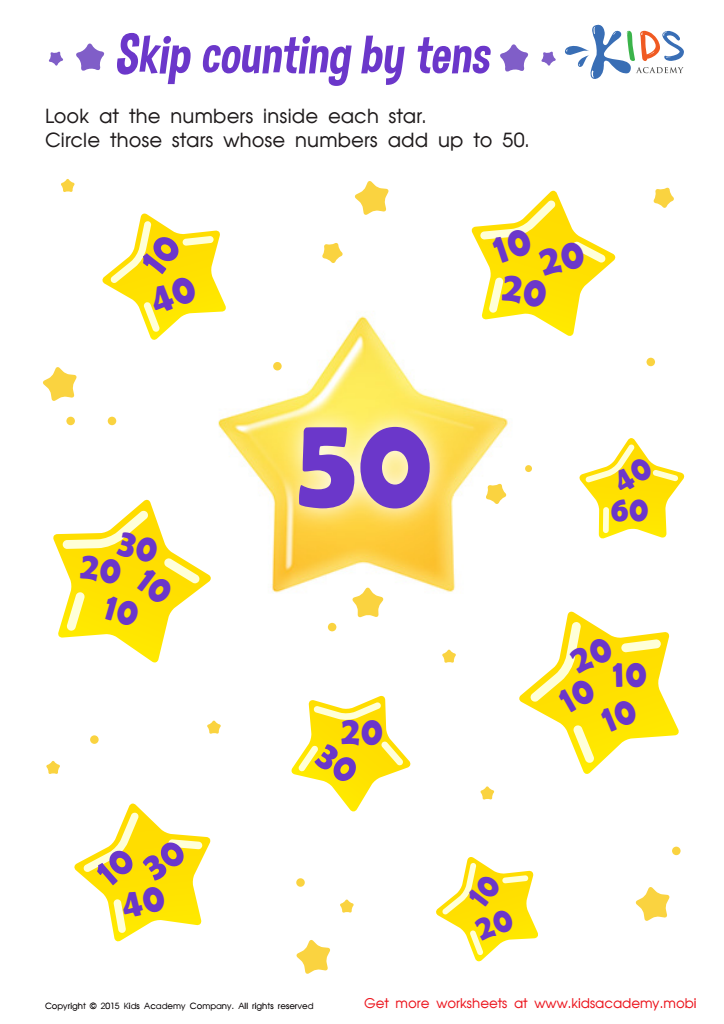
Learn Dozens: Skip Counting by Tens Printable
 Assign to My Students







Learning number patterns is essential for children aged 7-8 because it forms the foundation for numerous math concepts they will encounter in later grades. At this age, children's cognitive abilities are rapidly developing, and recognizing patterns in numbers enhances their critical thinking and problem-solving skills. Understanding number patterns helps children make sense of the numerical world around them. For instance, identifying sequences like 2, 4, 6, 8 aids in grasping multiplication and division concepts in a more intuitive way.
Number patterns also play a pivotal role in understanding and predicting mathematical outcomes, which builds the groundwork for algebraic thinking. Reinforcing this knowledge at an early age boosts children's confidence in handling more complex mathematical operations in the future. Additionally, it promotes logical reasoning, attention to detail, and analytical skills — abilities that are transferable beyond math class and beneficial in everyday decision-making processes.
Parents and teachers should emphasize learning number patterns through playful and engaging activities to ensure that children retain their interest and enjoy the process. This could involve interactive games, visual aids, or even daily life examples to make the learning concrete and relatable. By fostering a strong grasp of number patterns early on, we set children up for long-term success not only in mathematics but in their overall cognitive development.








