
Sentence construction Math Worksheets for Ages 7-8
5 filtered results
Difficulty Level
Grade
Age
-
From - To
Subject
Activity
Standards
Discover our engaging Sentence Construction Math Worksheets designed specifically for children aged 7-8. These worksheets combine language skills with math concepts, helping young learners enhance their sentence formation abilities while navigating through basic arithmetic problems. Each activity encourages critical thinking, fosters creativity, and strengthens language comprehension by allowing kids to craft sentences about numbers, patterns, and shapes. Perfect for both classroom and home use, our resources support foundational skills in a playful and interactive manner. Download Printable PDF worksheets and make learning fun! Transform math into a language arts adventure today with our thoughtfully designed materials. Start building confidence and competence in your young learners!
Favorites
With answer key
Interactive
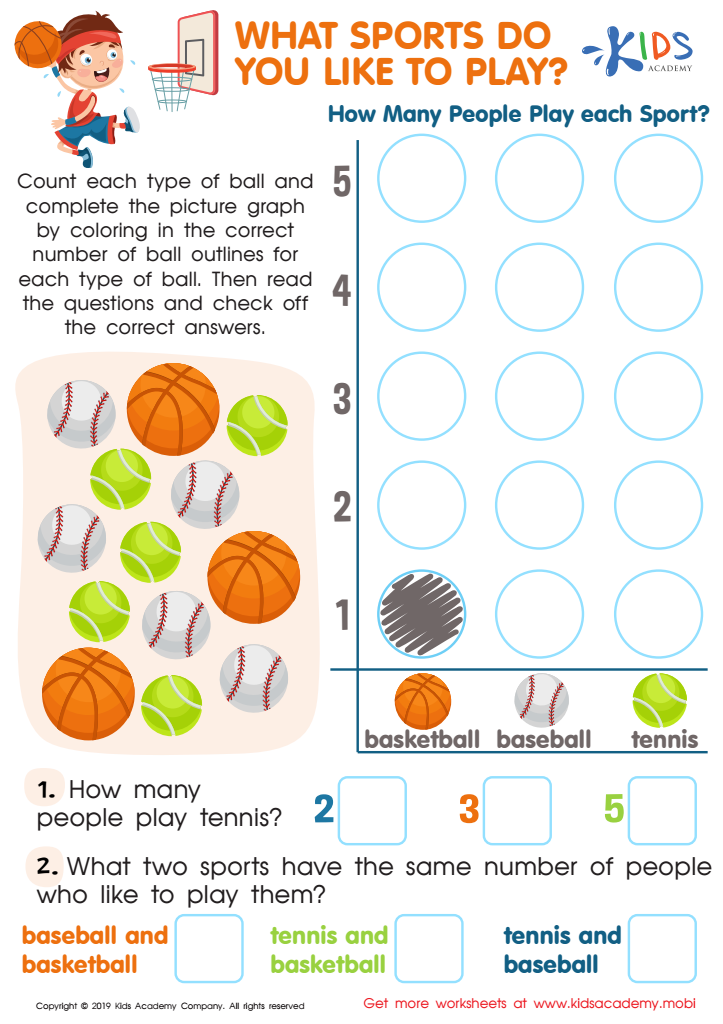
What Sports Do You Like to Play Worksheet
Encourage your kids to complete this fun sports-themed math worksheet! Count each type of ball then help them complete the picture graph. It's a great way to make math a fun, tear-free activity. Download our printable PDF to get started!
 Assign to My Students
What Sports Do You Like to Play Worksheet
Worksheet
Join Kids Academy for Free
Who is primarily going to use this learning content?






Sentence construction in math for ages 7-8 is crucial because it fosters a deeper understanding of mathematical concepts and encourages critical thinking. At this stage, children are beginning to internalize not just the “how” of problem-solving, but also the “why.” By encouraging students to express their math reasoning through complete sentences, parents and teachers help develop their ability to articulate thoughts clearly and logically.
Additionally, strong sentence construction skills in math enhance communication abilities. When children learn to explain their reasoning, they cultivate language skills that are transferable across subjects. For example, being able to phrase mathematical thoughts accurately can bolster their performance in reading comprehension and writing tasks.
Moreover, understanding how to construct mathematical sentences builds confidence. Students who can explain their thought processes are more likely to engage with complex problems and persist when challenges arise. Engaging with math in this way also prepares them for advanced concepts in the future, as foundations are laid early.
Lastly, helping children express themselves in math fosters a positive attitude toward the subject. When they see math as approachable and manageable through language, they are more likely to embrace it rather than shy away from it. This holistic approach creates lifelong learners and thinkers.








