
Understanding time Time Worksheets for Ages 7-8
3 filtered results
Difficulty Level
Grade
Age
-
From - To
Subject
Activity
Standards
Unlock your child's potential with our "Understanding Time Worksheets for Ages 7-8". Designed to make learning fun and engaging, these worksheets provide essential practice in reading clocks, understanding AM and PM, and calculating elapsed time. This resource, meticulously crafted for young learners, nurtures critical math skills in a creative and interactive way. Perfect for classrooms or home use, our worksheets will help kids gain confidence in managing time while staying ahead in their academic journey. Equip your child with the essential tools to master time-telling and enhance their overall math capabilities with Kids Academy.
Favorites
With answer key
Interactive
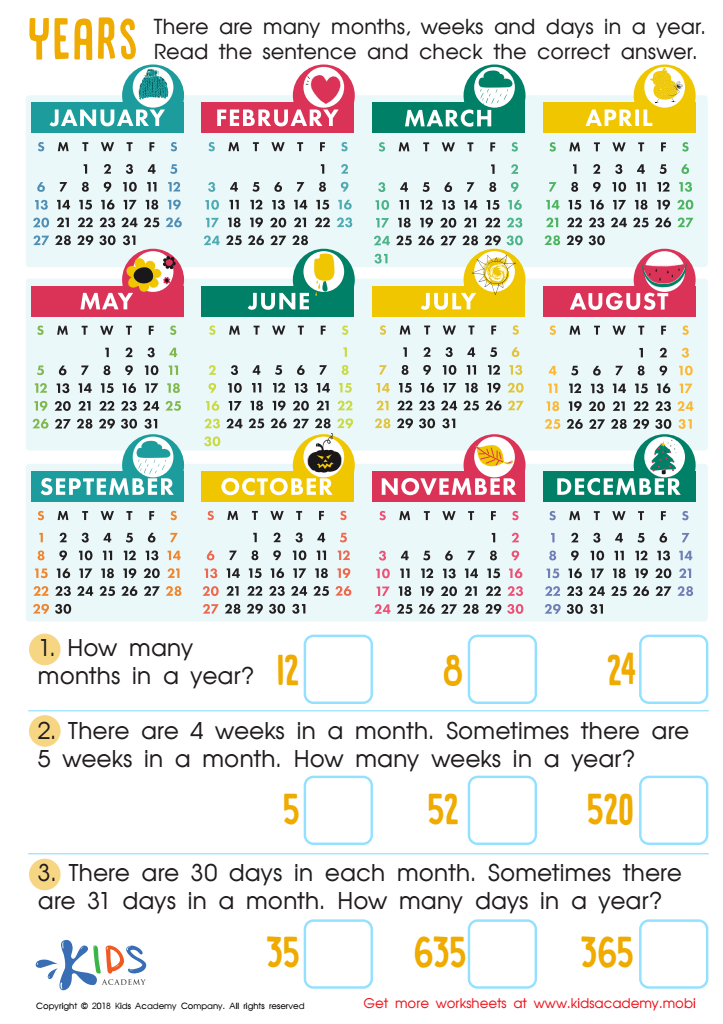
Years Worksheet
This worksheet is a great way to test your children's knowledge of the calendar. Ask them if they can name the days of the week and months in a year. Read and discuss the questions with them and help them find the right answers. Encourage them to check their answers.
 Assign to My Students
Years Worksheet
Worksheet
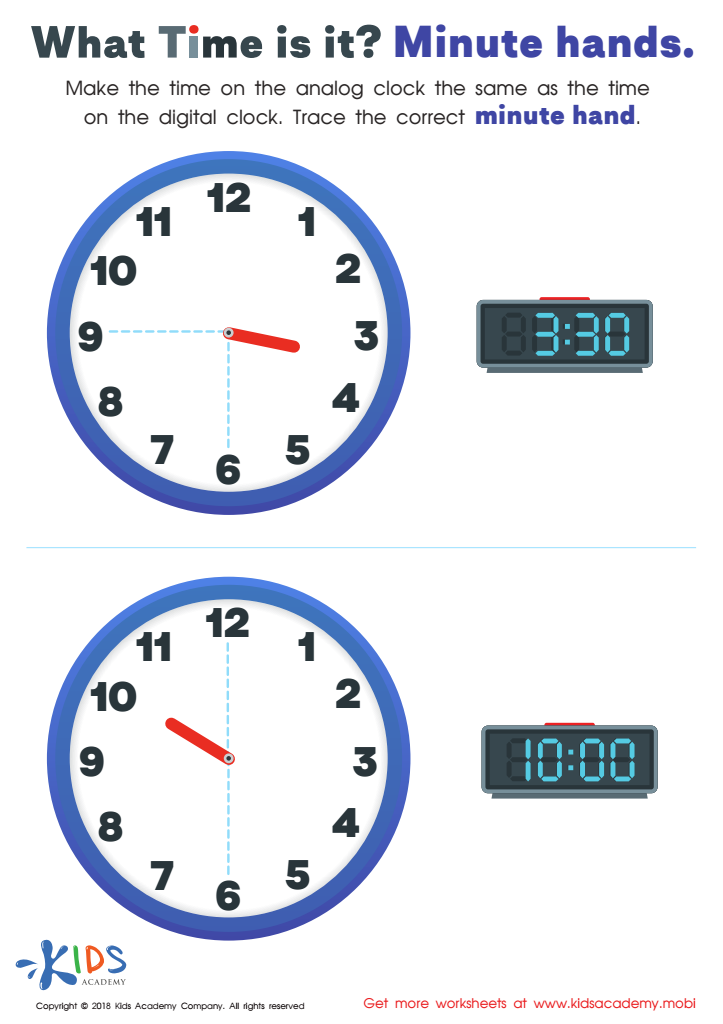
What Time Is it? Minute Hands Worksheet
Help your kids telling time with the minute hand correctly with this tracing sheet. Trace the correct minute hand to make the time on the analog clock the same as the time on the digital clock. Give them a pictured demonstration of how to do it and you'll be all set!
What Time Is it? Minute Hands Worksheet
Worksheet
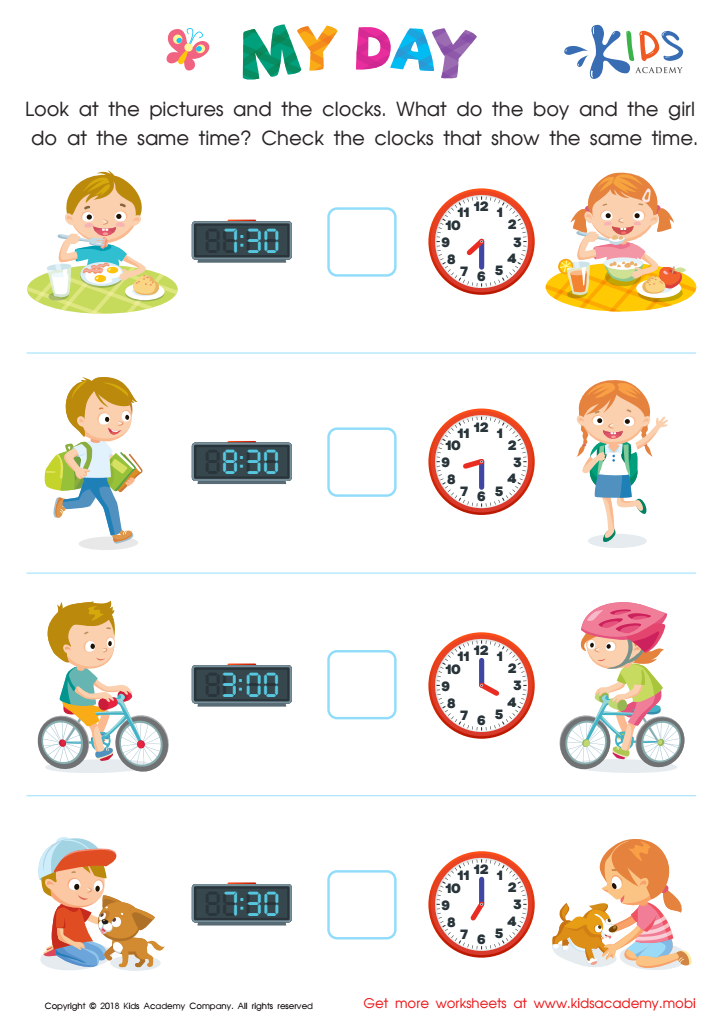
My Day Worksheet
Show your students the pictures and clocks in the colorful worksheet. Ask what the boy and girl are doing in each, then what time the clocks show. Finally, ask what activities they both do at the same time. Help them check the clocks showing the same time in both pictures.
My Day Worksheet
Worksheet
Join Kids Academy for Free
Who is primarily going to use this learning content?








Understanding time is a fundamental skill that immensely benefits children aged 7-8 in both their academic and personal lives. Firstly, a solid grasp of time concepts such as hours, minutes, and the sequence of events helps children develop essential life skills like punctuality and time management. This enables them to follow daily routines, fostering a sense of responsibility and independence.
In the academic context, understanding time enhances both mathematical abilities and logical reasoning. Reading clocks, calculating time intervals, and scheduling activities are common applications of time concepts in various subjects. These exercises improve problem-solving skills and boost cognitive development, preparing children for more complex educational challenges.
Moreover, time comprehension aids in improving children’s social interactions. Being able to anticipate the duration of activities allows children to manage their expectations and behavior better. For example, knowing how long playtime or study periods last helps them transition smoothly between tasks, reducing frustration and promoting cooperation.
Incorporating the understanding of time in early education ensures that children are equipped with the tools to navigate not just their current environment, but also future academic and life situations. Parents and teachers play a crucial role in this developmental milestone, helping children understand the importance of time and how to manage it effectively.








