Basic Math Skills Building Vocabulary Worksheets for Ages 7-8
10 filtered results
-
From - To
Our "Basic Math Skills Building Vocabulary Worksheets for Ages 7-8" seamlessly blend critical math concepts with essential vocabulary development. Designed to engage young learners, these fun activities encourage the mastery of key mathematical terms and boost overall literacy. Each worksheet focuses on interactive problems, including addition, subtraction, time-telling, and word problems, instilling confidence in young students. These well-crafted worksheets align perfectly with early elementary standards, providing the foundation for future success in both math and reading comprehension. Turn math practice into an exciting adventure that nurtures essential skills, preparing your child for advanced learning stages.
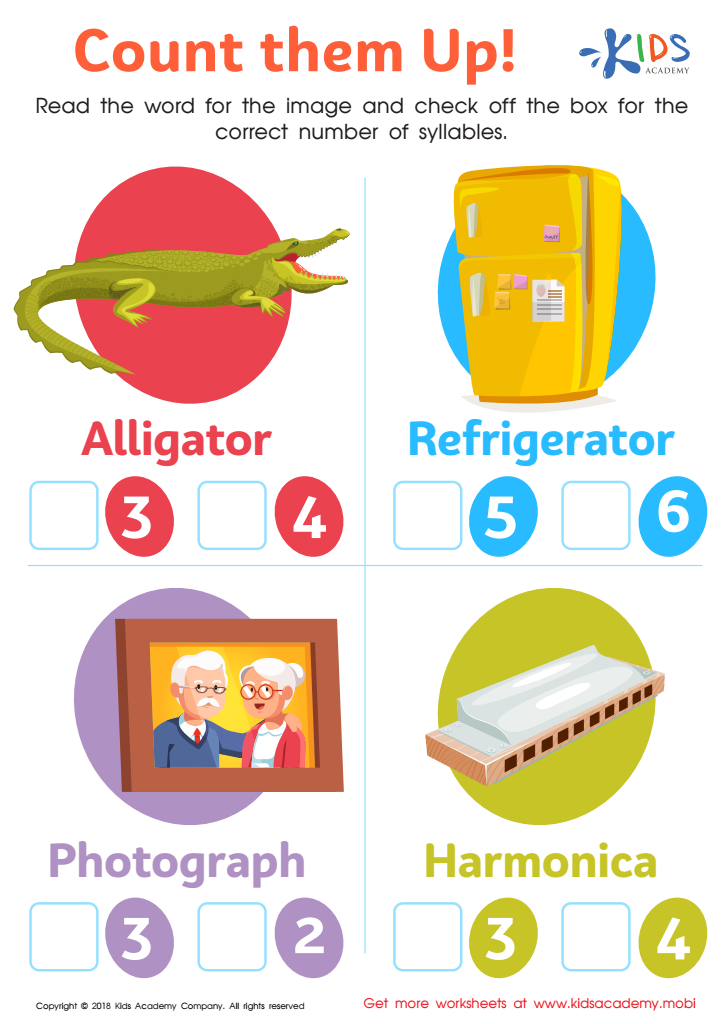
Count Them Up Worksheet
 Assign to My Students



















Building a strong vocabulary in basic math for children ages 7-8 sets a critical foundation for their future academic success and daily life problem-solving abilities. At this age, children are beginning to transition from intuitive understanding to more formal mathematical concepts, and vocabulary serves as the bridge to deeper comprehension.
When parents and teachers focus on developing children's math vocabulary, they help kids understand and articulate concepts clearly. Terms like "sum," "difference," "product," "quotient," and "fraction" become tools for thinking and reasoning, not just words to memorize. This understanding aids in grasping more advanced topics as they learn.
Furthermore, a strong math vocabulary enables effective communication about mathematics. When children can describe their thought processes and understand instructions or problems presented in specific terms, they can ask questions and seek help more efficiently, which facilitates better learning.
Additionally, math vocabulary can enhance children's confidence and reduce math anxiety. When students are familiar with the language, they are more likely to engage with and enjoy math activities, leading to positive academic experiences.
Incorporating math vocabulary in daily conversations and activities embeds these terms in natural contexts, making learning more meaningful and enjoyable. Thus, investing time in building this vocabulary equips children with the tools they need for both mathematical proficiency and overall cognitive development.








