Subtraction skills Worksheets for Ages 7-9 - Page 2
26 filtered results
-
From - To
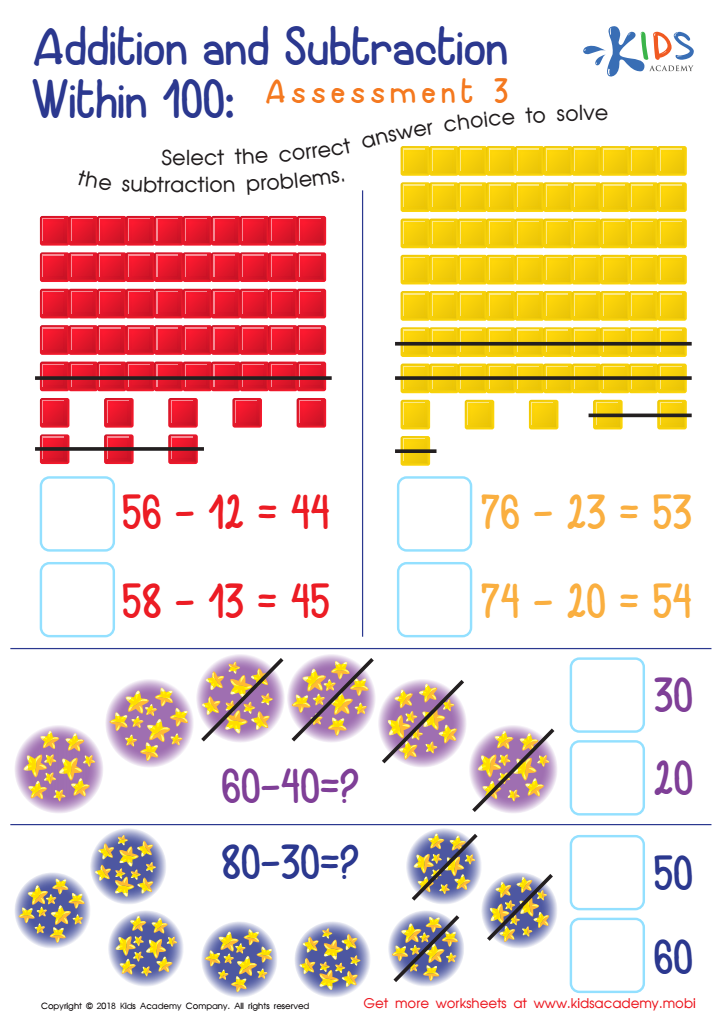
Addition and Subtraction Within 1: Assessment 3 Worksheet
 Assign to My Students






Subtraction skills are fundamental for children aged 7-9, and both parents and teachers should prioritize fostering these abilities for several critical reasons. During these formative years, children are developing their foundational math skills, and subtraction is a core component. Proficiency in subtraction is crucial for more advanced math subjects, such as algebra and geometry, which they will encounter later in their educational journey.
Moreover, subtraction is not just a classroom skill; it is essential for real-life situations. Children need to understand how to subtract to manage money, measure ingredients in recipes, and solve everyday problems that involve taking away or finding differences. By mastering subtraction, children can gain confidence in their numeracy skills, which translates to better academic performance and self-esteem.
Furthermore, developing strong subtraction skills at a young age also fosters critical thinking and problem-solving abilities. These cognitive skills are vital, enabling children to face complex challenges efficiently. Teachers and parents play a pivotal role in providing practice and encouragement, through engaging activities, practical examples, and consistent reinforcement. By ensuring children build strong subtraction skills early on, we equip them with tools necessary for academic success and everyday competence, setting a strong foundation for lifelong learning and practical application.








