Telling time Worksheets for Ages 7-9
4 filtered results
-
From - To
Welcome to our comprehensive collection of "Telling Time Worksheets" designed specifically for children ages 7-9! These engaging and educational resources help young learners master the essential skill of reading clocks and understanding time concepts. Our worksheets include a variety of interactive activities that challenge students to identify hours, half-hours, and minutes on both digital and analog clocks. With colorful illustrations and age-appropriate exercises, these worksheets foster a love for learning while reinforcing math skills. Perfect for home or classroom use, our "Telling Time Worksheets" support your child's educational journey and make learning about time fun and enjoyable! Download now and start learning!
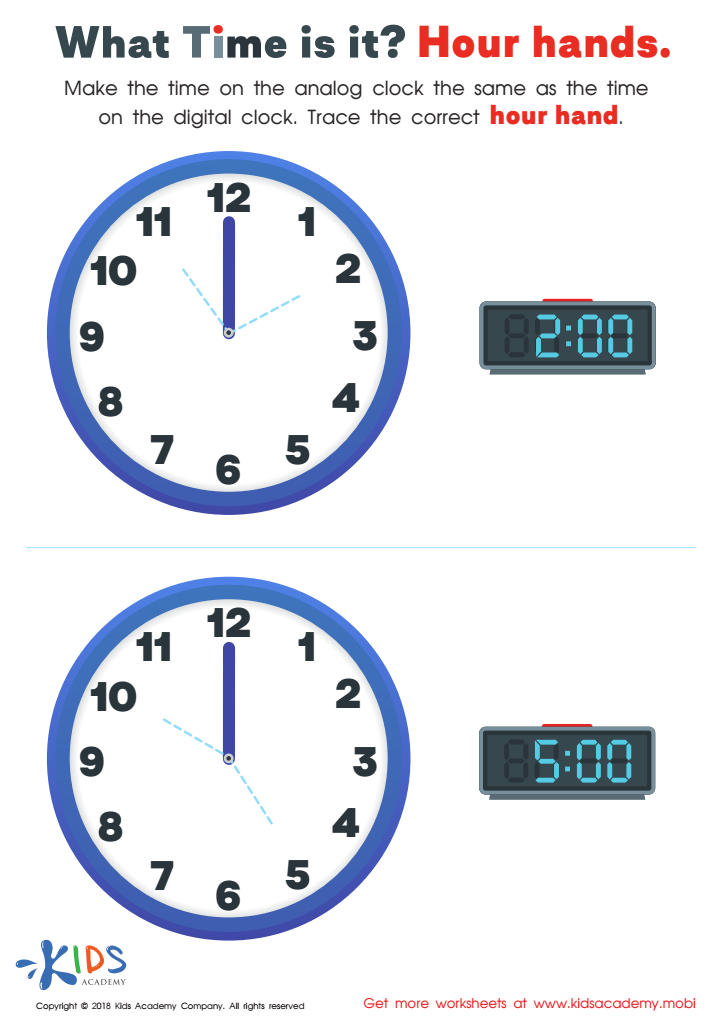
What Time Is it? Hour Hands Worksheet
 Assign to My Students








Teaching children to tell time is a fundamental skill that goes beyond merely reading the clock; it's about nurturing their independence and understanding the world around them. For children aged 7-9, grasping the concept of time fosters responsibility and time management skills essential for their daily routines, such as arriving at school, completing homework, and participating in extracurricular activities.
Understanding time also enhances cognitive abilities, as it requires the integration of numbers, fractions, and spatial recognition. This foundational knowledge lays the groundwork for more advanced mathematical concepts in the future. In a world increasingly dominated by digital technologies, where children are often reliant on gadgets for timekeeping, learning to read analog clocks cultivates resilience and adaptability.
Moreover, teaching time encourages conversations about scheduling, calendars, and the importance of punctuality—skills integral to personal and social development. It empowers children to plan their day, set personal goals, and understand the implications of time management. Ultimately, parents and teachers play critical roles in instilling these skills, supporting children as they grow into confident and self-sufficient individuals. Therefore, investing time in teaching kids to tell time is an investment in their lasting success and self-reliance.








