
Understanding commutative property Worksheets for Ages 7-9
4 filtered results
Difficulty Level
Grade
Age
-
From - To
Subject
Activity
Standards
Unlock the power of math with our "Understanding Commutative Property Worksheets" designed for ages 7-9! These engaging resources help young learners grasp the essential concept that changing the order of numbers in addition and multiplication doesn’t affect the sum or product. Featuring colorful illustrations and interactive exercises, our worksheets encourage critical thinking and foster a deeper understanding of mathematical relationships. These activities are perfect for classroom use or at-home practice, ensuring that children build a strong foundation in math concepts. Empower your students to solve problems confidently with our easy-to-follow worksheets and watch them thrive in their learning journey!
Favorites
With answer key
Interactive
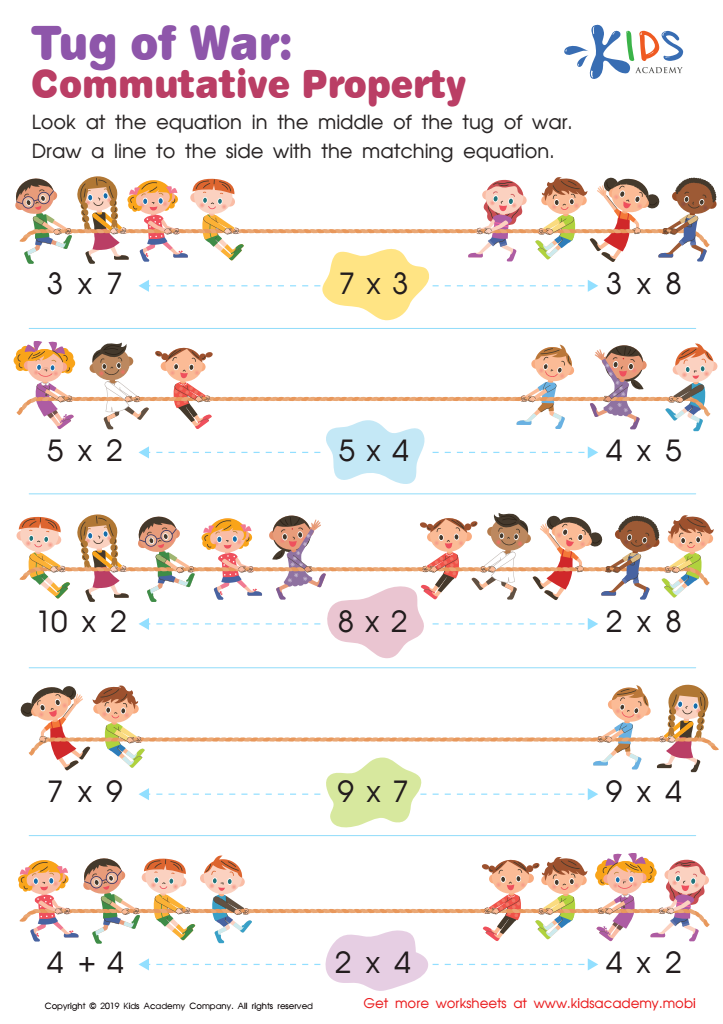
Tug of War: Commutative Property Worksheet
Tug of war is a great game to teach your child simple math. Explain the commutative property--it states that the product remains the same regardless of the order of factors. Use the equations in the middle of the worksheet and have your child draw a line to the corresponding equation. It's a fun and easy way to learn math.
 Assign to My Students
Tug of War: Commutative Property Worksheet
Worksheet
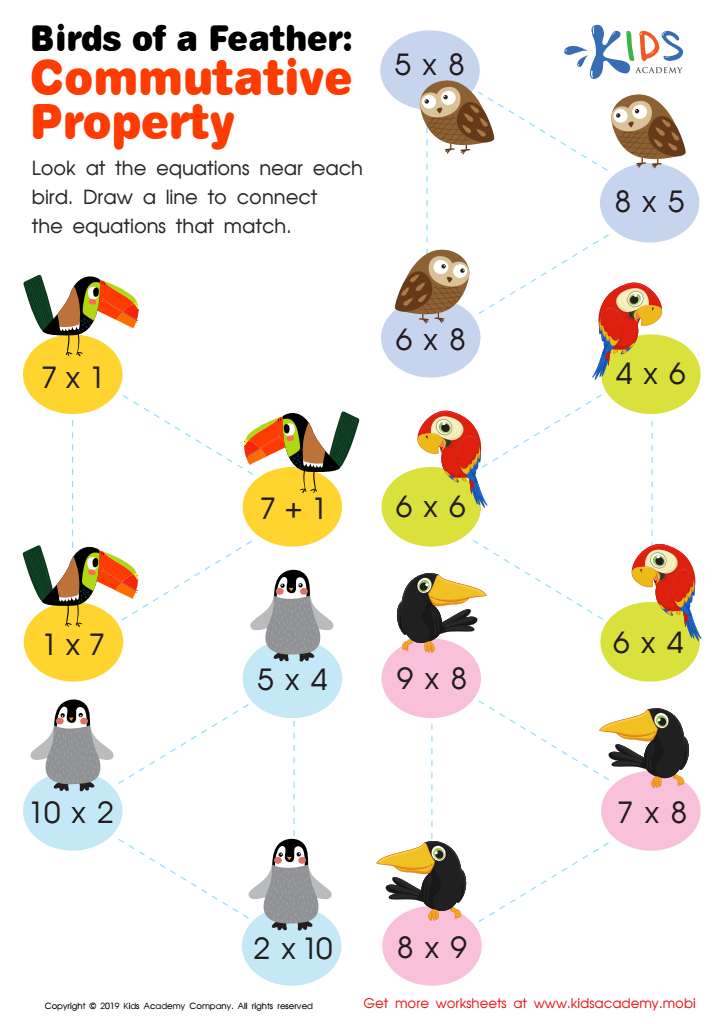
Birds of a Feather: Commutative Property Worksheet
The commutative property states that order of factors doesn't affect the product. Use it to help your kids solve simple problems. If they love birds, they'll love the colorful worksheet to identify exotic ones. Practicing is the best way to understand difficult topics. Look at the equations in this tracing sheet; help them draw a line to connect equations that match.
Birds of a Feather: Commutative Property Worksheet
Worksheet
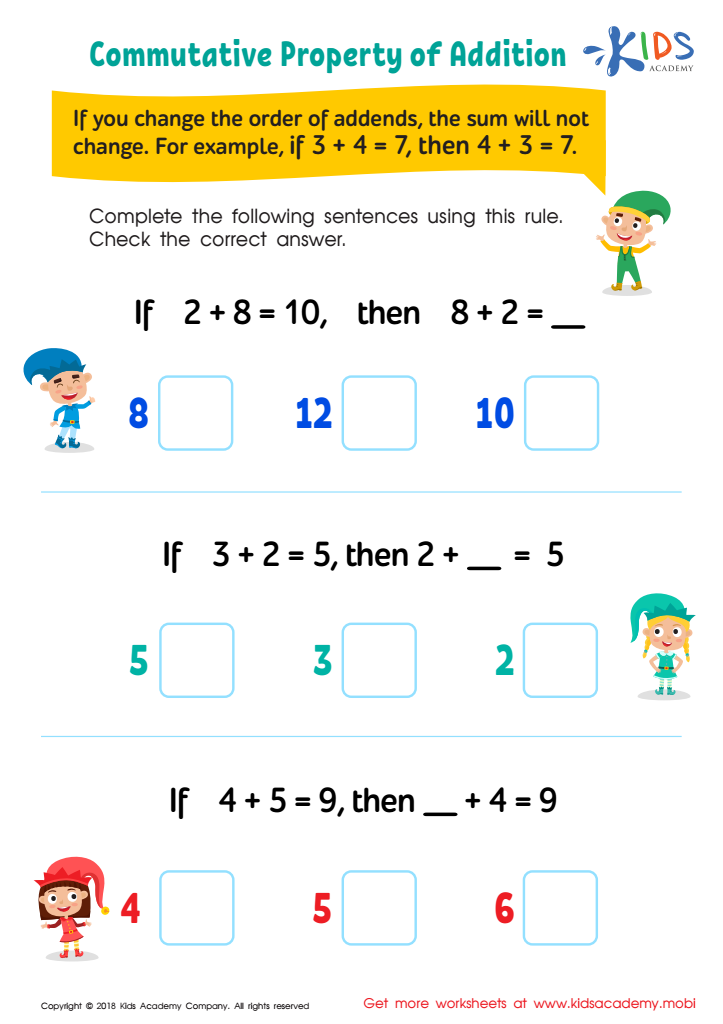
Commutative Property of Addition Worksheet
Master the commutative property of addition with Kids Academy's worksheet! Kids will have fun with silly elves as they complete the rows, switching or adding the addends. Observe that the sum stays the same no matter the order of the numbers!
Commutative Property of Addition Worksheet
Worksheet
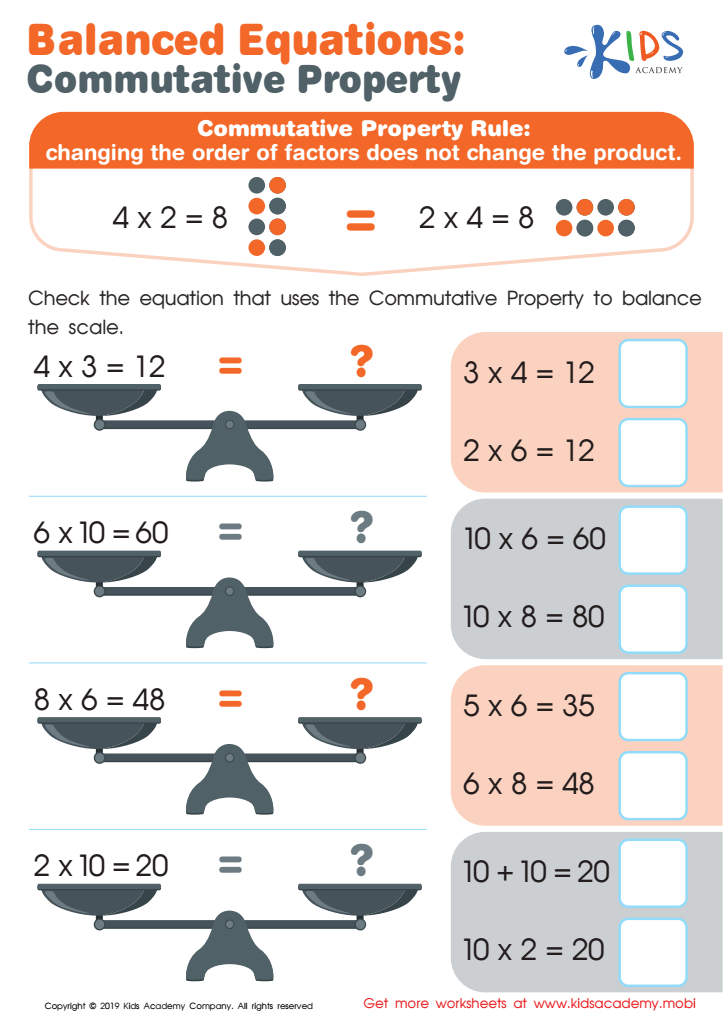
Balanced Equations: Commutative Property Worksheet
Math can be tough, causing a lot of stress. Remind kids that even adults struggle with it - learning never ends. Help kids with math stress or difficulty understanding equations with this worksheet. Explain the commutative property: changing order of factors doesn't change the product. Use the problems on the worksheet to guide them.
Balanced Equations: Commutative Property Worksheet
Worksheet
Join Kids Academy for Free
Who is primarily going to use this learning content?








Understanding the commutative property is crucial for children aged 7-9 as it lays the foundation for their mathematical thinking and problem-solving skills. This property states that the order in which two numbers are added or multiplied does not change the result (e.g., 2 + 3 = 3 + 2 and 4 × 5 = 5 × 4). Grasping this concept helps children simplify calculations and enhances their ability to work with numbers flexibly.
For parents and teachers, encouraging an understanding of the commutative property promotes mathematical confidence and curiosity. Recognizing that mathematical operations are interchangeable helps students build strong foundational skills needed for more advanced concepts, such as algebra, later in their education.
Moreover, this understanding fosters critical thinking and reasoning skills, allowing kids to approach complex problems from multiple angles. Additionally, it promotes a positive attitude toward math learning, reducing anxiety often associated with the subject. In a digital age, where problem-solving and logical reasoning are increasingly vital, nurturing these skills early allows children to build a productive mindset that can apply to various real-life scenarios, enhancing both academic performance and overall cognitive development. Emphasizing this foundational knowledge will benefit children in both their current education and future endeavors.








