
Vowel differentiation Worksheets for Ages 7-9
3 filtered results
Difficulty Level
Grade
Age
-
From - To
Subject
Activity
Standards
Enhance your child's reading skills with our Vowel Differentiation Worksheets for ages 7-9. These expertly crafted worksheets focus on distinguishing between short and long vowel sounds. Designed to build a strong foundation in phonics, each worksheet engages young learners with fun, interactive activities like matching exercises and fill-in-the-blanks. Perfect for both classroom use and home practice, these worksheets make it easy for children to recognize and pronounce vowels correctly. With colorful illustrations and a variety of exercises, our Vowel Differentiation Worksheets are an essential tool for boosting early reading confidence and proficiency.
Favorites
With answer key
Interactive
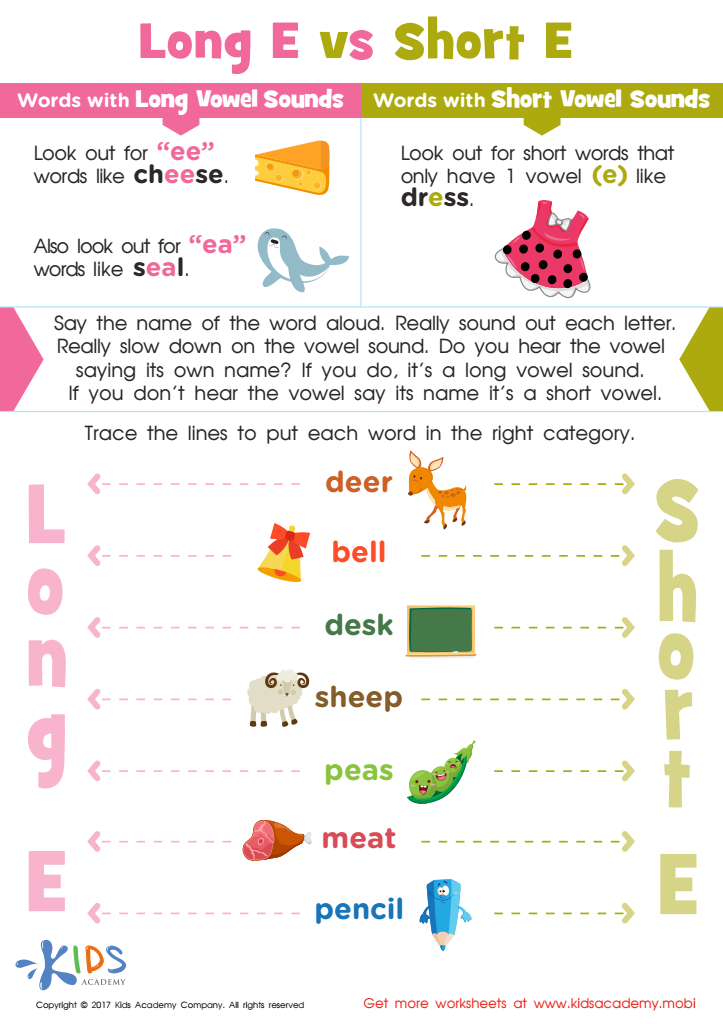
Long and Short Vowel E Spelling Worksheet
This worksheet helps kids master spelling with the letter "E". They read about long and short vowel sounds, view examples and sound out words to complete it. Two vowels distinguish long "E" sounds from its short vowel counterparts with just one.
Long and Short Vowel E Spelling Worksheet
Worksheet
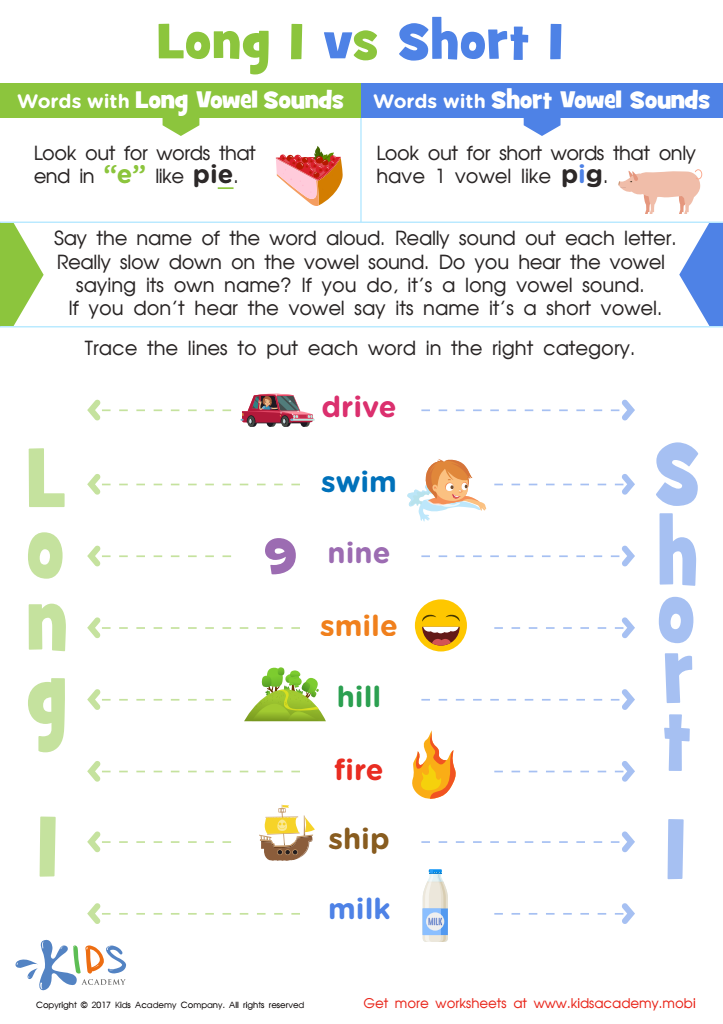
Long and Short Vowel I Spelling Worksheet
When it comes to long "I" sounds, kids should look out for the letter "E" at the end. With examples and sounding out words, kids will improve spelling skills with this long/short "I" worksheet!
Long and Short Vowel I Spelling Worksheet
Worksheet

Long and Short E Worksheet
This fun printout makes learning phonics enjoyable for Grade 3 students. Get them to read the words “tree” and “bed” to recognize the different sounds of the letter “E”. After hearing the words they can color the words and the pictures to understand differences between long and short vowels.
Download (PDF)
 Assign to My Students
Assign to My Students
Long and Short E Worksheet
Worksheet
Join Kids Academy for Free
Who is primarily going to use this learning content?




.jpg)



Vowel differentiation is critical for children ages 7-9 because it lays the foundation for effective reading, writing, and communication skills. During these years, children transition from learning to read to reading to learn. Distinguishing between short and long vowels, as well as understanding vowel combinations (like "ai" in "rain" or "oi" in "boil"), directly impacts their phonemic awareness—the ability to hear, identify, and manipulate individual sounds in words.
A strong grasp of vowel sounds enhances word recognition and decoding skills, which are imperative for fluency. Fluent readers are more likely to comprehend texts better and expand their vocabulary. Without this fundamental skill, a child may struggle with reading, leading to frustration and a negative attitude towards learning.
For teachers, implementing engaging activities such as vowel games or songs can make learning enjoyable and interactive. Parents can support by reading with their children, pointing out vowel sounds, and correcting mispronunciations in a positive environment. This collaborative effort can ensure kids become confident readers, setting a positive trajectory for their educational journey. Investing time in vowel differentiation now can mitigate future learning difficulties and promote long-term academic success.








