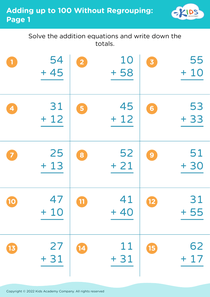
Practice problem-solving Adding up to 100 with Regrouping Worksheets for Ages 7-9
3 filtered results
-
From - To
Enhance your child's math skills with our "Practice Problem-Solving: Adding Up to 100 with Regrouping" worksheets, designed specifically for ages 7-9. These engaging worksheets focus on developing essential problem-solving abilities while teaching the concept of addition with regrouping. With a variety of fun and challenging exercises, your child will confidently tackle math problems that involve carrying numbers over as they work towards mastering addition up to 100. Ideal for independent practice or classroom use, these worksheets provide instant reinforcement and build a strong foundation in early math concepts. Unlock your child's potential and make learning enjoyable today!
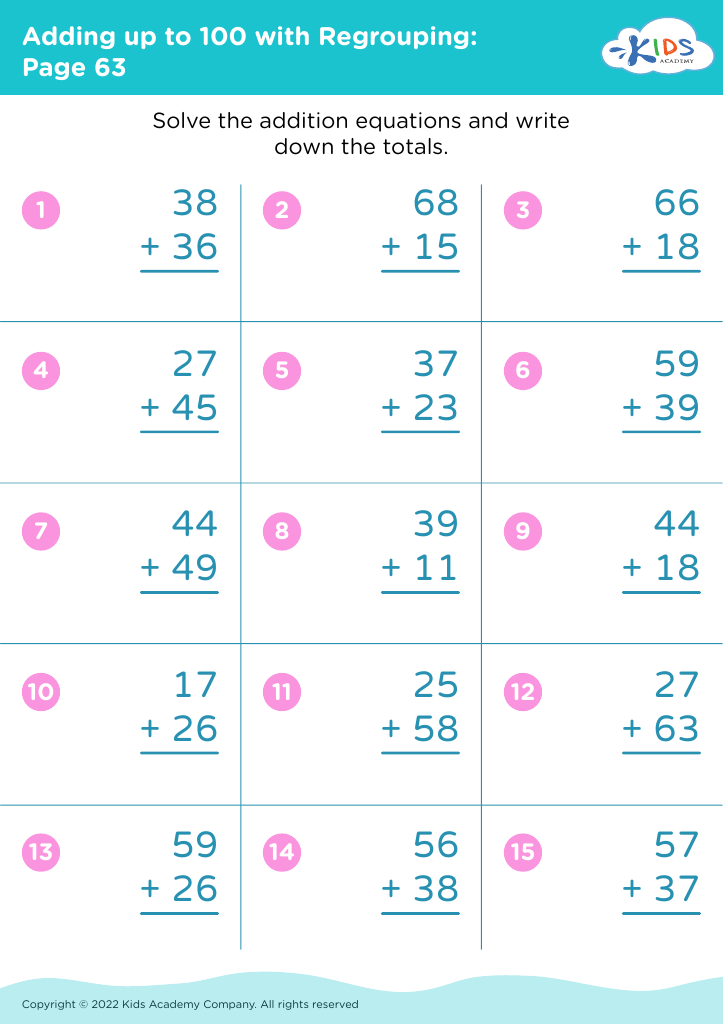
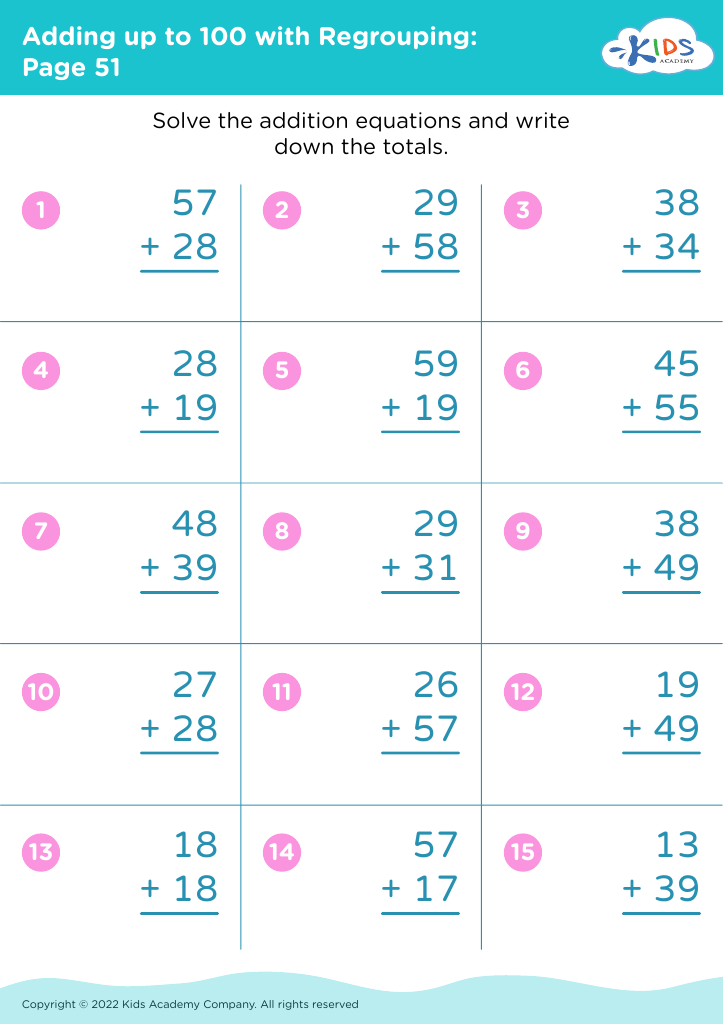
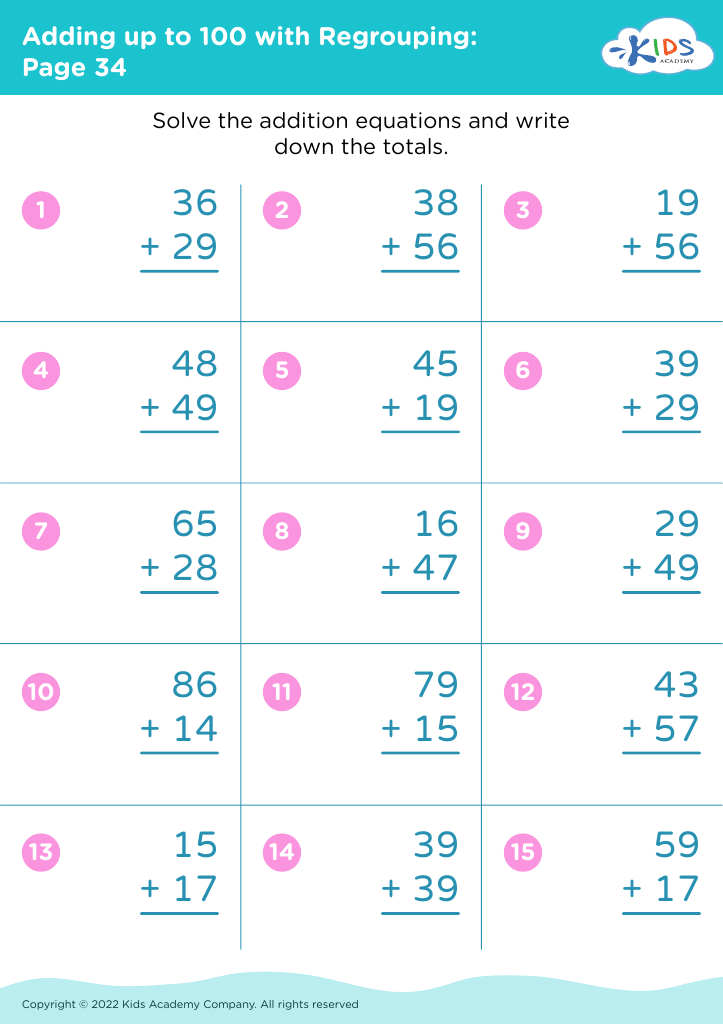




Practice problem-solving with regrouping for adding up to 100 is crucial for children's mathematical development, especially for those aged 7-9. At this age, children begin to move beyond basic counting and learn more complex arithmetic concepts. Regrouping, or carrying over, helps children understand the base-ten system, which is fundamental to all future math learning.
Engaging in problem-solving activities not only helps students develop their arithmetic skills but also fosters critical thinking, persistence, and reasoning—key components in approaching a problem. Mastery of regrouping enables children to tackle more advanced concepts such as subtraction with borrowing, multiplication, and even later topics like division and fractions.
Moreover, by practicing these skills, children experience the satisfaction of solving problems, which builds their confidence and motivation in math—a subject often viewed as challenging. For parents and teachers, focusing on these practices also means they can more effectively support children's learning styles and needs. This collaborative effort reinforces the importance of math in real-life situations, making learning relevant and empowering students to excel academically. Encouraging proficiency in foundational math skills sets children up for success in higher-level mathematics and overall cognitive growth.