Develop critical thinking Adding up to 100 Without Regrouping Worksheets for Ages 7-9
3 filtered results
-
From - To
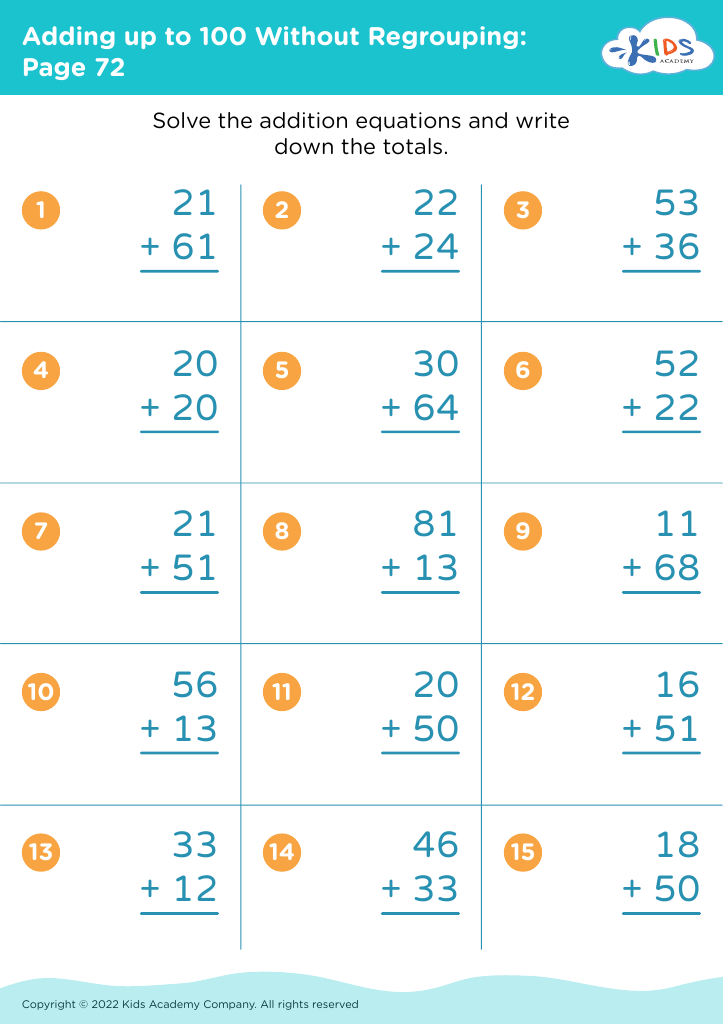
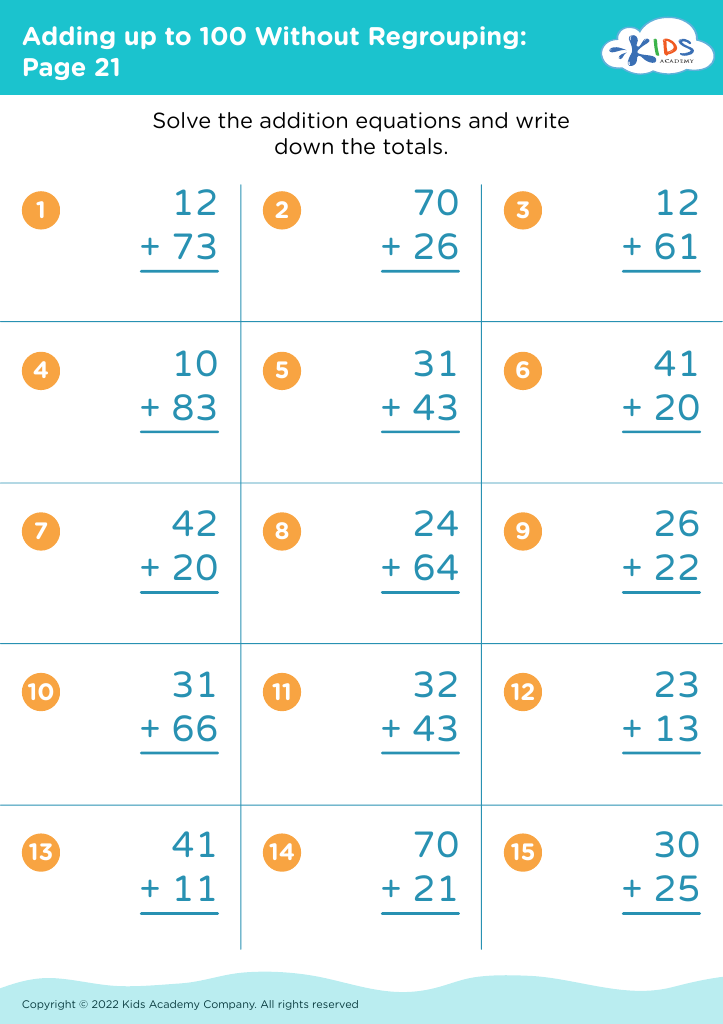
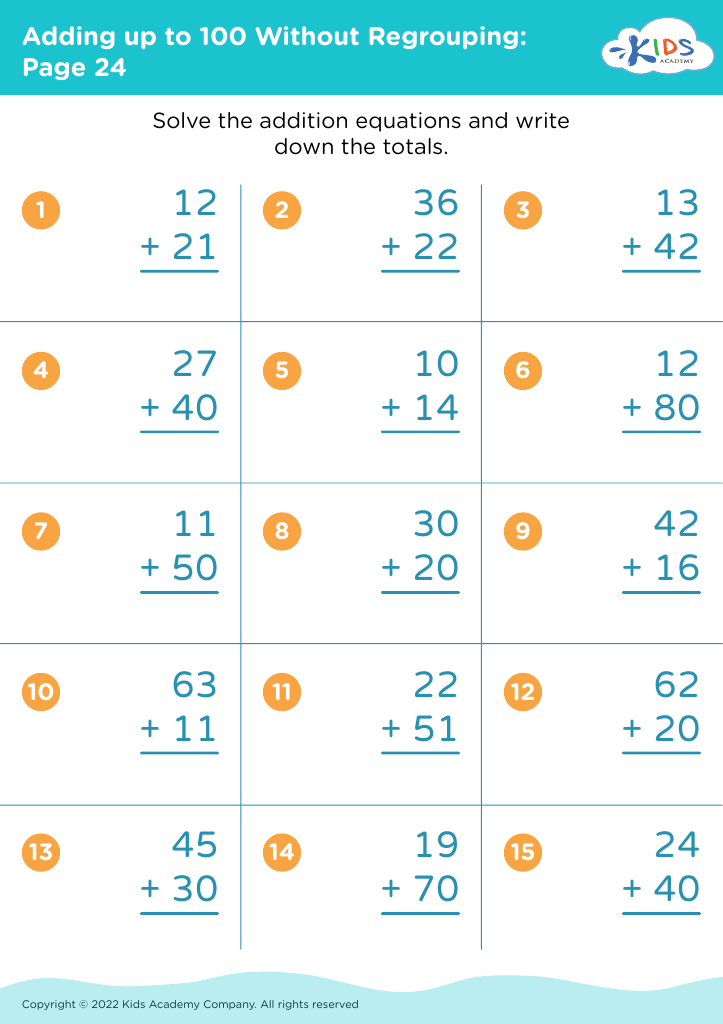
Develop critical thinking and enhance math skills with our Adding Up to 100 Without Regrouping Worksheets designed for ages 7-9. These engaging activities help young learners master addition within 100 effortlessly while reinforcing their understanding of number sense and mental arithmetic. Each worksheet is crafted to challenge students to think critically, as they solve problems without the need to regroup numbers. Through these exercises, children will refine their calculation strategies, build confidence, and gain a solid foundation in elementary math. Perfect for classroom use or homeschooling, these printable worksheets offer a fun, effective way to support math proficiency and cognitive development.




Developing critical thinking skills and mastering addition without regrouping up to 100 are essential aspects of a child's education, particularly between the ages of 7 and 9. For parents and teachers, prioritizing these areas can bring substantial long-term benefits both in academics and everyday problem-solving.
Critical thinking is foundational for effective learning and decision-making. When children learn to analyze situations, make connections, and evaluate outcomes, they gain the tools required to approach complex problems with confidence and clarity. These skills transcend academic subjects, enabling children to apply logical reasoning across various scenarios, be it in science projects, reading comprehension, or social interactions.
Addition without regrouping up to 100, on the other hand, strengthens arithmetic fluency. Mastery in this area helps children build a robust number sense, which is critical for learning more advanced mathematical concepts. It also promotes mental math skills, allowing students to perform calculations with ease—a handy ability that aids in everyday activities, such as counting money or measuring ingredients for a recipe.
By nurturing critical thinking and arithmetic competency, parents and teachers provide children with a strong educational foundation. These skills foster both intellectual independence and practical problem-solving abilities, setting the stage for future academic success and well-rounded personal growth.