Mathematical reasoning Adding up to 100 Without Regrouping Worksheets for Ages 7-9
3 filtered results
-
From - To
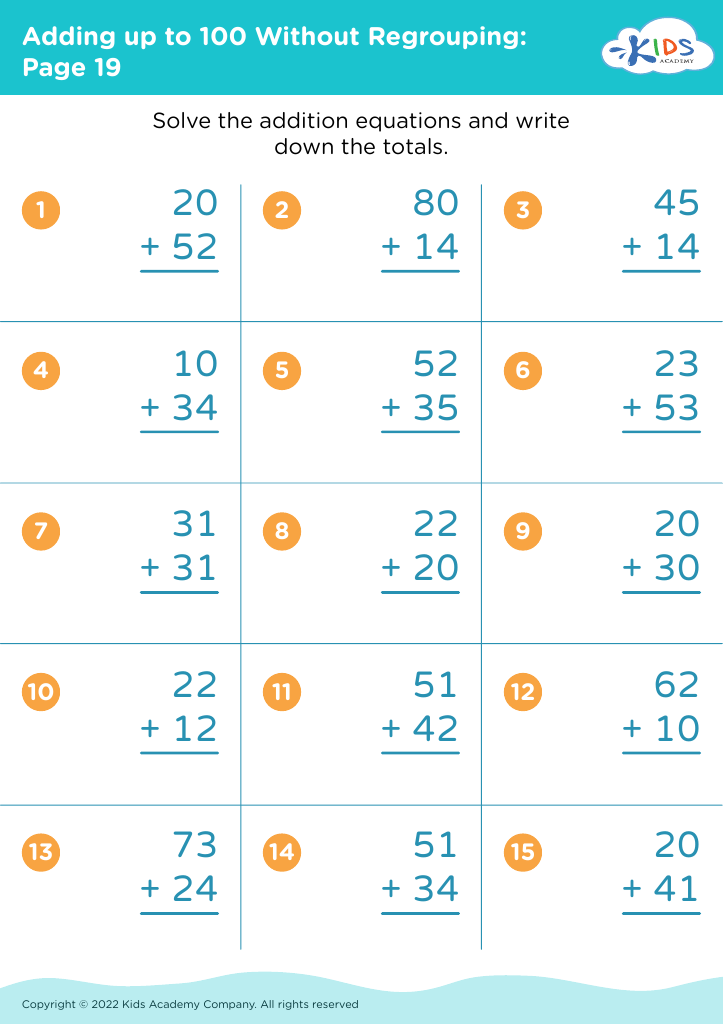
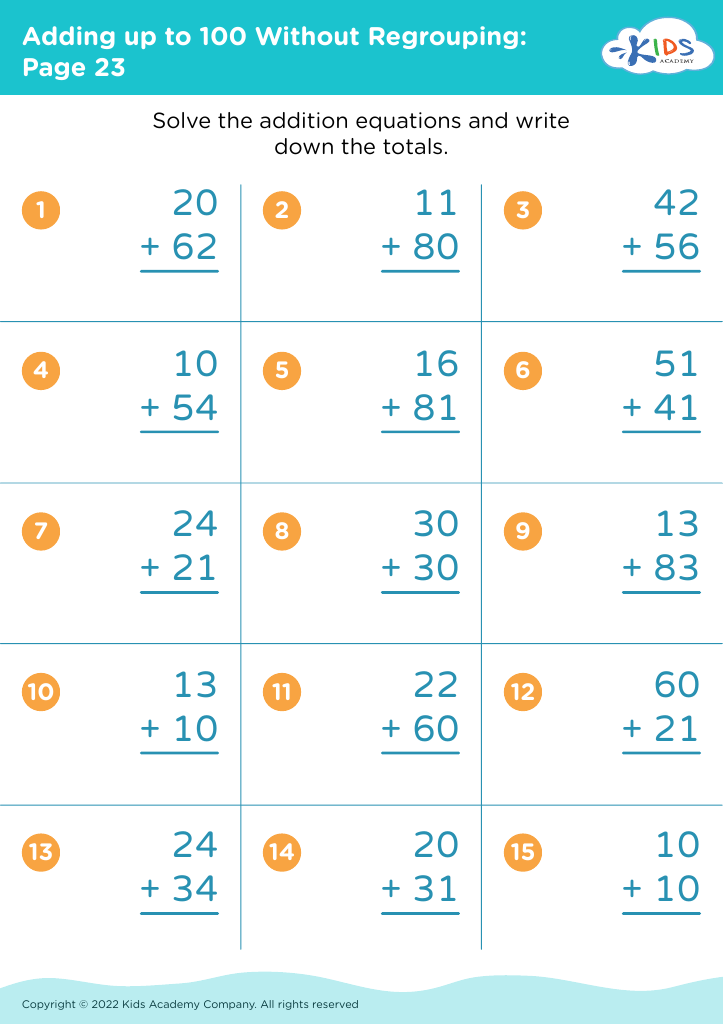
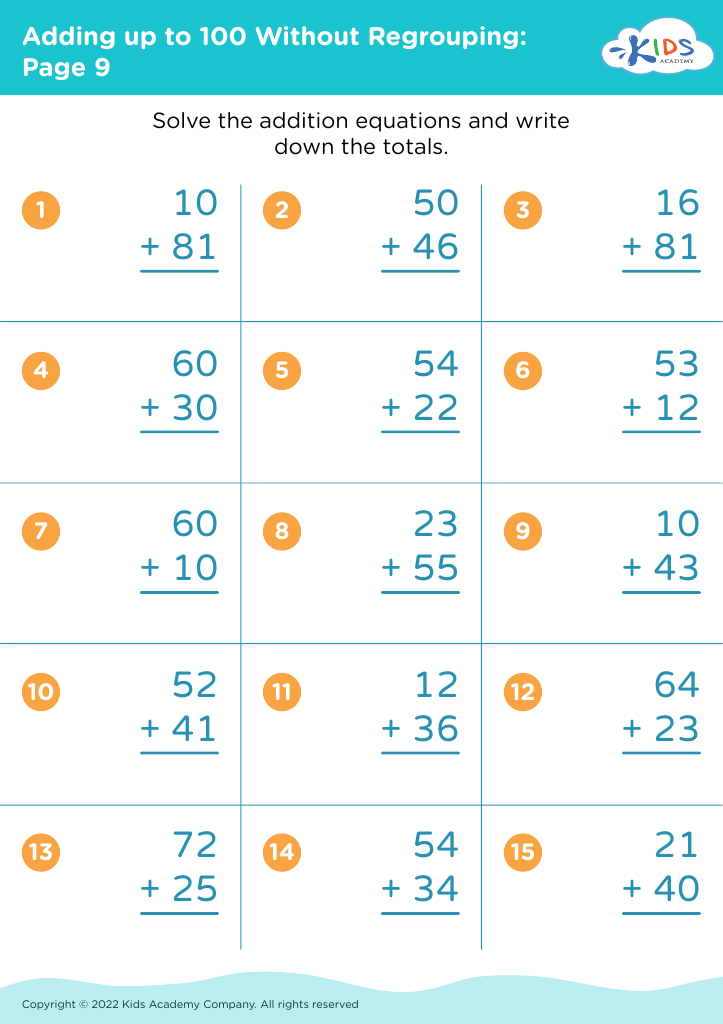
Discover our engaging "Mathematical Reasoning: Adding Up to 100 Without Regrouping Worksheets" designed specifically for children ages 7 to 9. These worksheets focus on enhancing students' addition skills, promoting both confidence and fluency as they learn to solve math problems accurately without the need for regrouping. Each exercise encourages critical thinking and problem-solving, making math enjoyable and accessible. Tailored to meet the educational needs of young learners, these resources are ideal for use in classrooms or at home. Support your child's mathematical journey and ensure a strong foundation in number concepts with our thoughtfully crafted worksheets!




Mathematical reasoning, particularly skills like adding up to 100 without regrouping, is essential for children aged 7-9 as it lays the foundation for more complex math concepts. Parents and teachers should prioritize this skill because it enhances critical thinking, problem-solving abilities, and number sense. At this age, children are beginning to grasp the principles of addition and developing number fluency, which are pivotal for future mathematical learning.
Practicing this skill helps children gain confidence in their capability to work with numbers, encouraging a positive attitude towards mathematics. When children understand how to break numbers down into manageable parts and combine them, they are more likely to succeed in subsequent math topics, including subtraction and multi-digit addition.
Moreover, mastering simple addition without regrouping can boost a child’s performance in standardized tests and class assessments. Being adept at these calculations also translates to real-life situations, as children begin to apply math in everyday contexts, such as budgeting, shopping, and time management.
Overall, fostering a strong foundation in mathematical reasoning not only enriches a child’s cognitive development but also shapes their overall academic journey, increasing their likelihood of success in various disciplines. Therefore, it is essential for educators and parents to support and value this skill.