Recognizing Patterns Adding up to 1000 with Regrouping Worksheets for Ages 7-9
4 filtered results
-
From - To
Enhance your child's mathematical skills with our "Recognizing Patterns Adding up to 1000 with Regrouping" worksheets, designed specifically for ages 7-9. These engaging resources foster critical thinking by helping students identify numerical patterns as they learn to add up to 1000 with regrouping techniques. Each worksheet is carefully crafted to promote a solid understanding of addition concepts while challenging children to recognize relationships between numbers. By practicing these activities, young learners will gain confidence in their mathematical abilities, paving the way for success in more complex mathematical operations. Discover the joy of learning with fun and interactive math worksheets today!
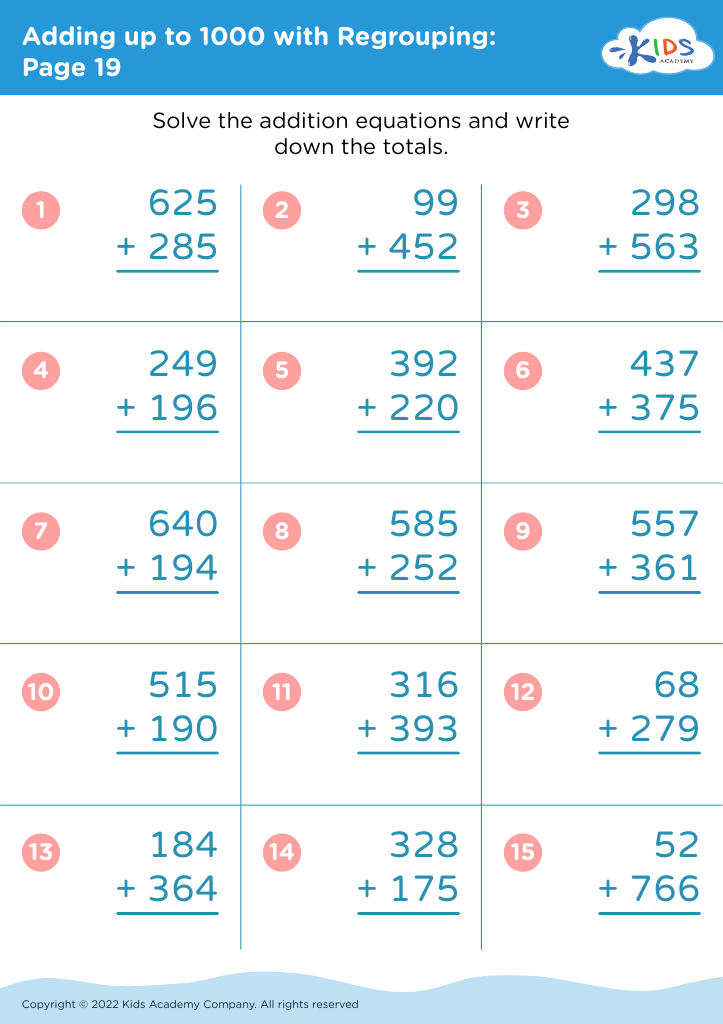
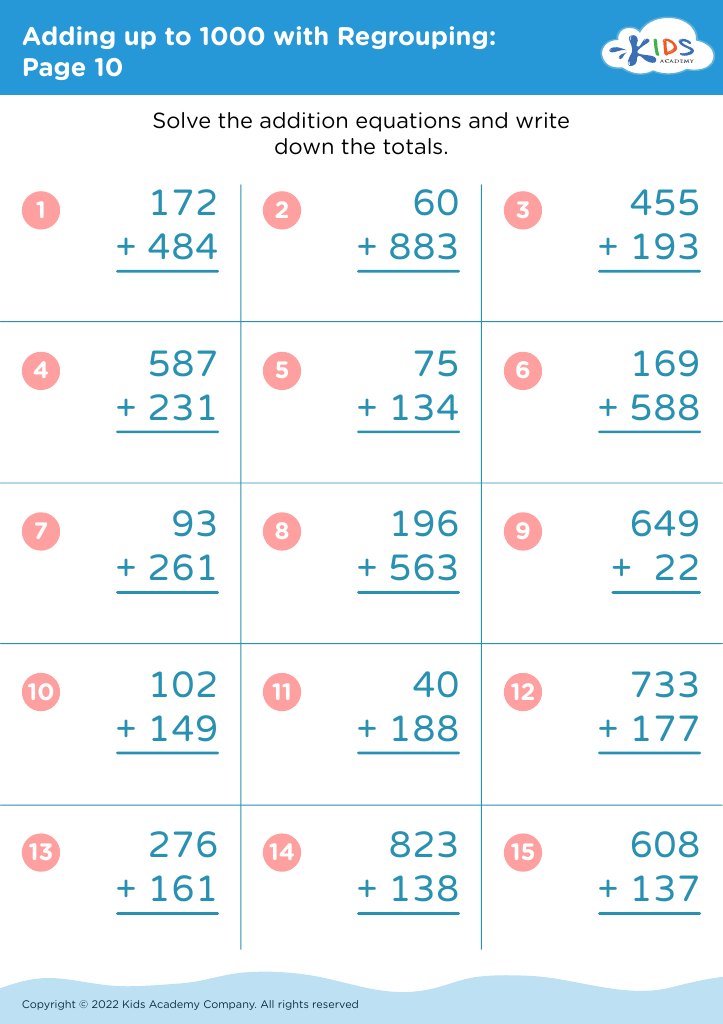
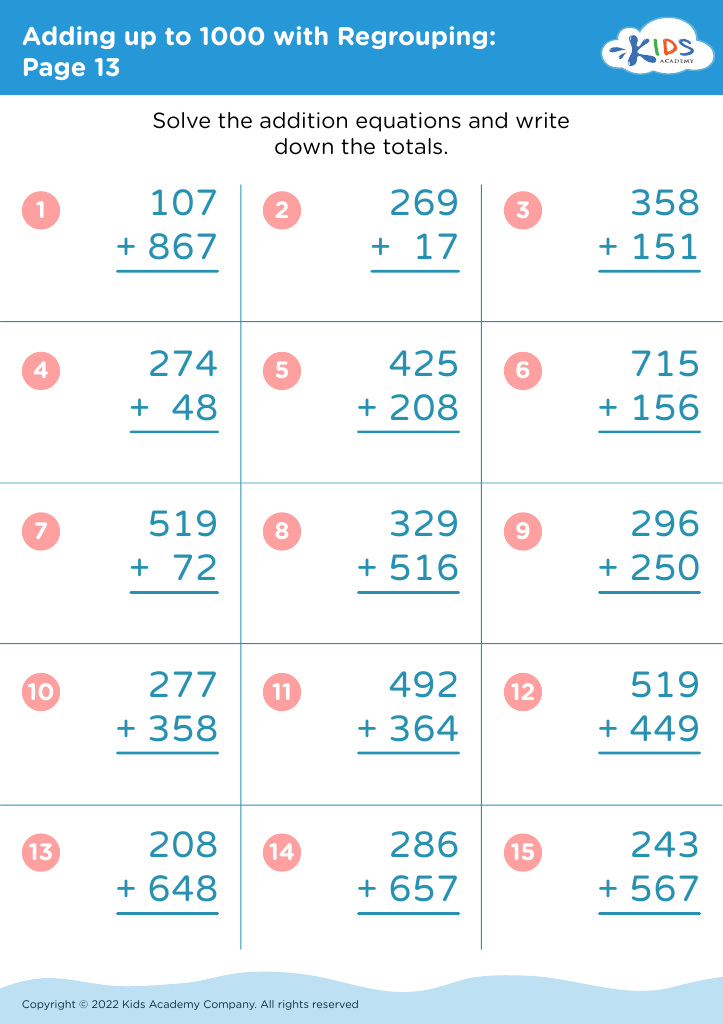
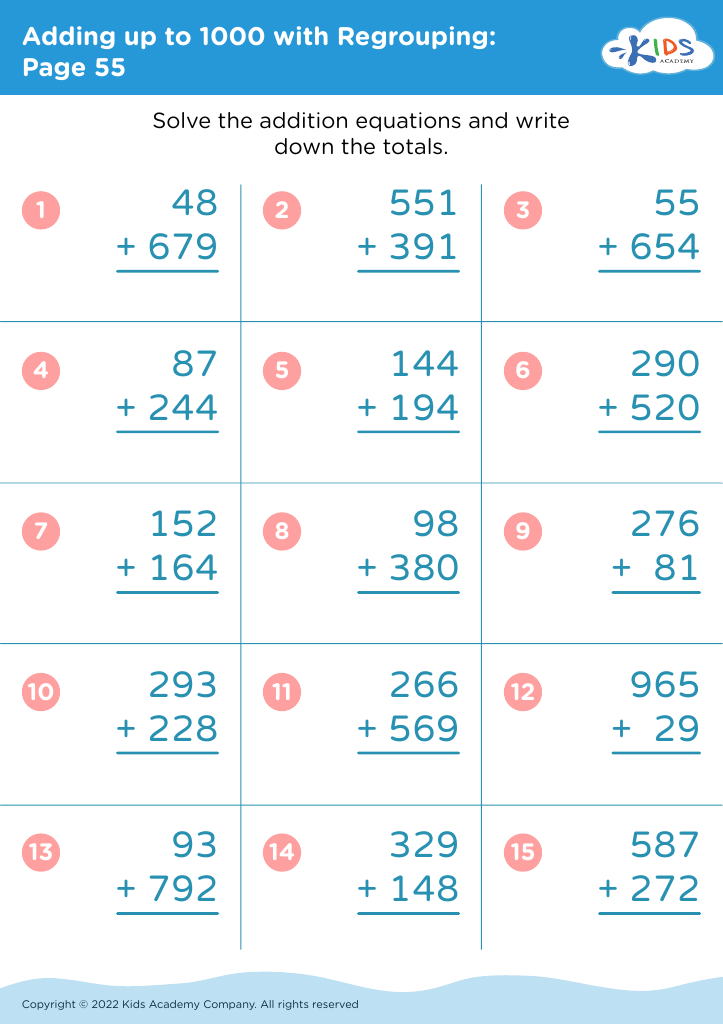


Recognizing patterns in addition, particularly when adding up to 1000 with regrouping, is essential for children aged 7-9 for several reasons. Firstly, it fosters a deeper understanding of place value, allowing students to grasp how numbers are structured and interact, which is foundational to their overall math literacy. Engaging with patterns helps children develop mental math skills, enabling them to perform calculations more quickly and effectively.
Moreover, recognizing these patterns helps cultivate critical thinking skills. It encourages students to look for relationships among numbers, enhancing problem-solving abilities and promoting a growth mindset in mathematics. These skills are vital, not only for their current learning but also for future math concepts they will encounter as they progress.
Parents and teachers should care about this concept because early mastery can lead to increased confidence in math, leading to a more positive attitude towards the subject overall. Encouraging students to interact with numbers in a relational manner lays the groundwork for more complex topics, such as multiplication, division, and even algebra, thereby supporting long-term educational success. Overall, fostering a thorough understanding of these patterns is a key step in building a strong mathematical foundation for young learners.