Recognizing shapes Adding up to 1000 with Regrouping Worksheets for Ages 7-9
4 filtered results
-
From - To
Discover our engaging "Recognizing Shapes Adding up to 1000 with Regrouping Worksheets" designed specifically for children aged 7-9. These interactive resources combine the essential concepts of shape recognition and addition, fostering critical math skills. Your child will enjoy identifying shapes while mastering the technique of regrouping numbers to accurately add up to 1000. Featuring vibrant illustrations and age-appropriate exercises, our worksheets promote a hands-on learning experience that captivates young minds. Ideal for homeschooling or classroom use, these worksheets ensure your child gains confidence and proficiency in mathematics, setting the foundation for future success. Explore our collection and watch your child thrive!
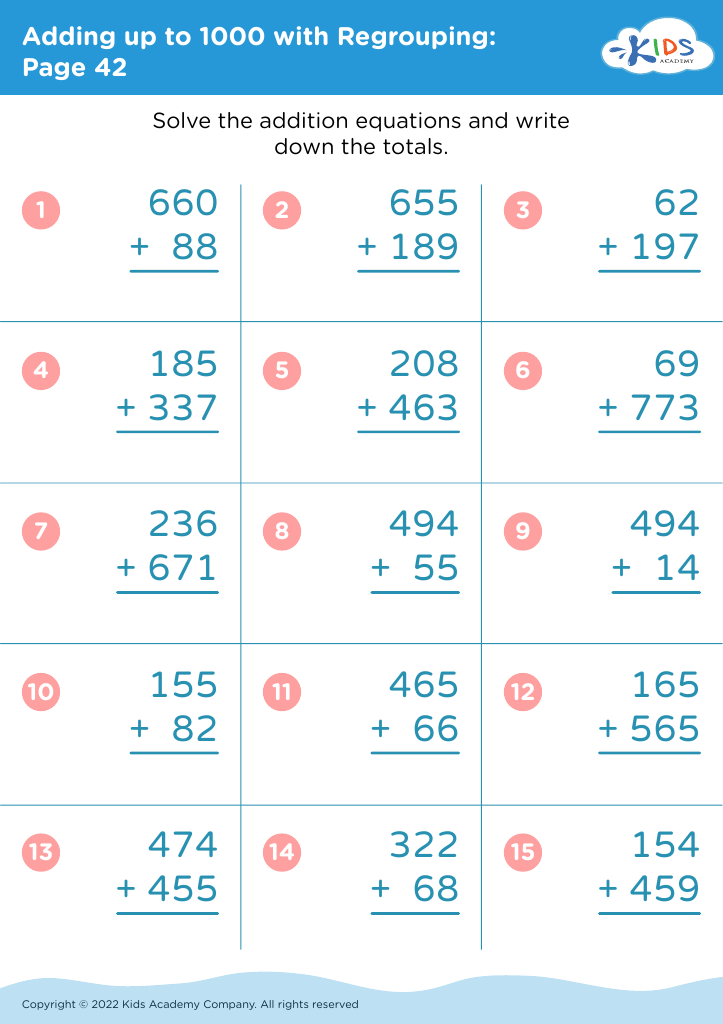
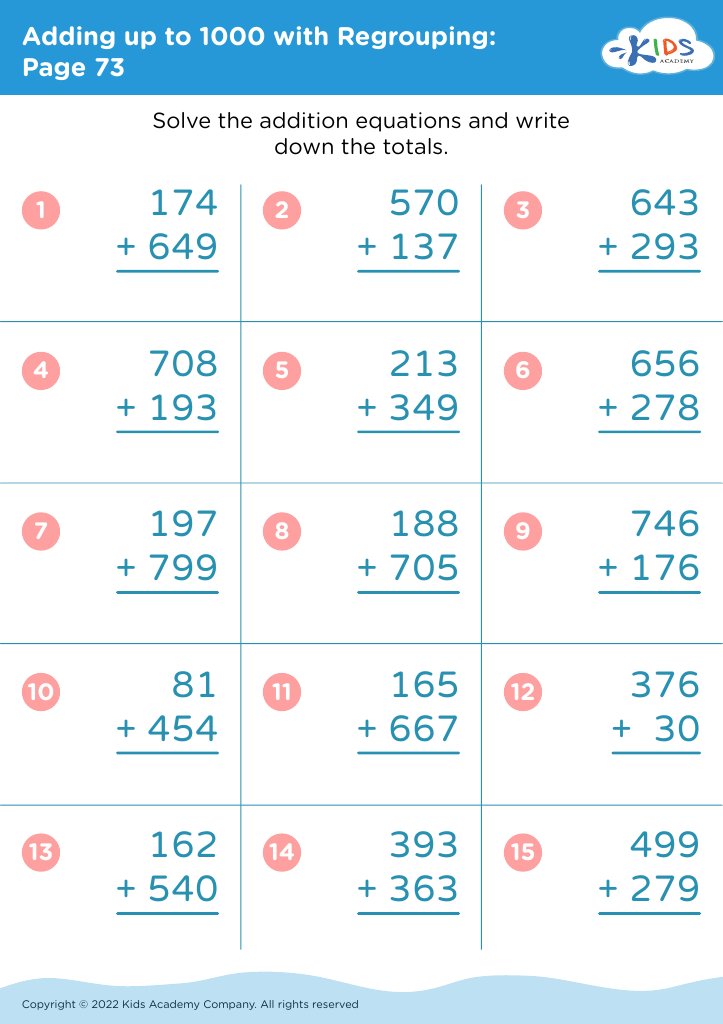
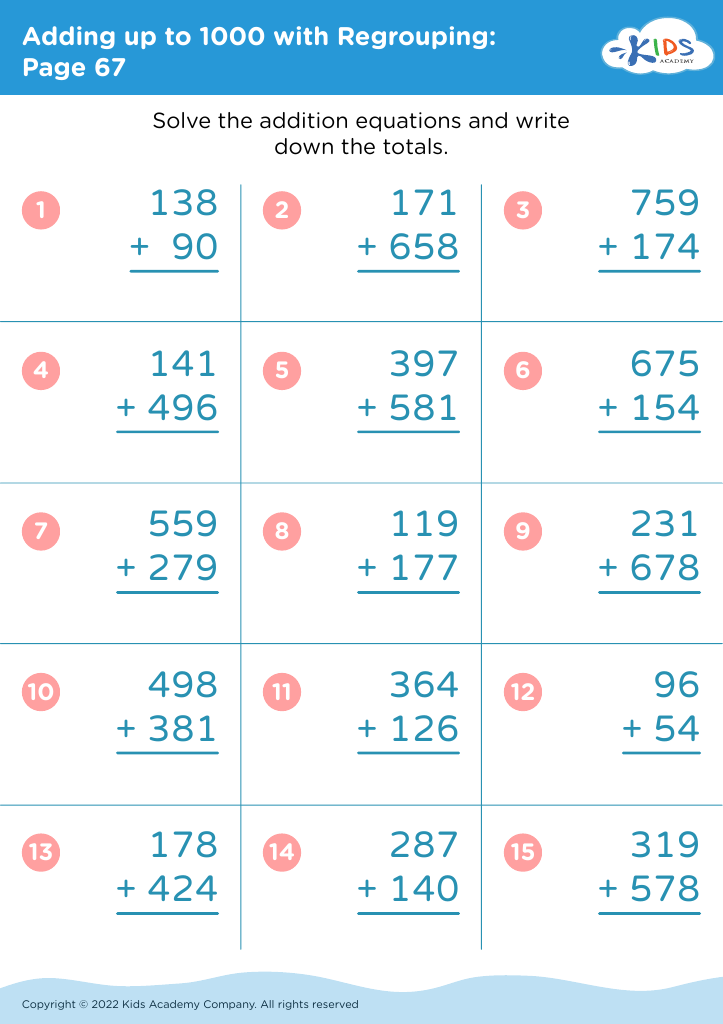
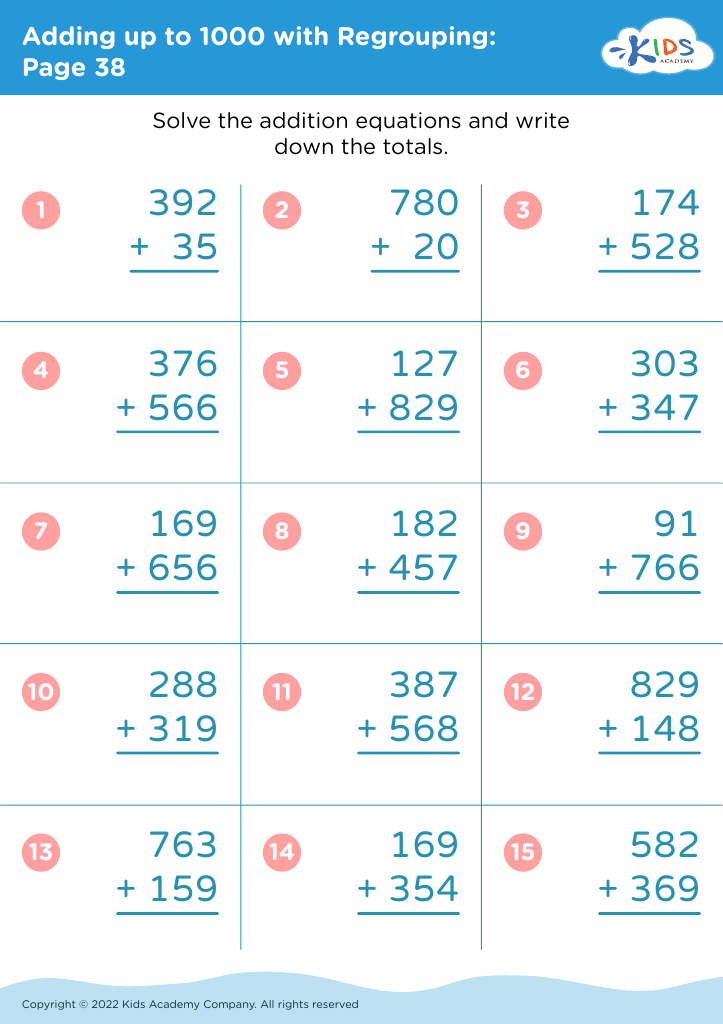


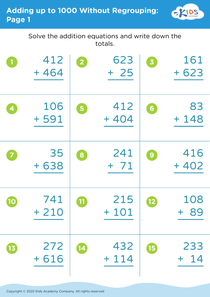
Recognizing shapes and understanding the concept of regrouping for adding numbers up to 1000 are crucial skills for children aged 7-9. Both skills foster critical mathematical thinking and provide a foundation for more advanced concepts.
Recognizing shapes enhances spatial awareness and helps children understand their world better. It supports problem-solving and encourages logical reasoning as they learn to identify patterns and relationships between objects. Additionally, shapes play a vital role in geometry, which connects to various real-life applications, from art to architecture.
Similarly, mastering regrouping in addition significantly impacts a child’s mathematical fluency. At this age, children are transitioning from simple arithmetic to more complex problem-solving. Regrouping teaches them how to handle larger numbers by breaking them down, making addition more manageable and intuitive. This skill also strengthens their understanding of place value, laying the groundwork for more advanced calculations, including subtraction, multiplication, and later, division.
Both skills empower kids to build confidence in math, nurturing a positive attitude towards learning. Parents and teachers who emphasize these areas are not only equipping children with essential academic tools but also fostering essential life skills that contribute to overall cognitive development and success in future learning endeavors.