Understanding symmetry Adding up to 50 Misc Worksheets for Ages 7-9
3 filtered results
-
From - To
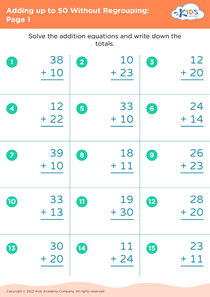
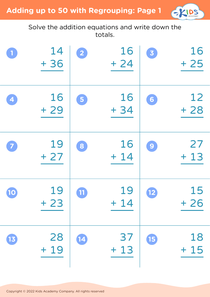
Unleash your child’s mathematical potential with our “Understanding Symmetry Adding up to 50 Misc Worksheets,” designed for ages 7-9! These engaging activities combine fun and learning, promoting critical-thinking skills through symmetry exercises and addition problems up to 50. Each worksheet aids in mastering essential math concepts, enhancing number sense, and boosting confidence. Ideal for home or classroom use, these printables offer varied challenges to keep young minds stimulated and entertained. Foster a love for math in your child today with these carefully crafted educational resources from Kids Academy. Enjoy a seamless learning experience and watch their math skills flourish!
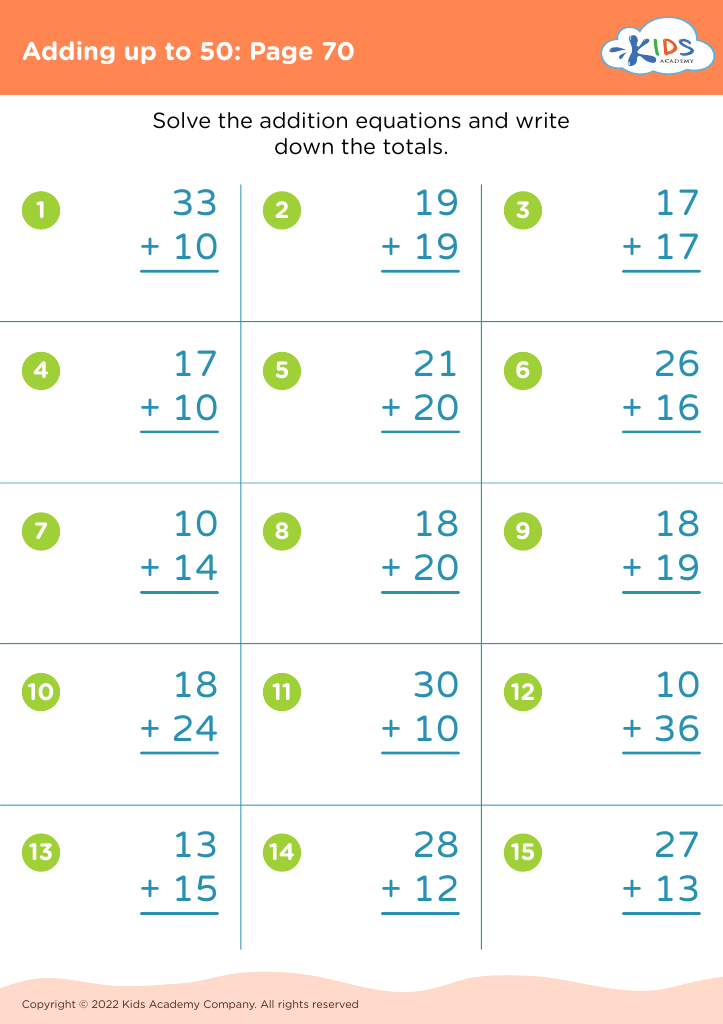


Understanding symmetry, learning to add numbers up to 50, and mastering other mathematical concepts are crucial for children aged 7-9 for several reasons.
Firstly, symmetry aids in developing spatial awareness and visual processing. It helps children recognize patterns, enhances problem-solving skills, and lays the groundwork for advanced geometrical understanding. This not only supports mathematical growth but also enriches skills in art, design, and everyday activities that involve visual analysis.
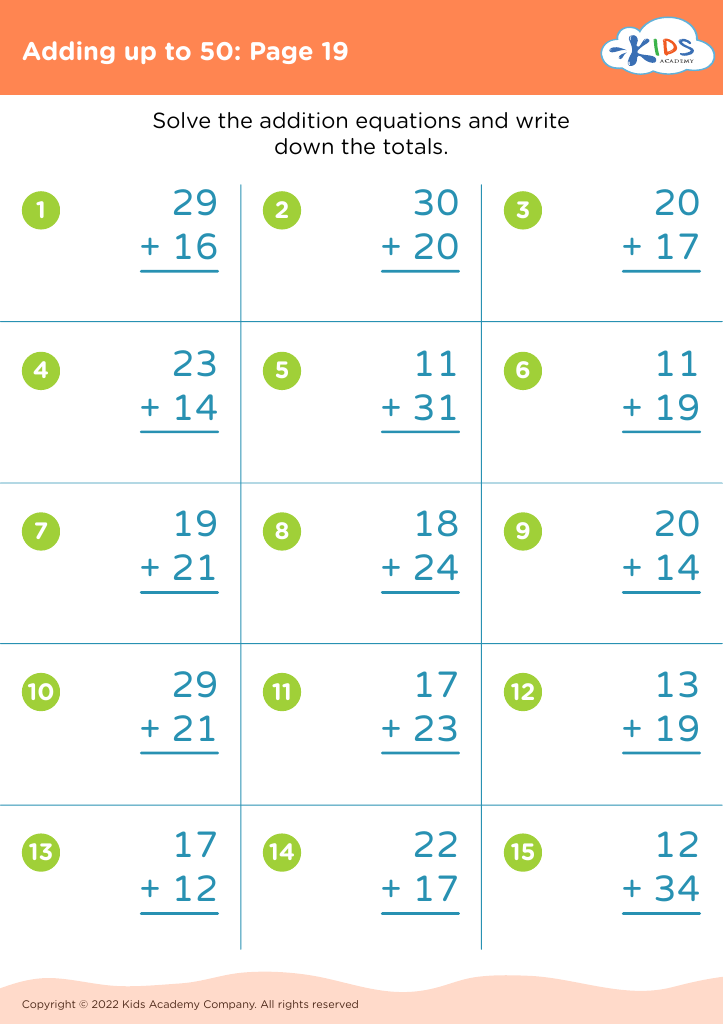
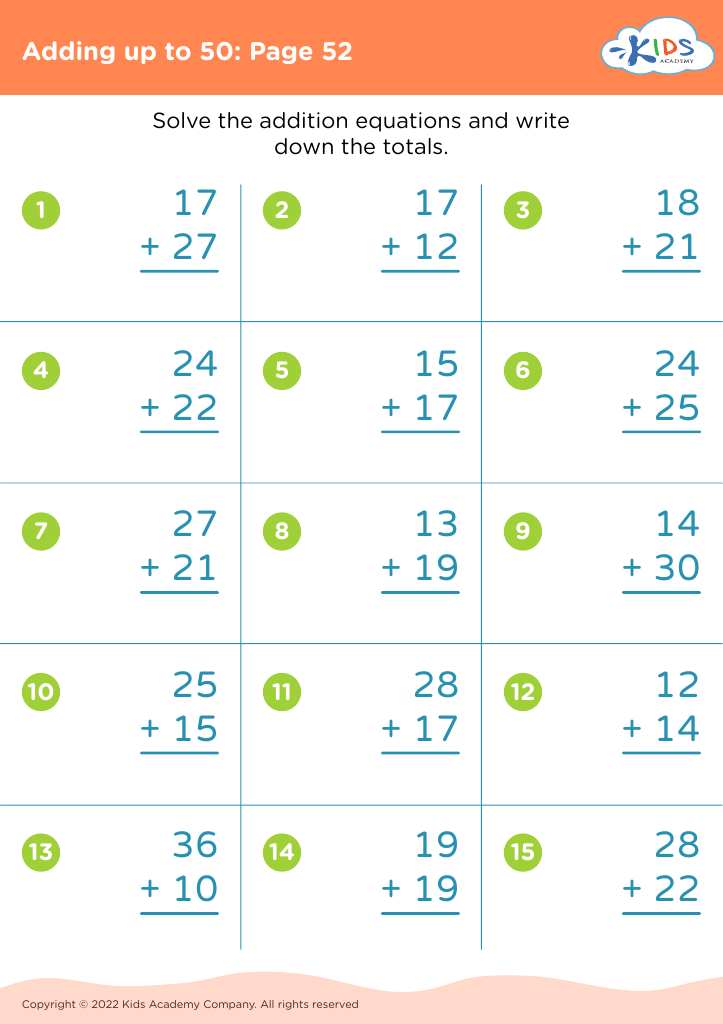
Secondly, adding up to 50 provides a solid foundation for arithmetic skills. Proficiency in addition builds confidence and prepares students for more complex mathematical operations such as subtraction, multiplication, and division. Simple addition forms the backbone of financial literacy, allowing children to handle money, time, and measurements accurately, all of which are essential life skills.
Moreover, early familiarity with numbers and mathematical principles encourages logical thinking and analytical reasoning. Teachers and parents should care because these skills are highly transferable and enhance overall academic performance. Engaging children with interesting, age-appropriate mathematical challenges also fosters a positive attitude towards learning.
Incorporating these concepts into early education ensures a well-rounded cognitive development, setting children up for future success in both their academic journey and daily lives. Therefore, understanding symmetry, mastering basic addition, and tackling miscellaneous math problems are fundamental at this stage.