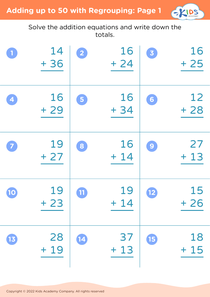
Counting practice Adding up to 50 Without Regrouping Worksheets for Ages 7-9
5 filtered results
-
From - To
Enhance your child's math skills with our Counting Practice: Adding Up to 50 Without Regrouping worksheets, designed specifically for ages 7-9. These engaging and interactive resources help young learners develop their addition skills and boost their confidence in mathematics. Each worksheet encourages children to practice adding pairs of numbers without the need for regrouping, making it an ideal tool for reinforcing foundational math concepts. Seamlessly aligned with educational standards, our worksheets make learning fun and accessible. Perfect for at-home practice or classroom use, these counting exercises are here to support your child's journey to math mastery! Get started today!
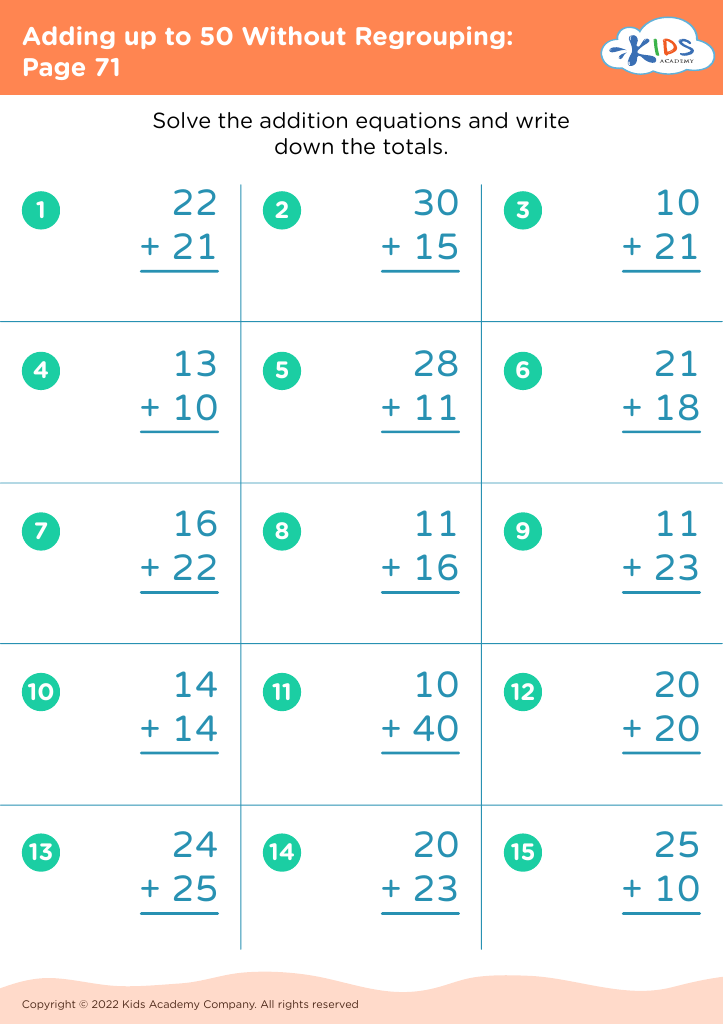
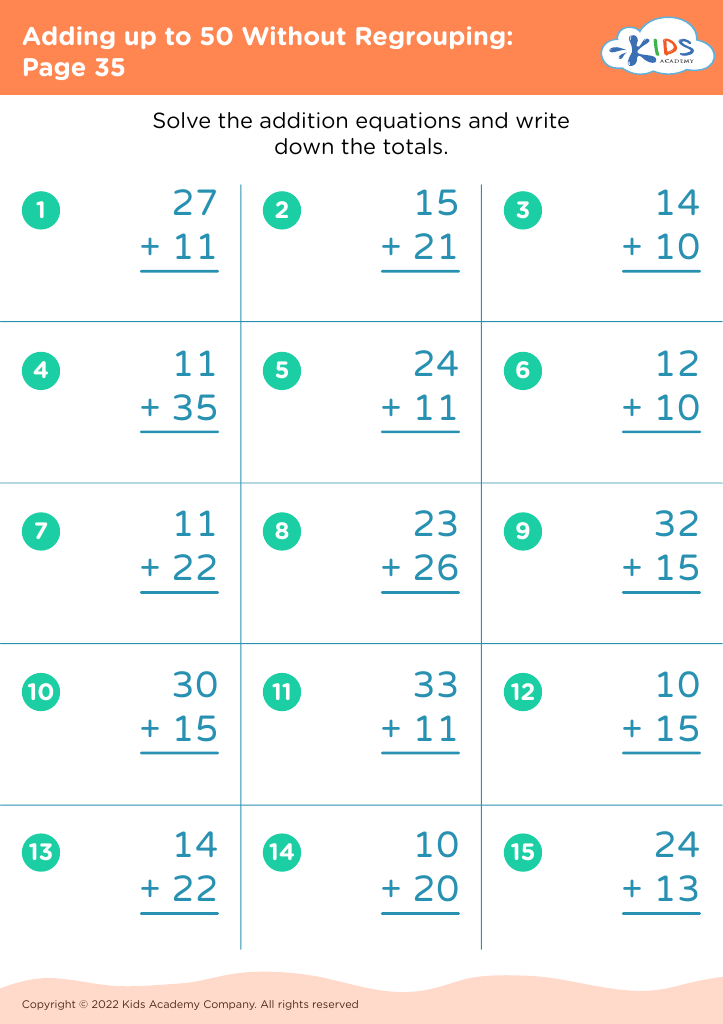
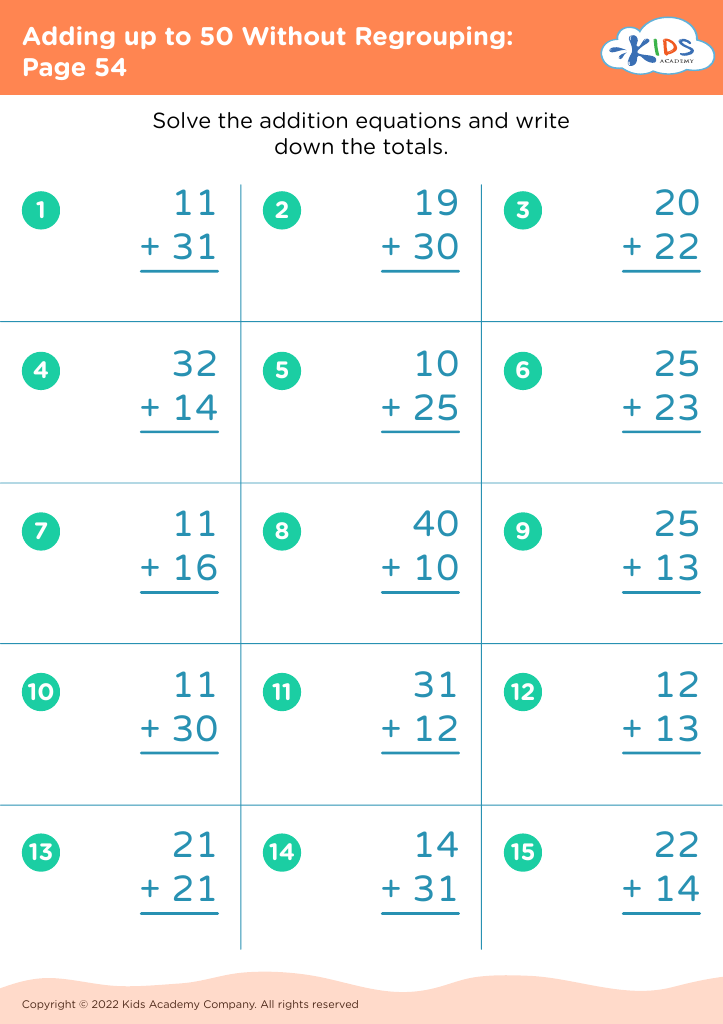
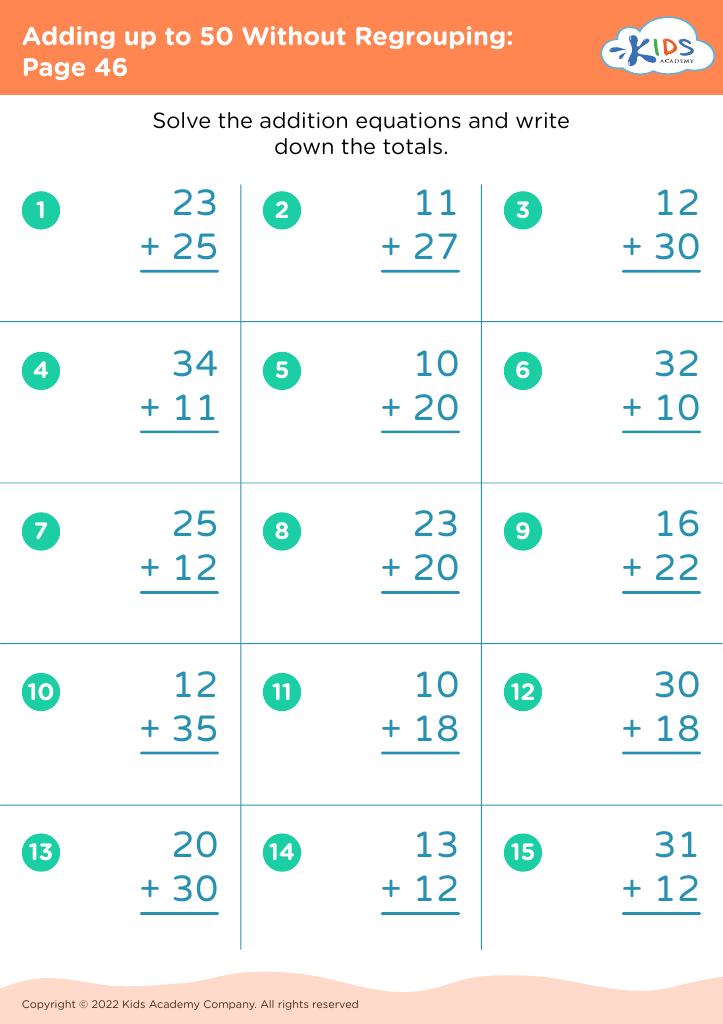
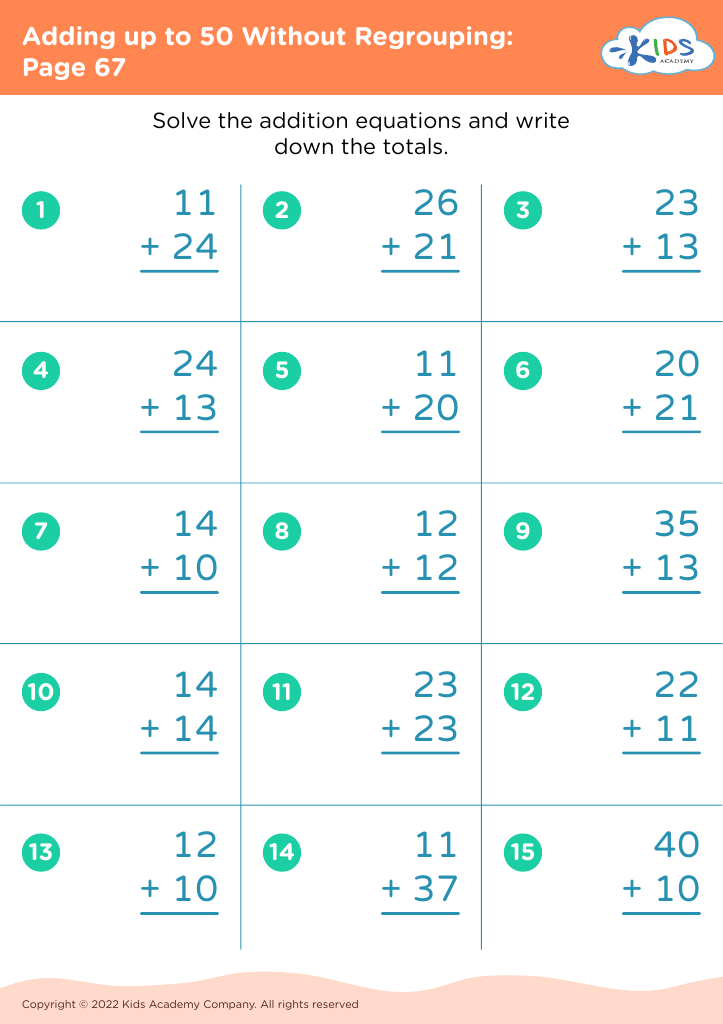


Counting practice, particularly when adding up to 50 without regrouping, is a crucial skill for children aged 7 to 9. This foundational math practice fosters a solid understanding of addition, which enhances overall numerical fluency. At this stage, children are developing critical thinking skills, and mastering addition lays the groundwork for more complex mathematical concepts they will encounter later.
Parents and teachers should care about this because early arithmetic confidence significantly impacts a child's attitude towards math. Successfully performing simple additions reinforces their self-esteem and encourages a positive association with learning. Moreover, as children navigate everyday situations—like adding scores, planning parties, or managing allowance—they’ll benefit from being comfortable with basic math.
Engaging in counting methods builds not only mathematical skills but also cognitive abilities like focus, problem-solving, and perseverance. By incorporating structured practices in counting up to 50, parents and teachers set a pathway for academic success, making future comparisons, operations, and ultimately higher-level math much more accessible and comprehensible.
In short, fostering these early math skills supports children emotionally, socially, and intellectually, establishing a lifelong appreciation for math and structured thinking.