Comparing quantities Adding up to 50 Worksheets for Ages 7-9
3 filtered results
-
From - To
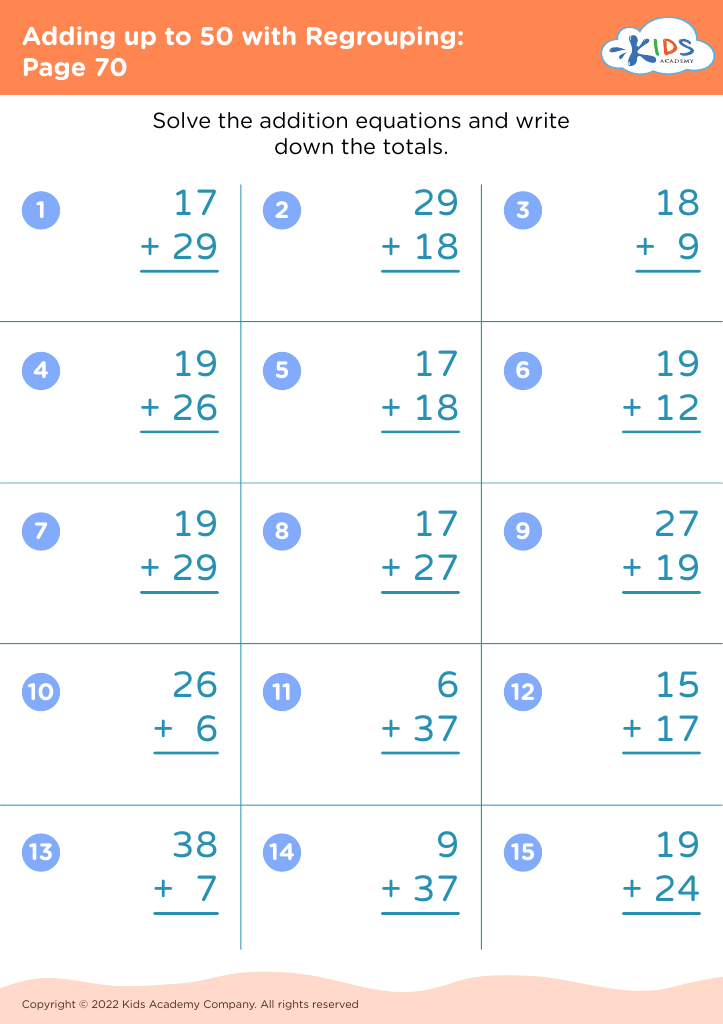
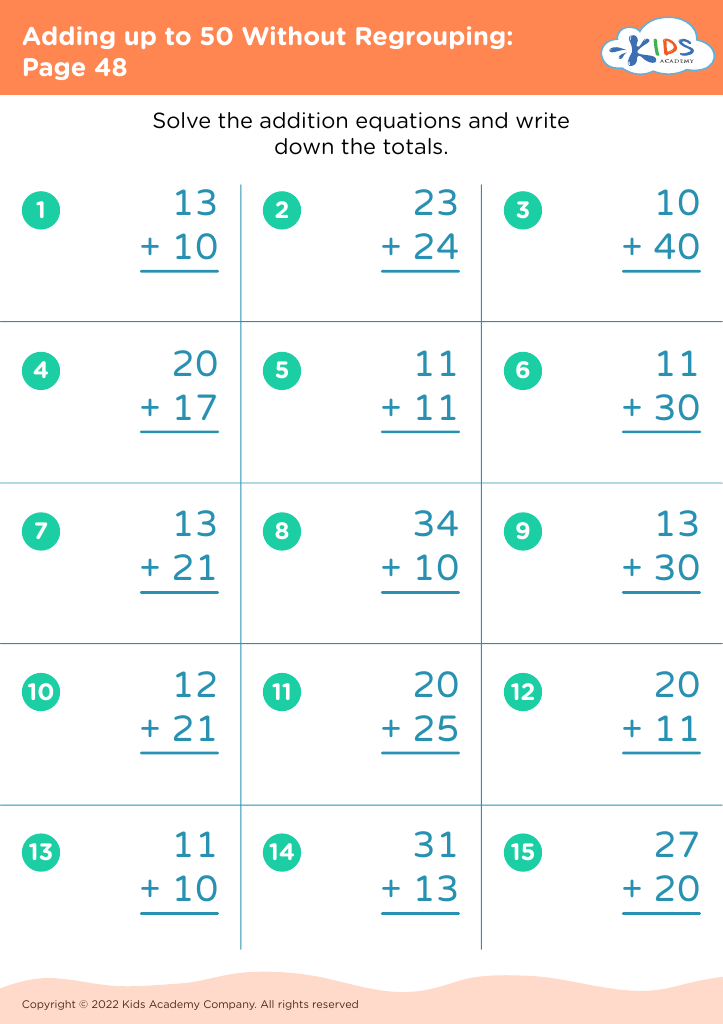
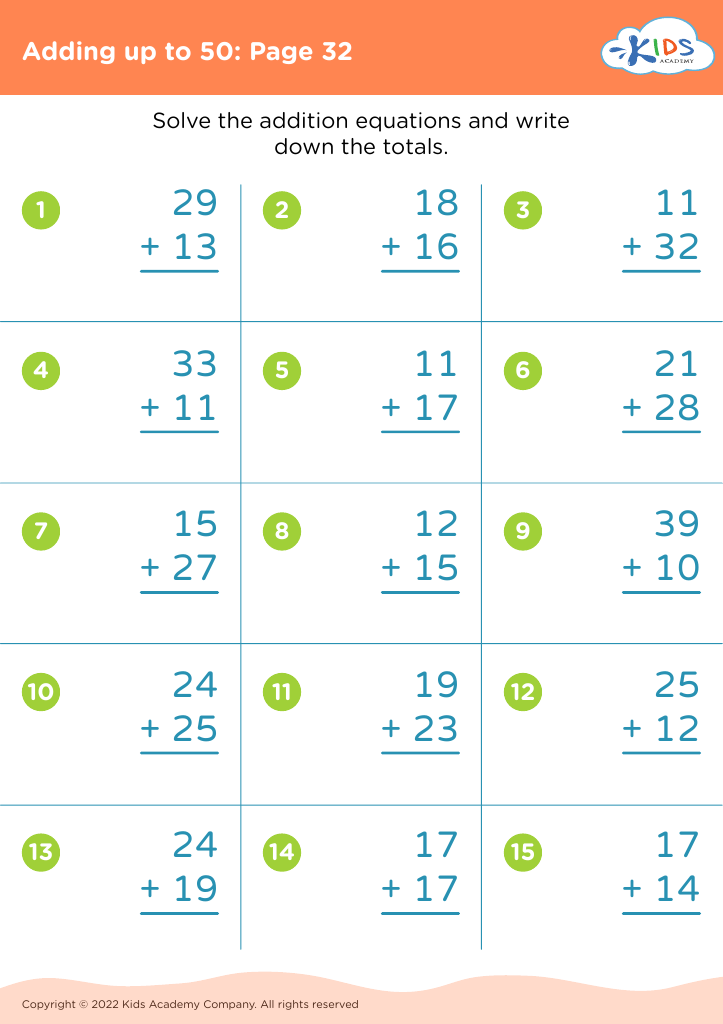
Explore our engaging "Comparing Quantities Adding Up to 50 Worksheets" designed specifically for children aged 7-9. These worksheets aim to enhance critical math skills by teaching students how to effectively compare and analyze quantities that total up to 50. Through a variety of fun activities and practical examples, kids will strengthen their understanding of addition and develop their ability to recognize relationships between numbers. Perfect for classroom use or home practice, our worksheets encourage independent problem-solving and boost confidence in mathematical reasoning. Foster your child's love for math while building essential skills for future learning!




Understanding the concept of comparing quantities and adding up to 50 is crucial for children aged 7-9, as it lays the foundation for more advanced mathematical skills. At this age, students are developing their number sense, which includes recognizing the relationships between numbers, understanding their values, and mastering basic operations. This foundational knowledge is essential not only for arithmetic but also for problem-solving and critical thinking.
Parents and teachers should care about this skill because it fosters confidence in students' mathematical abilities. When children can compare quantities, they start grasping the concept of relative value—how much larger or smaller one number is compared to another. Additionally, mastering addition up to 50 encourages fluency with numbers, enabling them to handle larger computations in future grades.
Engaging students in practical activities related to these concepts—like games, real-life scenarios (e.g., shopping), or puzzles—can make learning enjoyable and relevant. Ultimately, instilling such mathematical skills early on equips children for future academic success, opening doors to STEM fields and enhancing their problem-solving capabilities in everyday situations. Prioritizing these foundational concepts supports holistic developmental outcomes, making them essential in the educational journey of young learners.








