Practice counting Adding up to 50 Worksheets for Ages 7-9
3 filtered results
-
From - To
Discover our engaging "Practice Counting: Adding Up to 50 Worksheets" designed specifically for children ages 7-9. These interactive worksheets provide a fun way for young learners to enhance their counting and addition skills. With vibrant illustrations and a variety of exercises, students will practice adding up to 50, reinforcing their understanding of numbers in a playful manner. Each worksheet is tailored to promote critical thinking and problem-solving abilities, preparing your child for more advanced math concepts. Perfect for both classroom and home use, these resources make learning enjoyable while fostering a strong mathematical foundation. Download and start practicing today!
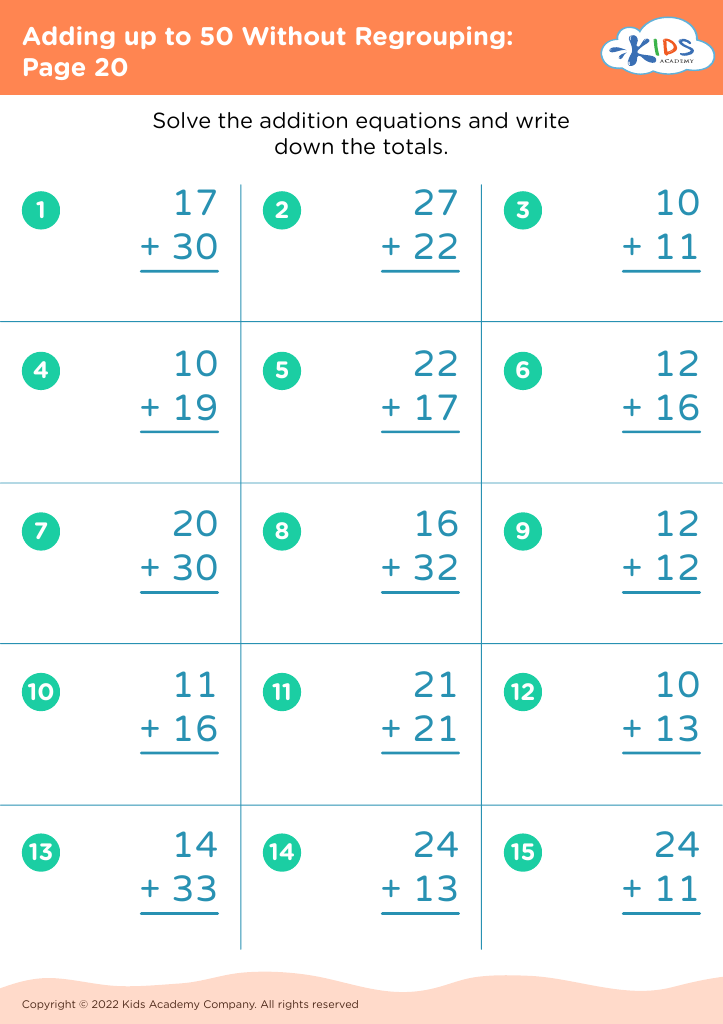
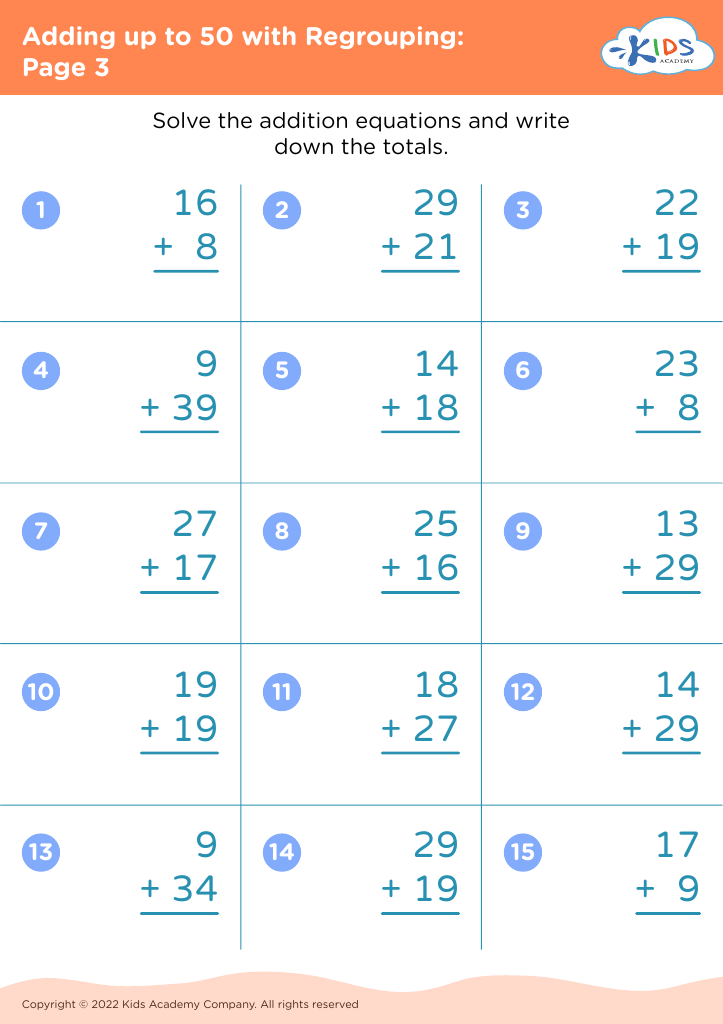
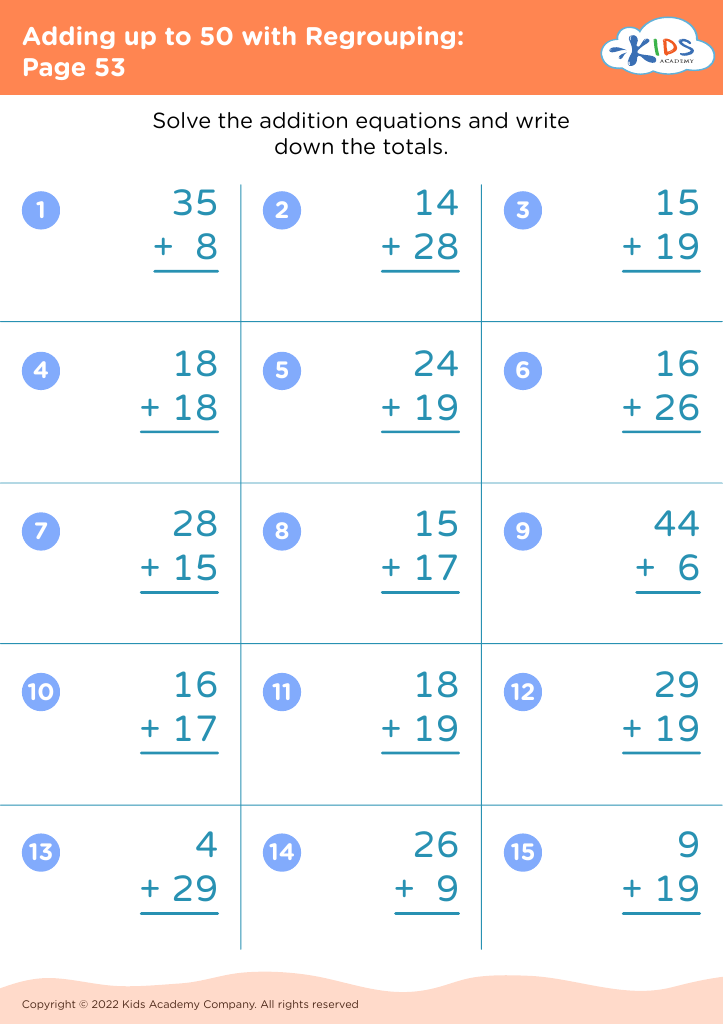




Practicing counting and adding up to 50 is crucial for children aged 7-9, as it lays a strong foundation for their mathematical understanding. At this age, children enter a vital stage of cognitive development where number sense becomes increasingly relevant. Mastering addition within 50 enhances their ability to perform more complex calculations and problem-solving in later years.
Parents and teachers should prioritize this practice because it promotes not only mathematical skills but also critical thinking and confidence. Children who are adept at basic addition are more likely to engage positively in math-related activities, reducing anxiety around the subject. This early proficiency can lead to better performance in school, setting a pattern of success as the curriculum becomes increasingly rigorous.
Moreover, practice counting and adding helps develop fine motor skills through writing numbers and engaging in interactive activities. Additionally, incorporating games and real-world scenarios makes learning enjoyable and relevant, fostering a love for mathematics.
Ultimately, nurturing these skills supports children's overall academic growth, promotes a positive attitude towards learning, and equips them with essential tools for everyday life. Investing time and effort into counting and addition now will yield significant benefits for children as they progress in their education.








