
Mathematical thinking Addition & Subtraction Worksheets for Ages 7-9
3 filtered results
Difficulty Level
Grade
Age
-
From - To
Subject
Activity
Standards
Enhance your child's mathematical thinking with our engaging Addition & Subtraction Worksheets designed specifically for ages 7-9. These worksheets encourage critical thinking and problem-solving skills while reinforcing essential math concepts. Our carefully crafted activities promote a deeper understanding of addition and subtraction through a variety of fun exercises and challenges. From simple equations to real-world scenarios, each worksheet fosters independent learning and mastery of key skills. Ideal for classroom use or at-home practice, these resources support your child's educational journey while making math enjoyable. Help your child build a strong foundation in mathematics today with our comprehensive collection!
Favorites
With answer key
Interactive
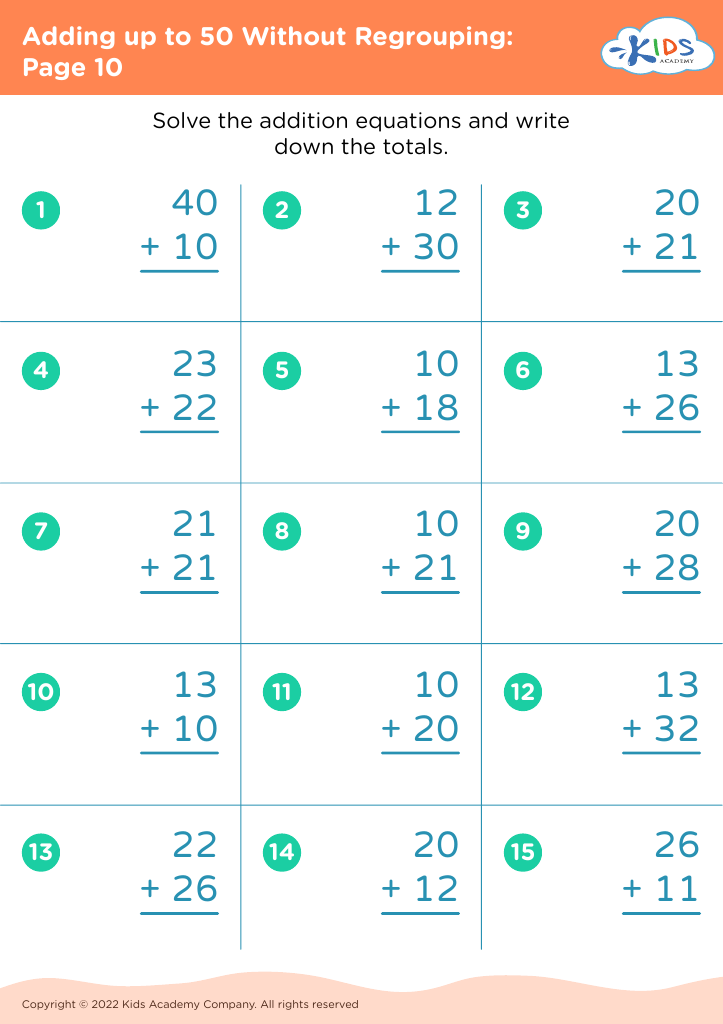
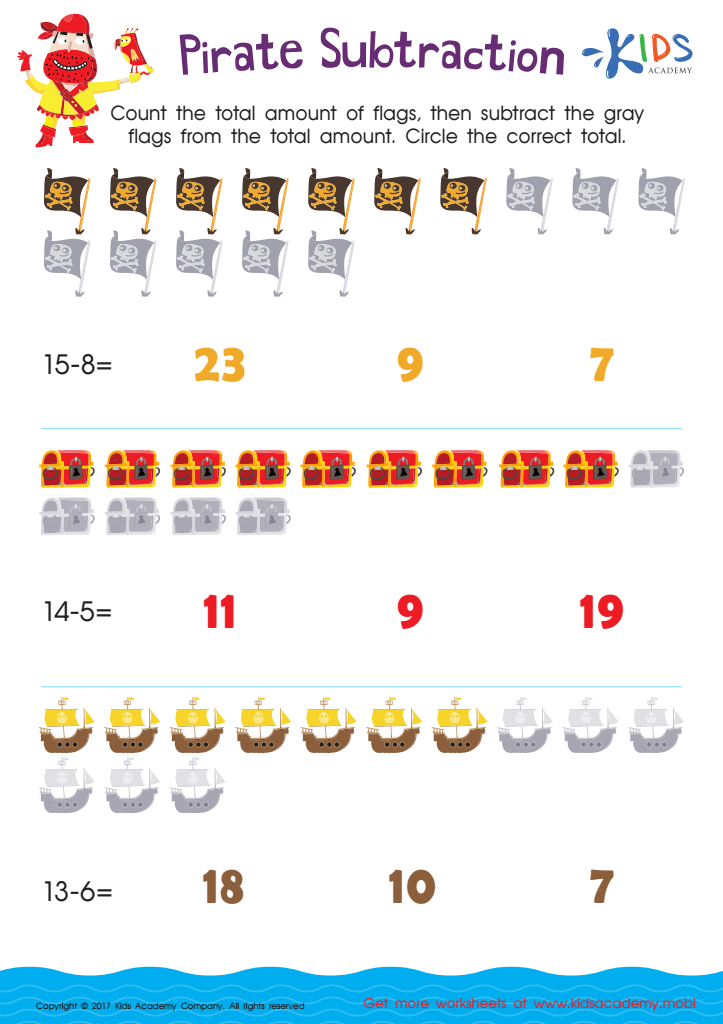
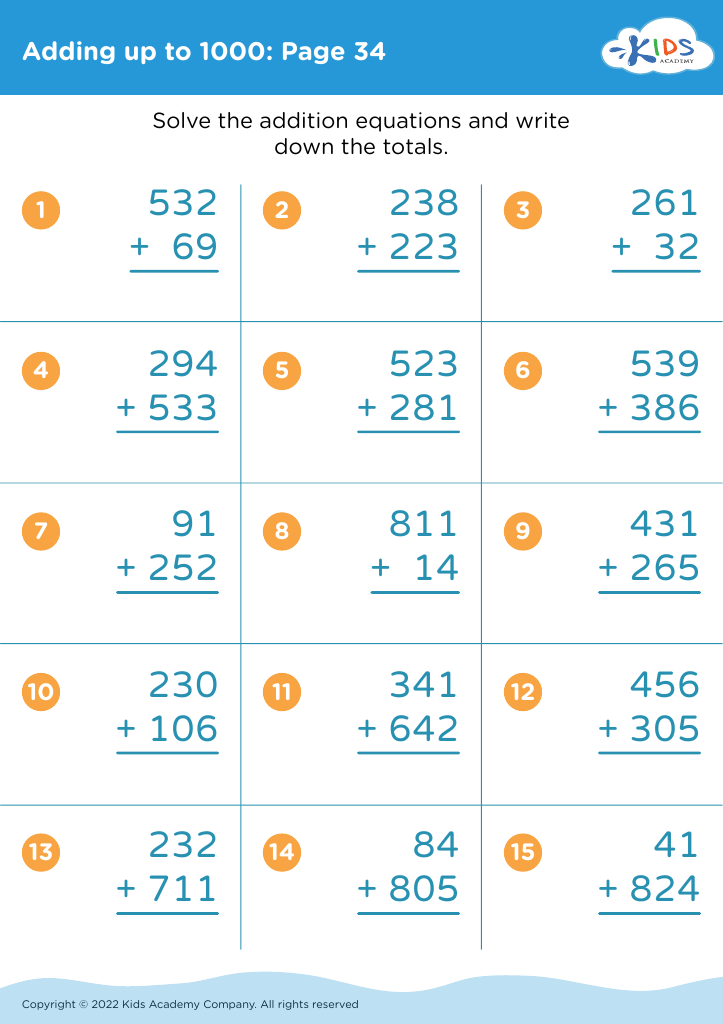
Pirate Subtraction Substraction Worksheet
Ahoy! Learn to subtract with pirate-themed math fun! This worksheet has ships and treasure chests to help your little one understand subtraction using a helpful strategy. Colorful illustrations make it a great learning experience.
 Assign to My Students
Pirate Subtraction Substraction Worksheet
Worksheet
Join Kids Academy for Free
Who is primarily going to use this learning content?








Mathematical thinking, particularly in addition and subtraction, is a fundamental skill for children aged 7-9. At this developmental stage, children are transitioning from basic arithmetic to more complex problem-solving and critical thinking. Understanding these operations strengthens their cognitive abilities, enhancing logic and reasoning skills that are essential beyond mathematics.
Parents and teachers should care because proficient mathematical thinking encourages a positive attitude towards math, reducing anxiety related to the subject and increasing confidence. Mastery in addition and subtraction lays the groundwork for more advanced concepts, such as multiplication, division, and eventually algebra. Engaging children in playful, hands-on activities involving addition and subtraction fosters deeper understanding and retention.
Furthermore, these skills are not just academic; they apply to everyday situations like managing money, telling time, or understanding schedules, thereby equipping children with practical skills for life. Encouraging mathematical reasoning nurtures persistence and resilience, teaching children that it's okay to make mistakes and learn from them.
Ultimately, promoting computation and problem-solving skills in young learners sets the foundation for successful future learning and empowerment in a data-driven world, making it crucial for parents and educators to prioritize these skills in a supportive and engaging manner.








