
Observational skills Addition Worksheets for Ages 7-9
3 filtered results
Difficulty Level
Grade
Age
-
From - To
Subject
Activity
Standards
Enhance your child's mathematical abilities with our "Observational Skills Addition Worksheets for Ages 7-9." These worksheets are meticulously designed to combine engaging activities with essential addition problems, fostering keen observational skills. Each worksheet encourages students to find patterns, spot differences, and sharpen their focus, all while practicing addition. By integrating observational exercises, learning becomes a captivating adventure, empowering young minds to excel in math and daily problem-solving. Perfect for classroom or home use, our worksheets are a wonderful resource to reinforce foundational math skills, build confidence, and make learning fun for young learners.
Favorites
With answer key
Interactive
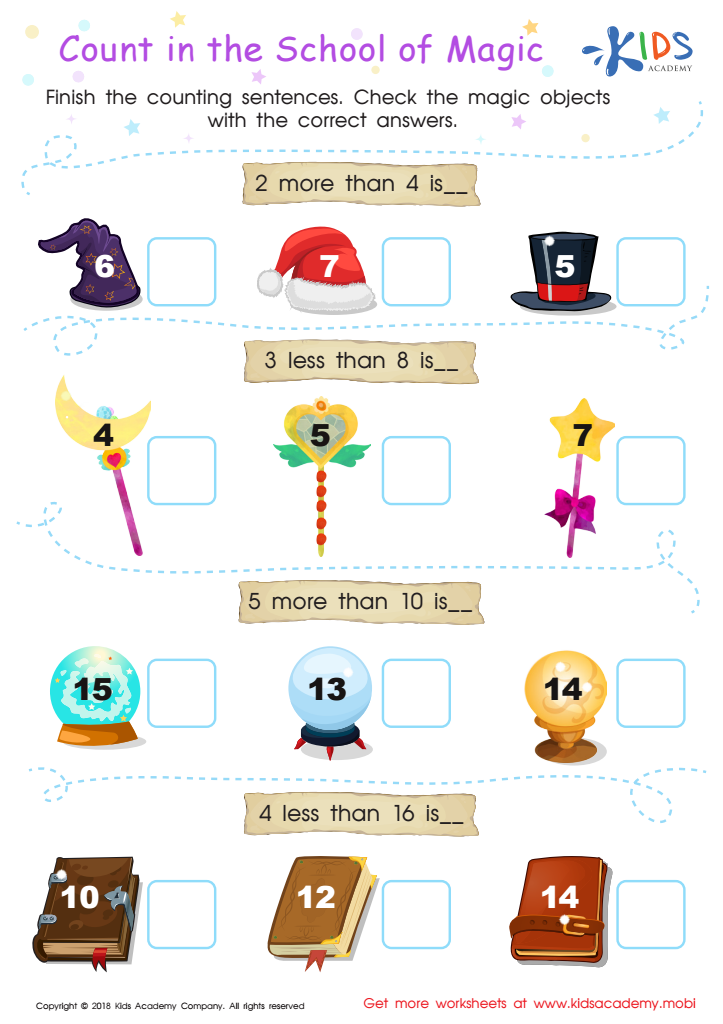
Count in the School of Magic Worksheet
Your math learners can explore the School of Magic with this worksheet. They'll read equations with addition and subtraction numbers under 20, count back and forth to find the answer, then complete the counting sentences. Fun pictures and easy accuracy make it an enjoyable and successful learning experience.
 Assign to My Students
Count in the School of Magic Worksheet
Worksheet
Join Kids Academy for Free
Who is primarily going to use this learning content?








Observational skills are crucial for children aged 7-9 as they lay the foundation for academic success and personal growth. These skills help children notice details about their surroundings, which can significantly enhance their learning experiences. By fostering observational abilities, parents and teachers enable children to become more attentive and aware, which leads to better comprehension in subjects like science, math, and reading. For example, in science, children learn to observe experiments and note small changes, while in reading, they detect subtle details that enrich their understanding of stories.
Enhancing observational skills also bolsters problem-solving and critical thinking. When children notice patterns or inconsistencies, they become adept at analyzing situations and making informed decisions. These skills are essential not only in academics but also in day-to-day activities.
Moreover, developing keen observational skills fosters empathy and social awareness. Children become more adept at understanding non-verbal cues and the emotions of their peers, leading to improved social interactions and a more harmonious classroom environment.
In summary, prioritizing the development of observational skills in children aged 7-9 equips them with fundamental tools for academic excellence, critical thinking, and emotional intelligence. This holistic growth ensures they are well-prepared for future educational challenges and social relationships.








