Counting skills improvement Math Worksheets for Ages 7-9
3 filtered results
-
From - To
Enhance counting skills with our Math Worksheets for Ages 7-9! Perfectly crafted for young learners, these worksheets focus on strengthening key counting abilities. Engaging and educational, each worksheet helps kids grasp numerical concepts through fun exercises. From counting forward and backward to skip counting and identifying patterns, our resources support comprehensive skill development. Ideal for parents, teachers, and homeschoolers, these activities make learning accessible and enjoyable. Boost your child's confidence in math with our expertly designed printable worksheets, ensuring they build a strong foundation in counting and problem-solving. Visit Kids Academy for a better learning experience!
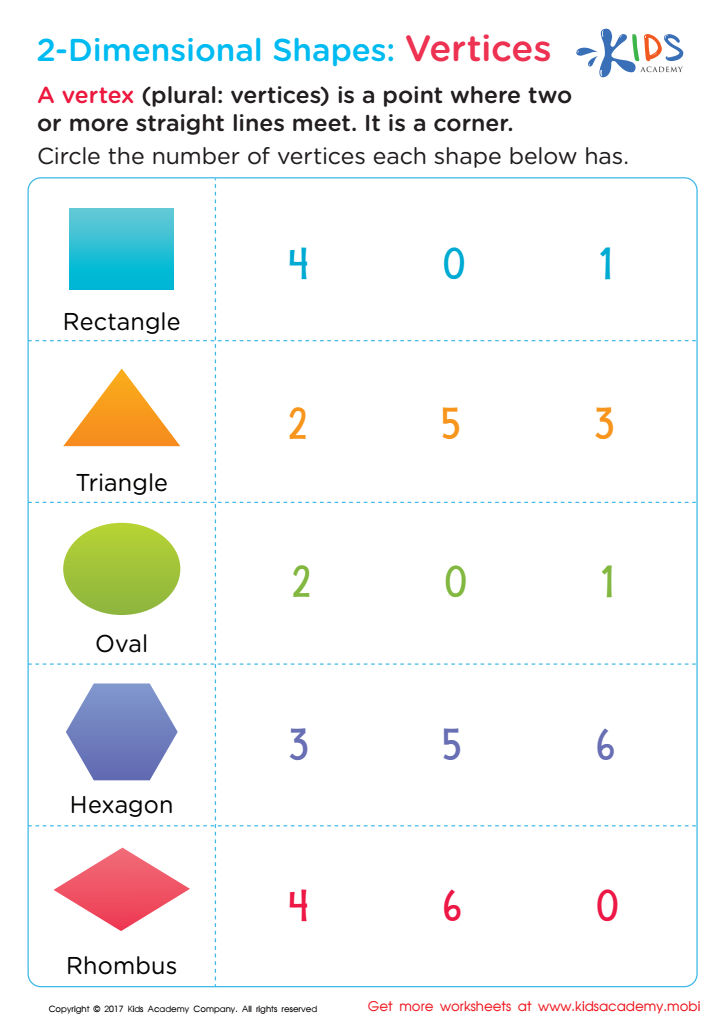
Two–Dimensional Shapes: Vertices Printable
 Assign to My Students
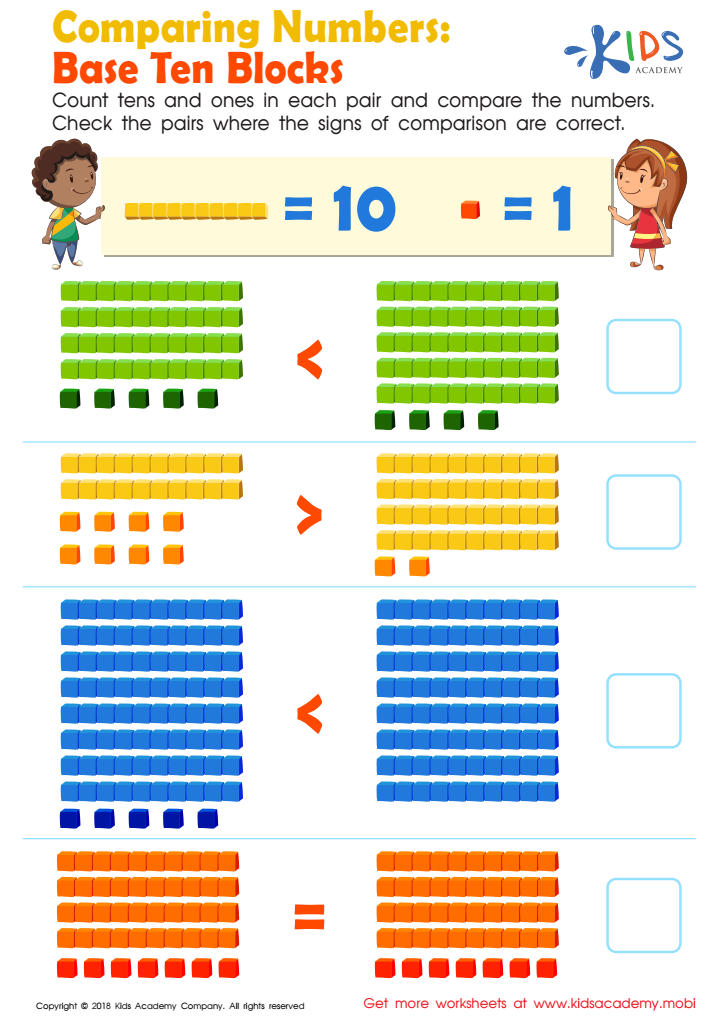
Comparing Numbers: Base Ten Blocks Worksheet








Counting skills are foundational for mathematical learning and cognitive development, making it crucial for parents and teachers to focus on improving these skills in children aged 7-9. At this stage, children move beyond simple counting to more complex tasks such as addition, subtraction, and recognizing number patterns, which are vital for advanced math concepts.
Firstly, mastering counting aids in developing a solid number sense, allowing children to understand the relationships between numbers and their magnitudes. This competency is essential for problem-solving and logical thinking, which are applicable across various subjects and daily life situations.
Secondly, proficiency in counting helps build confidence and a positive attitude towards math. Early success in understanding numbers fosters a sense of achievement, motivating children to tackle more challenging problems without fear or frustration.
Additionally, strong counting skills contribute to better performance in future academic pursuits. Mathematical proficiency gained during these years lays the groundwork for algebra, geometry, and other higher mathematics, which are critical for many careers.
Lastly, early math skills are predictive of future academic achievement not just in mathematics, but also in literacy and science. By improving counting skills, parents and teachers are equipping children with tools that will benefit their overall educational trajectory and lifelong learning. Therefore, focusing on counting skills at this age paves the way for future success.








