Critical thinking development Math Worksheets for Ages 7-9
4 filtered results
-
From - To
Enhance your child's critical thinking skills with our engaging Math Worksheets for ages 7-9! Designed to stimulate analytical thinking, these worksheets challenge younger learners to solve problems creatively and logically. With a variety of exercises that promote reasoning, pattern recognition, and problem-solving, kids will enjoy honing their skills in a fun, interactive way. Our resources are aligned with educational standards, ensuring that your child is not only learning but also building a strong foundation for future math concepts. Explore our collection and watch your child's confidence and critical thinking abilities flourish as they tackle each engaging math challenge!
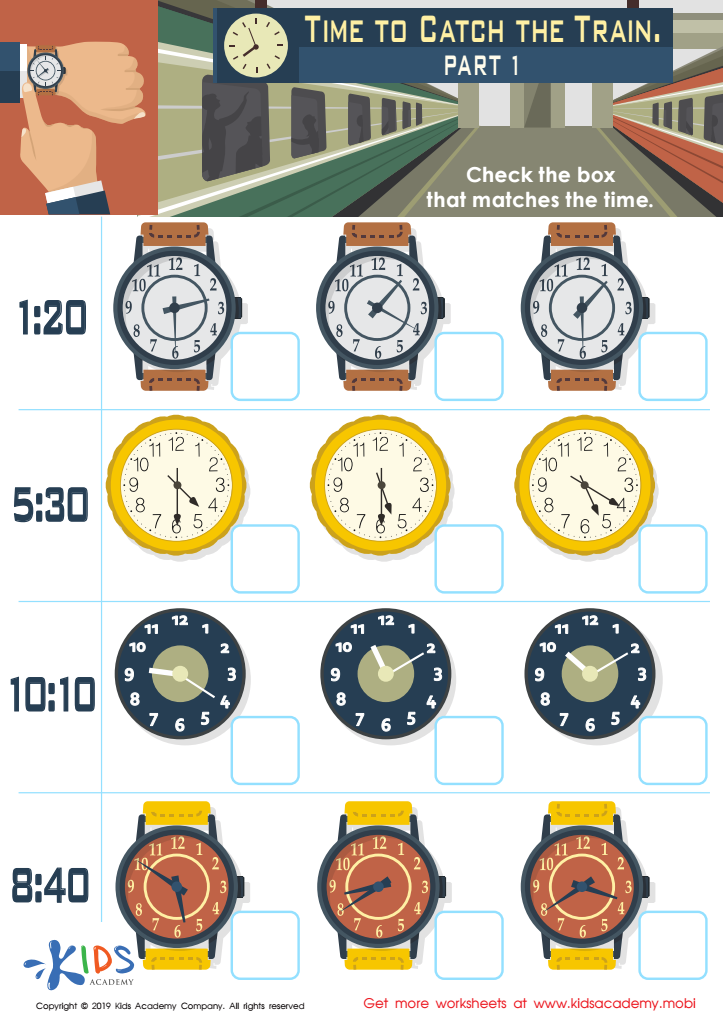
Time to Catch the Train Part 1 Worksheet
 Assign to My Students








Critical thinking development in math is essential for children aged 7-9, as it fosters deeper understanding and problem-solving skills that are foundational for future learning. At this age, children are transitioning from concrete to more abstract thinking, making it an optimal time to cultivate critical thinking skills in mathematics.
By encouraging critical thinking, teachers and parents help children not just to memorize formulas or quick calculations, but to understand underlying concepts, relationships, and logical reasoning. This deeper comprehension promotes confidence in tackling complex problems and enhances their ability to analyze, evaluate, and construct arguments based on mathematical evidence.
Furthermore, critical thinking in math prepares children for real-world situations. They begin to see how math applies to everyday life, such as budgeting, shopping, and even planning a trip. This applicability embeds a practical understanding that encourages lifelong learning.
In addition, developing critical thinking skills fosters resilience, as children learn to approach challenges with curiosity and creativity. This mindset is essential not just in math, but across all subjects and life situations. Therefore, prioritizing critical thinking in math during these formative years will equip children with the tools they need as active, engaged learners and decision-makers.








