
Improving observational skills Math Worksheets for Ages 7-9
3 filtered results
Difficulty Level
Grade
Age
-
From - To
Subject
Activity
Standards
Enhance your child's learning with our "Improving Observational Skills Math Worksheets" designed for ages 7-9. These engaging worksheets help students sharpen their attention to detail while tackling fun mathematical challenges. By focusing on various math concepts, kids will develop their observational skills, boosting both their accuracy and confidence. From pattern recognition to problem-solving exercises, our resources cater to diverse learning styles, encouraging critical thinking. Ideal for home or classroom use, these worksheets inspire curiosity and facilitate a deeper understanding of mathematics. Unlock your child's potential today and watch their skills flourish with interactive learning tools that make math enjoyable!
Favorites
With answer key
Interactive
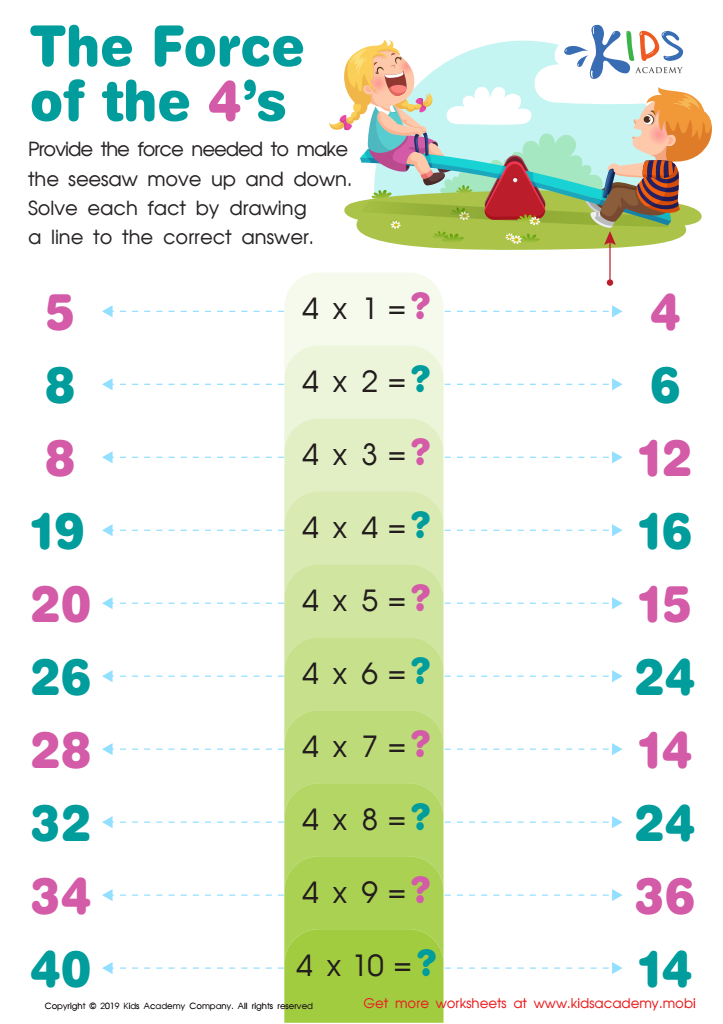
The Force of the 4's Worksheet
Ride a seesaw with your child and explore the physics behind it! Explain how it needs two people and how force makes it go up and down. Use the memories of the pleasurable experience to teach your kid a lesson in force. Show them how to solve the worksheet by drawing a line to the correct answer. This way, they'll learn the force needed for the seesaw to move.
 Assign to My Students
The Force of the 4's Worksheet
Worksheet
Join Kids Academy for Free
Who is primarily going to use this learning content?








Improving observational skills in mathematics for children aged 7-9 is crucial for several reasons. At this developmental stage, children are laying the foundation for more complex mathematical concepts. Strong observational skills enable them to notice patterns, relationships, and differences among numbers and shapes, fostering a deeper understanding of the subject matter.
When children can observe and analyze mathematical structures, they become adept problem-solvers. For instance, recognizing patterns can enhance their ability to understand multiplication and division. Additionally, observational skills support critical thinking; students learn to explore various strategies, encouraging discussions and collaborative learning in the classroom.
Moreover, enhancing these skills boosts confidence. When children can see and articulate their observations in mathematics, they feel more empowered to participate in learning activities. This active engagement often leads to a love of learning and increased motivation.
Lastly, observational skills transcend mathematics and are foundational for success in a wide range of subjects. By supporting and nurturing these abilities at an early age, parents and teachers equip children with essential tools for academic achievement and lifelong learning. Investing in the development of observational skills today equals a brighter educational future for our children.








