
Understanding grouping Math Worksheets for Ages 7-9
3 filtered results
Difficulty Level
Grade
Age
-
From - To
Subject
Activity
Standards
Discover our "Understanding Grouping Math Worksheets for Ages 7-9" designed to help young learners master the concept of grouping in mathematics. These engaging and educational worksheets are crafted to improve your child's counting, addition, and multiplication skills through fun and interactive exercises. Our expertly developed activities encourage critical thinking and problem-solving, making math enjoyable and accessible. With colorful illustrations and varied tasks, children remain motivated and confident. Perfect for both classroom and home use, these worksheets provide a solid foundation in grouping that supports ongoing math education. Equip your child with essential skills through our thoughtfully designed worksheets.
Favorites
With answer key
Interactive
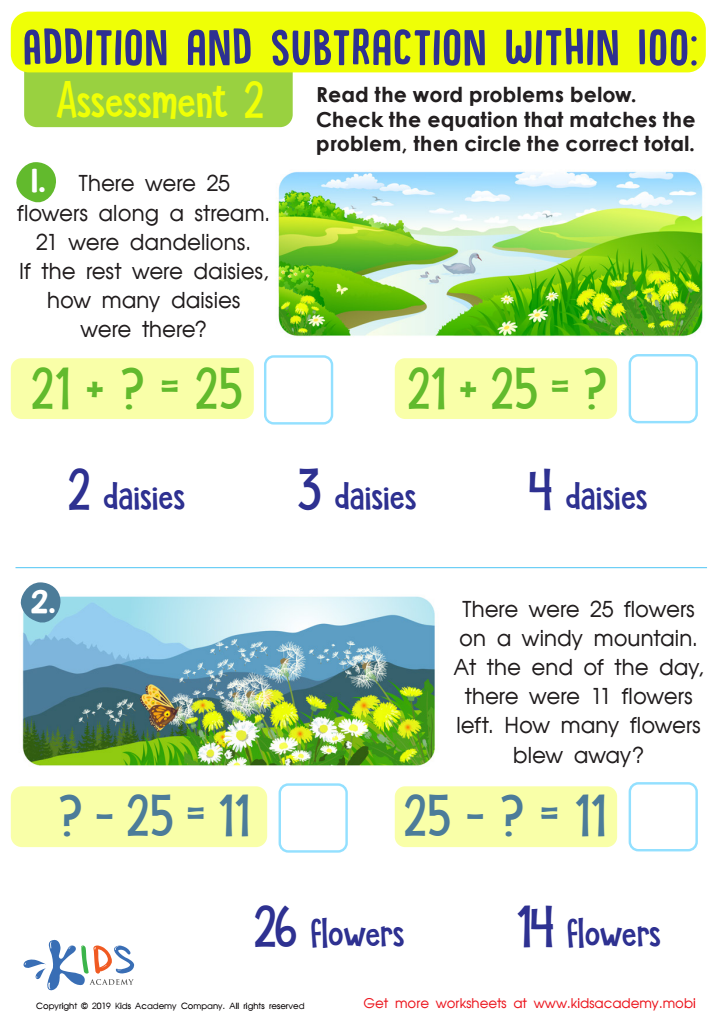
Assessment 2 Math Worksheet
Using fun exercises and pictures, you can get kids excited about math. With practice and reminders of what they've learnt, they'll be solving simple addition and subtraction equations with ease. Read the word problems in the picture to them, then help them check the equation and choose the correct answer.
 Assign to My Students
Assessment 2 Math Worksheet
Worksheet
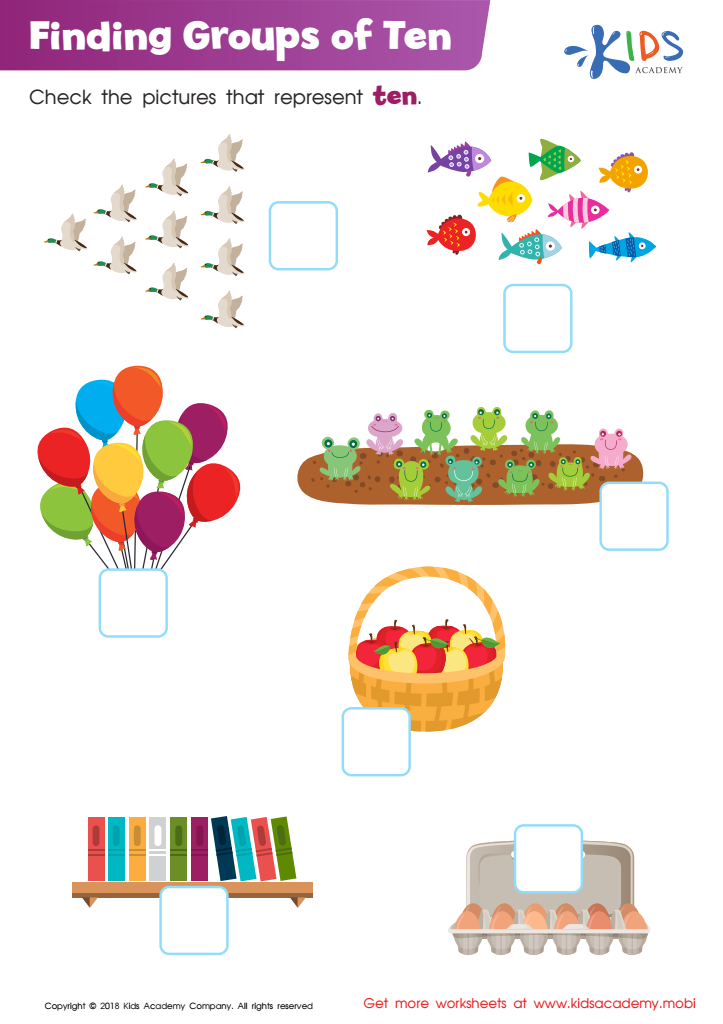
Finding Groups of Ten Worksheet
Can your kids count? If they can't go higher than tens, introduce them to this worksheet. Counting can be fun and easy with this exercise. Ask if they can identify the pictures, then help them count each group. Help them check the pictures that represent ten.
Finding Groups of Ten Worksheet
Worksheet
Join Kids Academy for Free
Who is primarily going to use this learning content?




.jpg)


Understanding grouping in math is crucial for children aged 7-9 because it forms the foundation for advanced mathematical concepts. Grouping, or the ability to categorize and organize numbers, helps solidify a child’s comprehension of addition, subtraction, multiplication, and division. At this critical stage, many children transition from concrete operational thinking to more abstract thought processes, and mastering grouping enables them to visualize math problems better.
For parents and teachers, encouraging proficiency in grouping can alleviate math anxiety, a common barrier to academic success. When children understand how numbers can be grouped to simplify calculations, they develop confidence and enthusiasm towards math, enhancing their overall academic performance.
Additionally, grouping fosters problem-solving skills and logical reasoning. For example, recognizing that 12 can be grouped into three sets of 4 or four sets of 3 allows children to approach multiplication and division with greater ease and flexibility. It also ties into real-world applications such as organizing objects, understanding arrays, and managing time or resources effectively.
Moreover, a solid grasp of grouping sets the stage for quick mental math and estimation skills, essential life competencies. By promoting these abilities, teachers and parents equip children with the tools to engage fully and successfully with future, more complex mathematical tasks.








