
Reading analog clocks Time Worksheets for Ages 7-9
3 filtered results
Difficulty Level
Grade
Age
-
From - To
Subject
Activity
Standards
Enhance your child's time-telling skills with our "Reading Analog Clocks Time Worksheets for Ages 7-9." Perfectly designed for children in second and third grade, these worksheets transform learning to read an analog clock into an engaging and educational experience. Through various exercises, kids will master how to interpret hour and minute hands, understand the difference between AM and PM, and build critical thinking skills. Each worksheet is tailored to meet the developmental needs of 7-9-year-olds, ensuring they gain confidence and accuracy in reading analog clocks. Set your child on the path to becoming a time-telling pro today!
Favorites
With answer key
Interactive
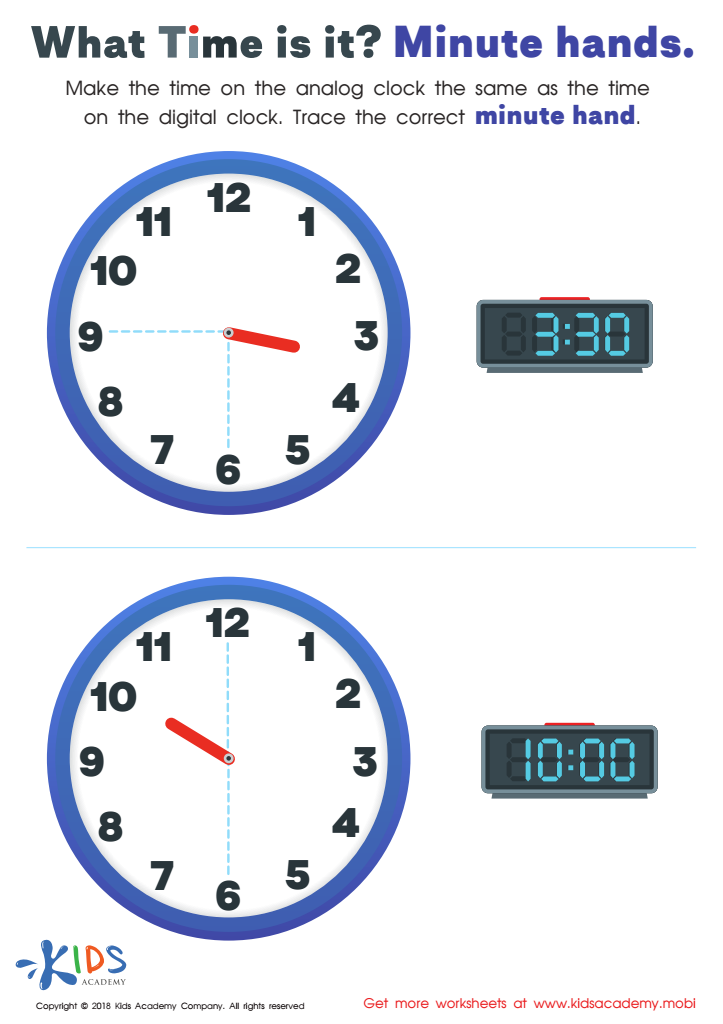
What Time Is it? Minute Hands Worksheet
Help your kids telling time with the minute hand correctly with this tracing sheet. Trace the correct minute hand to make the time on the analog clock the same as the time on the digital clock. Give them a pictured demonstration of how to do it and you'll be all set!
 Assign to My Students
What Time Is it? Minute Hands Worksheet
Worksheet
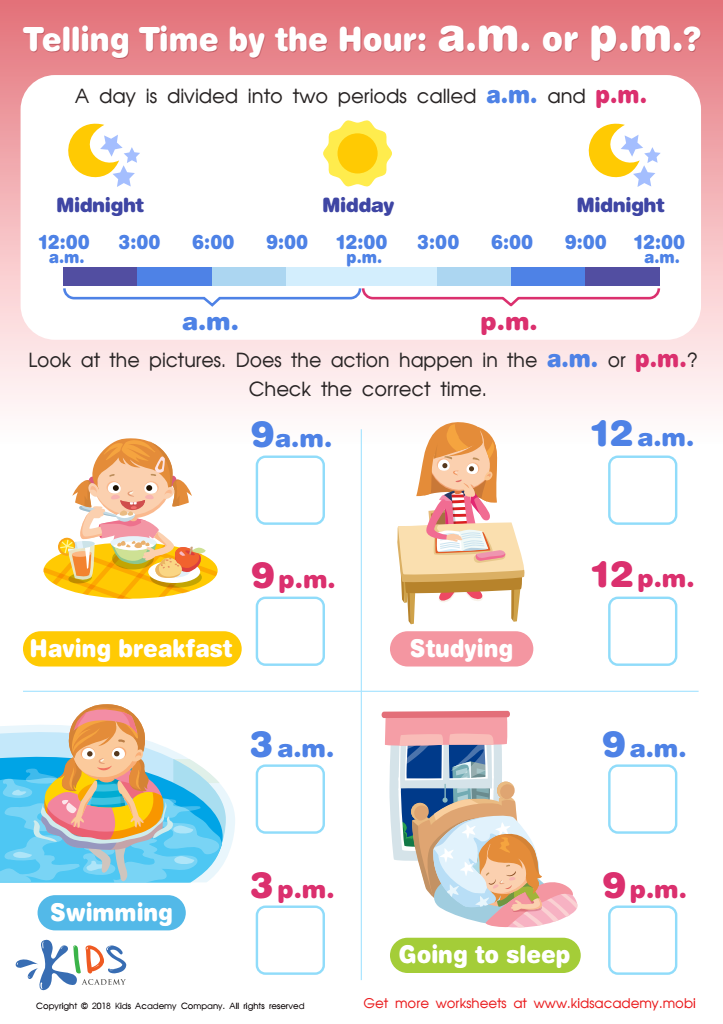
Tilling Time by the Hour: a.m. or p.m.? Worksheet
Can your child tell the time? This worksheet will help them learn. Explain a.m and p.m. and look at the pictures together. Ask your child if the activities happen in the a.m or p.m and help them check the correct time.
Tilling Time by the Hour: a.m. or p.m.? Worksheet
Worksheet
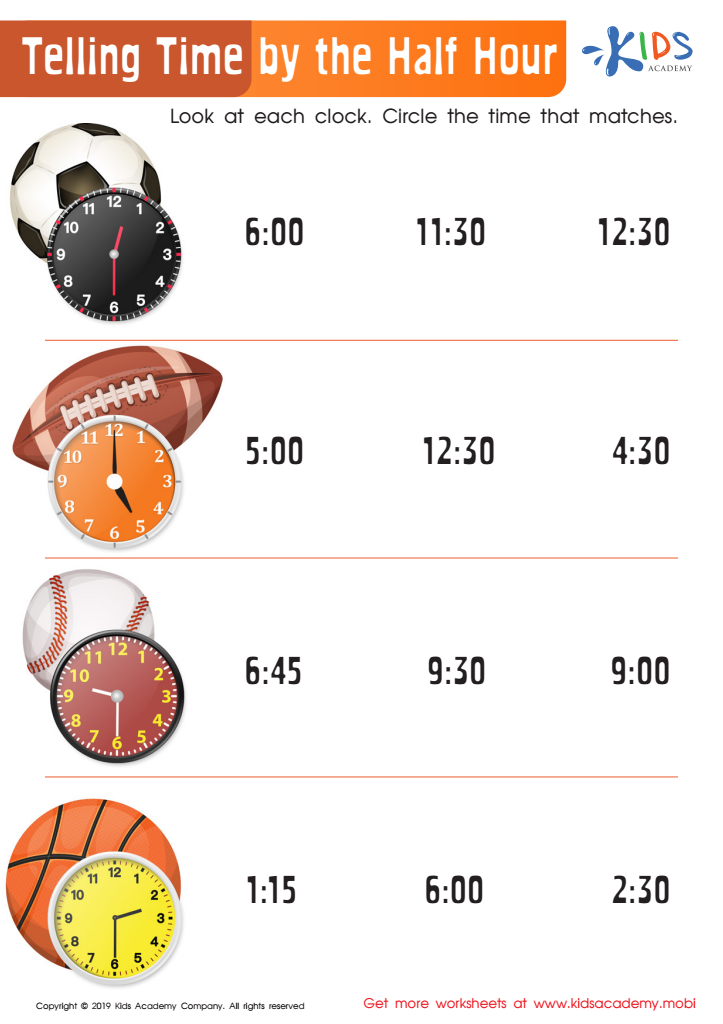
Telling Time by the Half Hour Worksheet
Teach kids to tell time with this worksheet! Four clocks are labeled with different times; help your child circle the right one. It's a great way to teach them to read analog and digital clocks, watches, and written times. Easy and fun learning!
Telling Time by the Half Hour Worksheet
Worksheet
Join Kids Academy for Free
Who is primarily going to use this learning content?






Reading analog clocks is an essential skill for children aged 7-9, and parents and teachers should prioritize this learning for several reasons. First, understanding how to read an analog clock enhances cognitive skills. It involves interpreting different minute and hour hand positions, promoting critical thinking and problem-solving abilities. Children develop a sense of numerical relationships and sequencing, fostering mathematical understanding.
Second, telling time on an analog clock is a practical life skill. Despite the prevalence of digital devices, many environments still use analog clocks, such as classrooms, public places, and certain home settings. Children who can't read these may struggle with everyday activities, such as adhering to schedules for chores, school, or recreational activities.
Third, mastering analog clocks promotes time management skills. By learning to recognize the passage of time in an analog format, children can better gauge time intervals and durations, leading to improved punctuality and organization. This skill carries over into adult life, affecting personal and professional success.
Finally, reading analog clocks connects children with traditional methods of timekeeping and cultural norms, enriching their historical understanding and appreciation of technological advancements. Equip children with this fundamental skill early on to build a strong foundation for lifelong learning and practical competency.








