
Sound recognition Vowels Worksheets for 7-Year-Olds
5 filtered results
Difficulty Level
Grade
Age
-
From - To
Subject
Activity
Standards
Enhance your 7-year-old's reading skills with our Sound Recognition Vowels Worksheets. Specifically designed for young learners, these engaging activities help children identify and differentiate vowel sounds. Each worksheet provides fun, interactive exercises that build phonemic awareness, boosting confidence in reading and pronunciation. Developed by education experts, our worksheets cover various vowel sounds through colorful images, matching games, and fill-in-the-blanks. Ideal for classroom or at-home practice, they offer a perfect blend of learning and fun, ensuring foundational literacy skills. Download now to support your child's journey in mastering vowel sounds uniquely and enjoyably!
Favorites
With answer key
Interactive
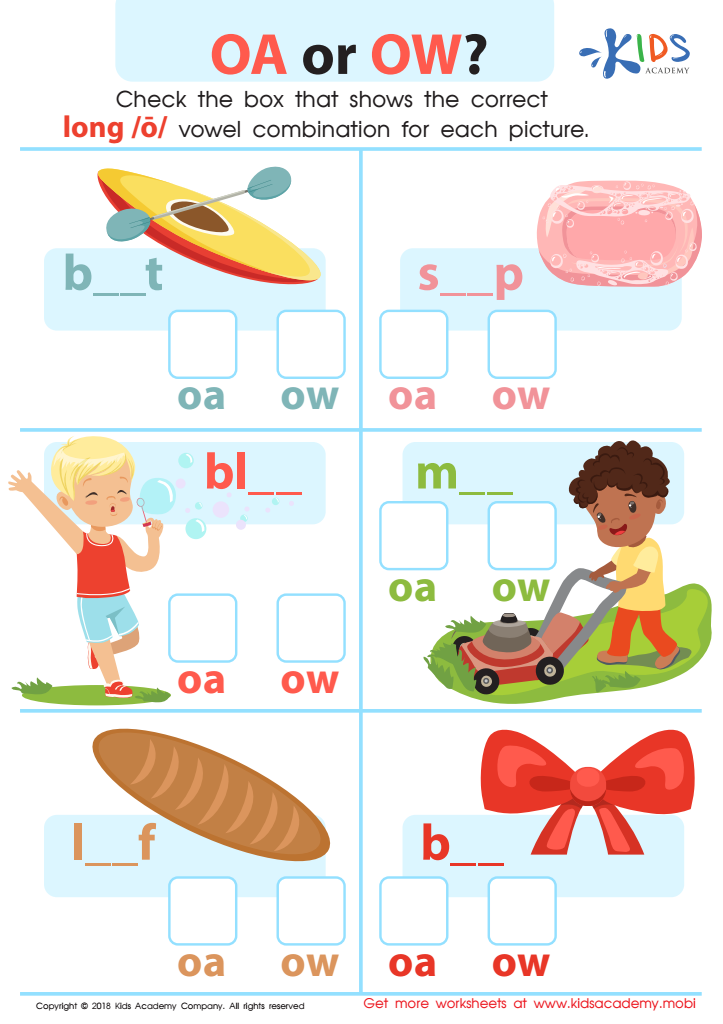
Reading: OA or OW Worksheet
This printable worksheet helps young and emergent readers with decoding words and understanding digraphs (two letters with one sound). It requires students to complete the spelling for each word based on the picture, focusing on /oa/ and /ow/ spellings. It's ideal for a reading classroom and for spelling practice.
Reading: OA or OW Worksheet
Worksheet
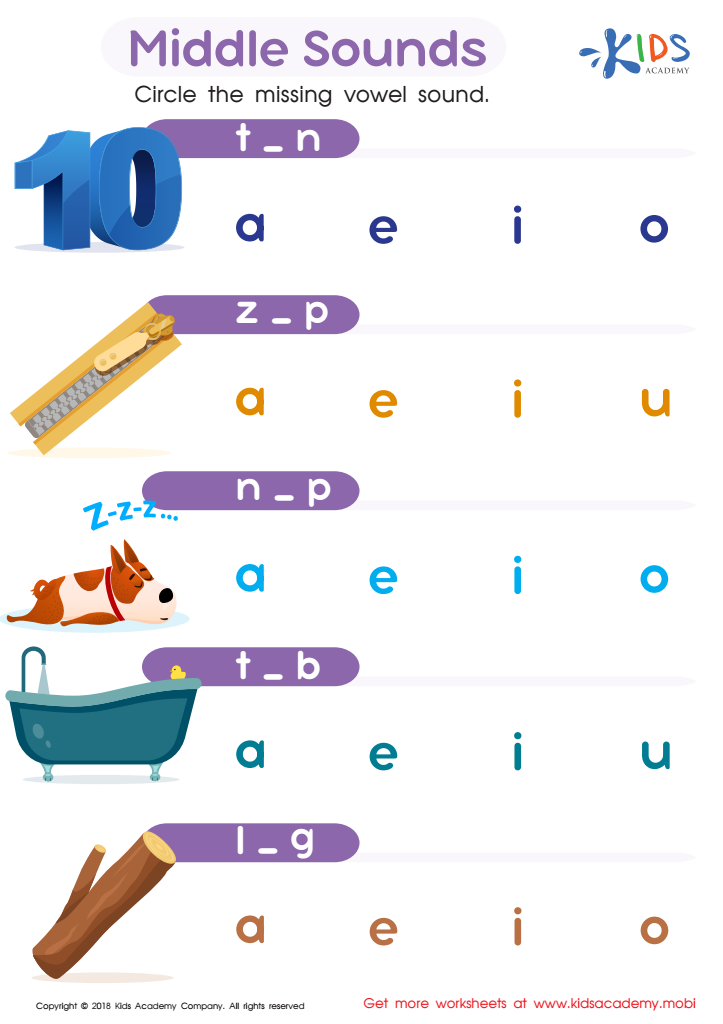
Middle Sounds Worksheet
Download this free worksheet and help your reader identify middle sounds in words. Pictures provide clues to the word, while tracing circles around the middle vowel sound strengthens fine motor and visual discrimination skills. It's a great way to teach sound discrimination between similar-sounding short vowels - a key component for proficient reading.
Middle Sounds Worksheet
Worksheet

Long and Short U Worksheet
Revised: Spice up your lesson on long and short vowels with this fun printout! Kids read the words "tube" and "tub," then reinforce the sound by coloring in the words and pictures. It's a great way to make phonics class enjoyable!
Download (PDF)
 Assign to My Students
Assign to My Students
Long and Short U Worksheet
Worksheet
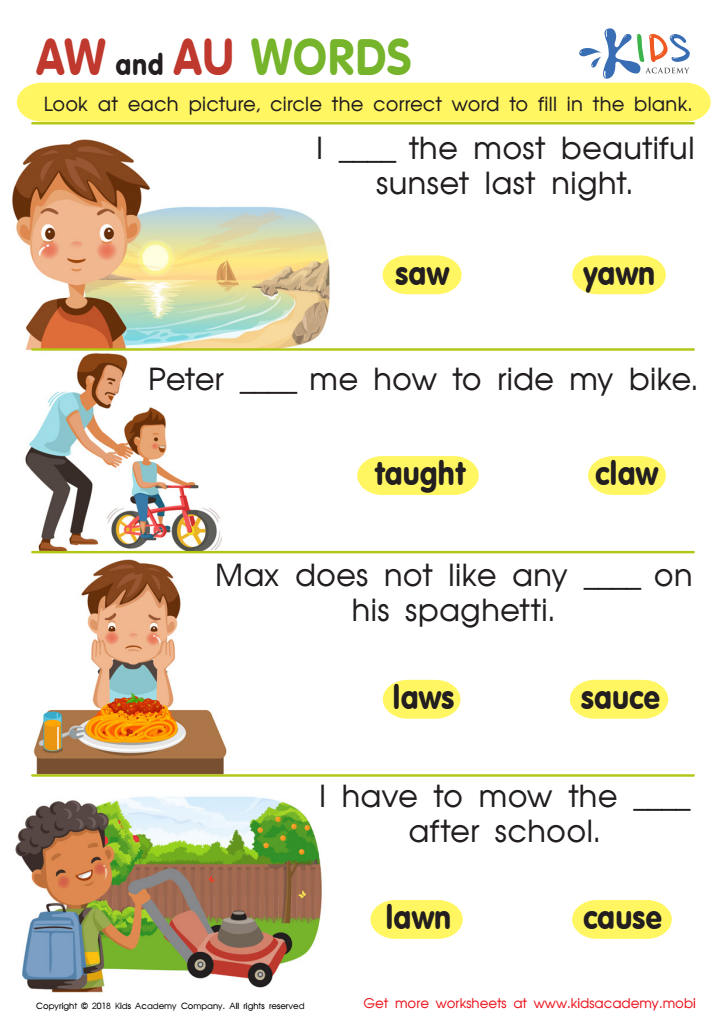
Reading: AW and AU Words Worksheet
This worksheet helps kids recognize that /au/ and /aw/ can make the same sound. Students read sentences and pick the correct word with one of the digraphs. Understanding digraphs improves decoding and reading fluency. Perfect for reading and phonics classes.
Reading: AW and AU Words Worksheet
Worksheet
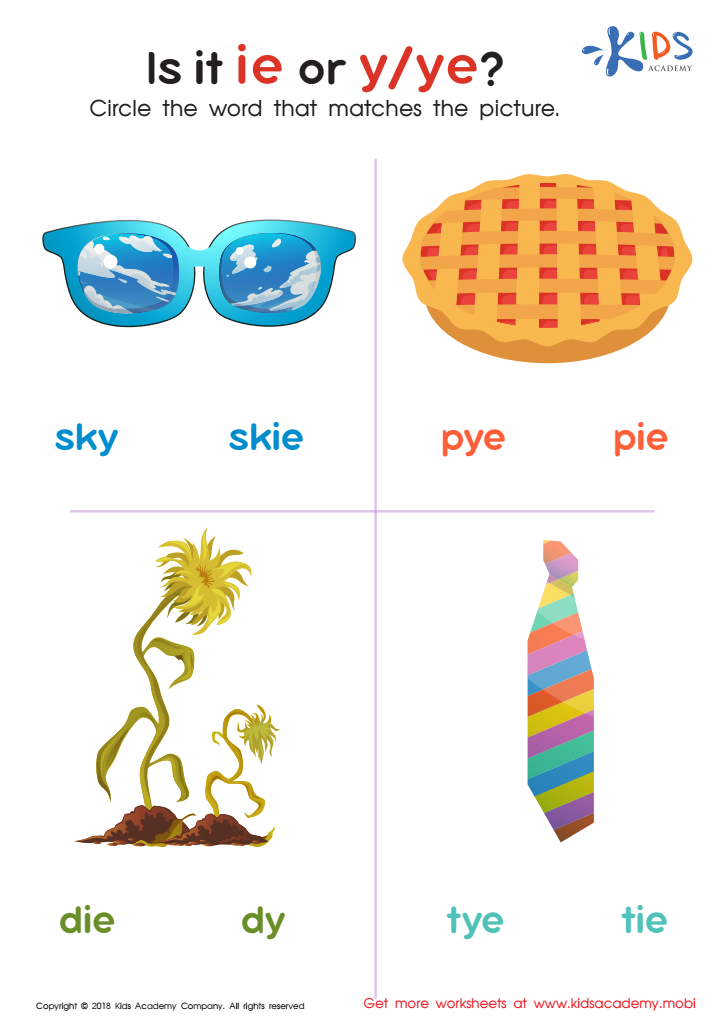
Is It IE or Y/Ye? Worksheet
Test your child's picture identification skills by pointing at common items in your house and asking them to name them. Then, look at the objects in this worksheet with your little one. Point at each one, ask for the name, then ask which spelling is correct. Help them circle the correct word.
Is It IE or Y/Ye? Worksheet
Worksheet
Join Kids Academy for Free
Who is primarily going to use this learning content?





Sound recognition, particularly for vowels, is fundamental in early literacy development for 7-year-olds. Vowels are the building blocks of syllables, which are essential elements in decoding and forming words. When children recognize and differentiate vowel sounds accurately, they lay a sturdy foundation for reading and spelling proficiency.
Parents and teachers who prioritize vowel sound recognition notice significant improvements in children's reading skills. This skill helps kids decode new words, enhancing their vocabulary and comprehension. Additionally, vowels often appear in sight words, which are common words that young readers should recognize immediately. Mastery in vowel sounds facilitates quicker identification of these essential words, improving reading fluency.
Moreover, sound recognition sharpens phonemic awareness, the ability to hear, identify, and manipulate individual sounds in spoken words. Such awareness is a strong predictor of future reading success. Engaging in vowel recognition activities fosters attentive listening and pronunciation skills, which benefit overall communication abilities.
By being actively involved, parents and teachers can create engaging, vowel-rich learning environments. This can involve games, songs, or interactive reading sessions that reinforce recognition and proper usage. Ultimately, this sets the stage for lifelong literacy skills, academic success, and a love for reading.
Thus, understanding vowel sounds is not just about reading; it's about empowering young learners with the skills necessary for all future learning endeavors.







