Identify colors Worksheets for 7-Year-Olds
3 filtered results
-
From - To
Explore our engaging 'Identify Colors Worksheets for 7-Year-Olds' to enhance your child's understanding of color recognition. These specially crafted worksheets offer fun and educational activities designed to help young learners identify and differentiate various colors, fostering critical cognitive skills and creativity. Through vibrant illustrations and interactive tasks, children can practice matching, sorting, and naming colors while enjoying the learning process. Perfect for both classroom and home use, our printable sheets provide a delightful way to reinforce color concepts, making learning an enjoyable experience for your 7-year-old. Unlock their potential with Kids Academy's vibrant, expertly designed resources!
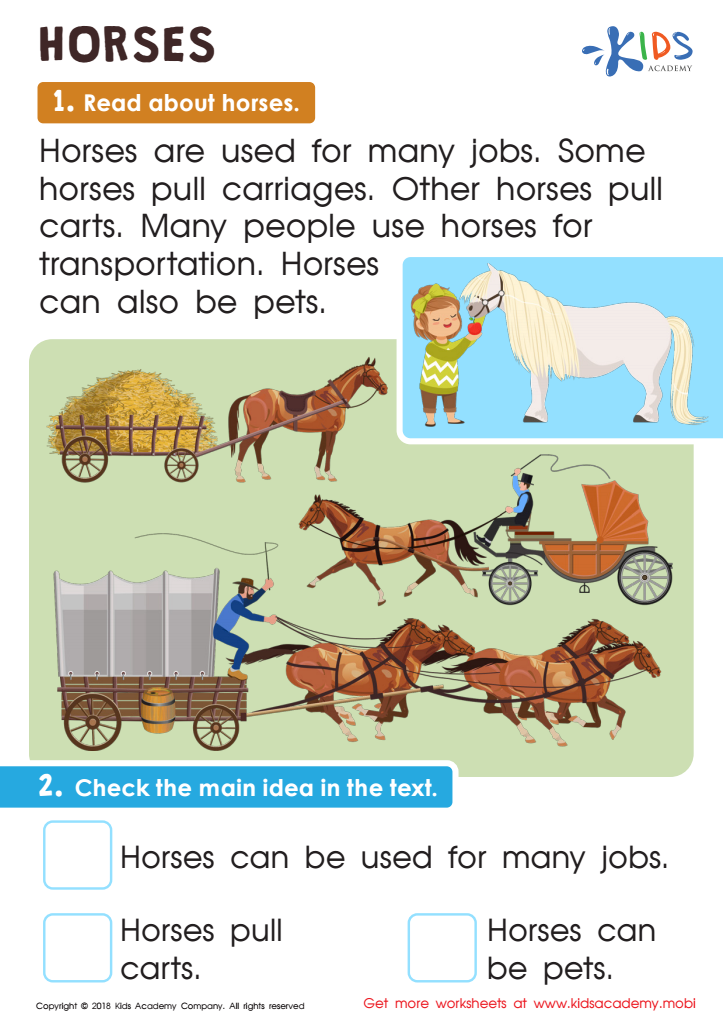
Horses Worksheet
 Assign to My Students








Identifying colors is a critical developmental milestone for 7-year-olds, playing a fundamental role in their cognitive, emotional, and social development. At this stage, children's brains are rapidly expanding in their ability to process complex information and differentiate among subtleties, which includes recognizing and naming colors accurately.
For parents and teachers, ensuring that children can identify colors is important because it strengthens their linguistic skills. Mastery of color names enhances vocabulary, which deepens communication capabilities and supports other learning areas, such as reading and writing.
From a cognitive standpoint, color identification aids in critical thinking and memory retention. Young children often use colors as visual cues to categorize objects and learn new concepts, making it easier for them to absorb and retain information. Additionally, an understanding of colors lays a foundation for grasping more advanced scientific and mathematical principles, like sorting, pattern recognition, and organizing data.
Emotionally and socially, colors can influence mood and behavior, assisting children in expressing their feelings and understanding the emotional context in various situations. Teaching colors also fosters inclusivity during play and collaborative work, where clear communication bolsters teamwork.
Overall, attention to color recognition endorses a well-rounded developmental journey, equipping 7-year-olds with essential skills for greater academic achievements and everyday social interactions.








