Critical Thinking Adding 2-digit Numbers Worksheets for 7-Year-Olds
3 filtered results
-
From - To
Enhance your child's mathematical skills with our Critical Thinking Adding 2-Digit Numbers Worksheets designed specifically for 7-year-olds. These engaging worksheets not only focus on mastering 2-digit addition but also encourage critical thinking and problem-solving abilities. Each exercise challenges young learners to think creatively as they apply addition strategies, making math both fun and educational. By incorporating real-world scenarios and varied contexts, these worksheets help students connect math concepts to everyday life. Give your child the tools they need to succeed and develop their confidence in math with our thoughtfully crafted worksheets that promote essential thinking skills.
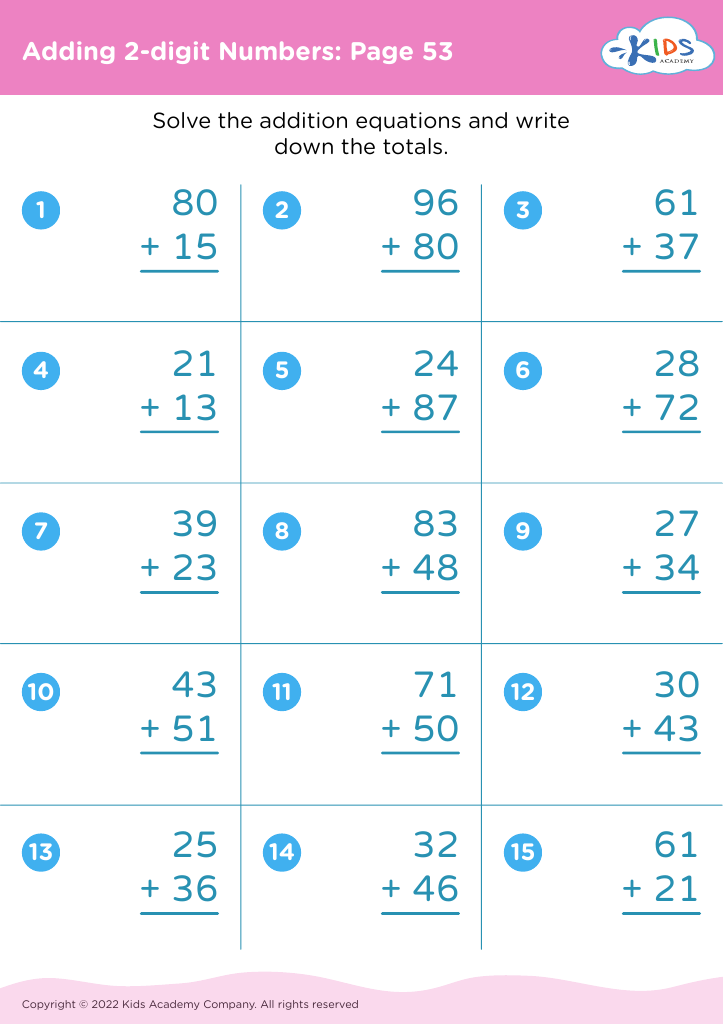
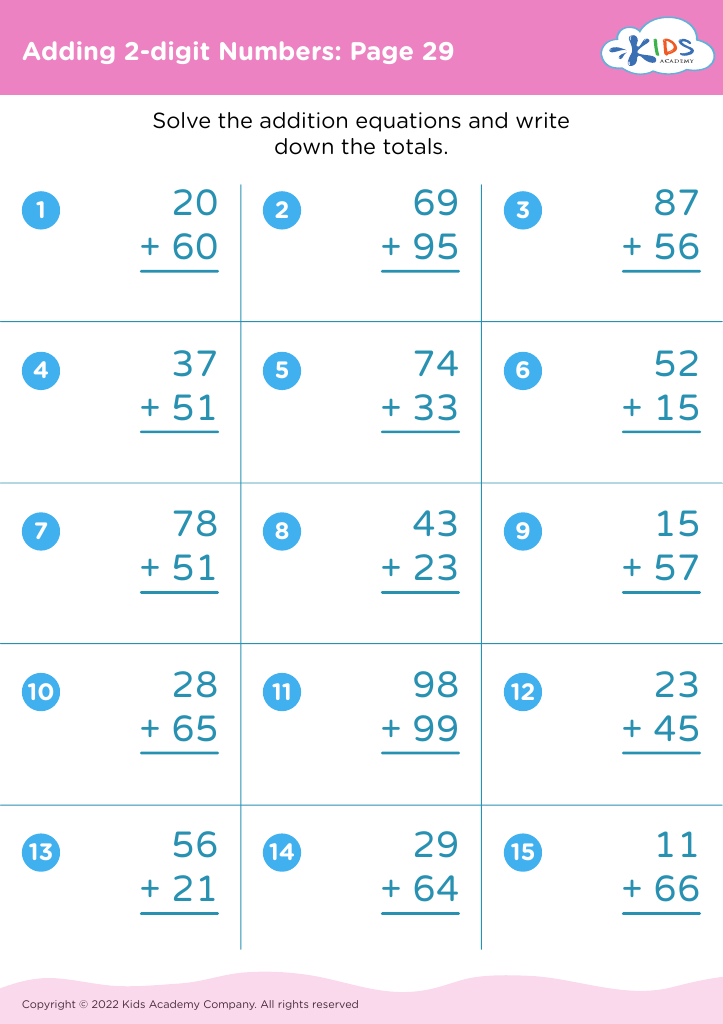
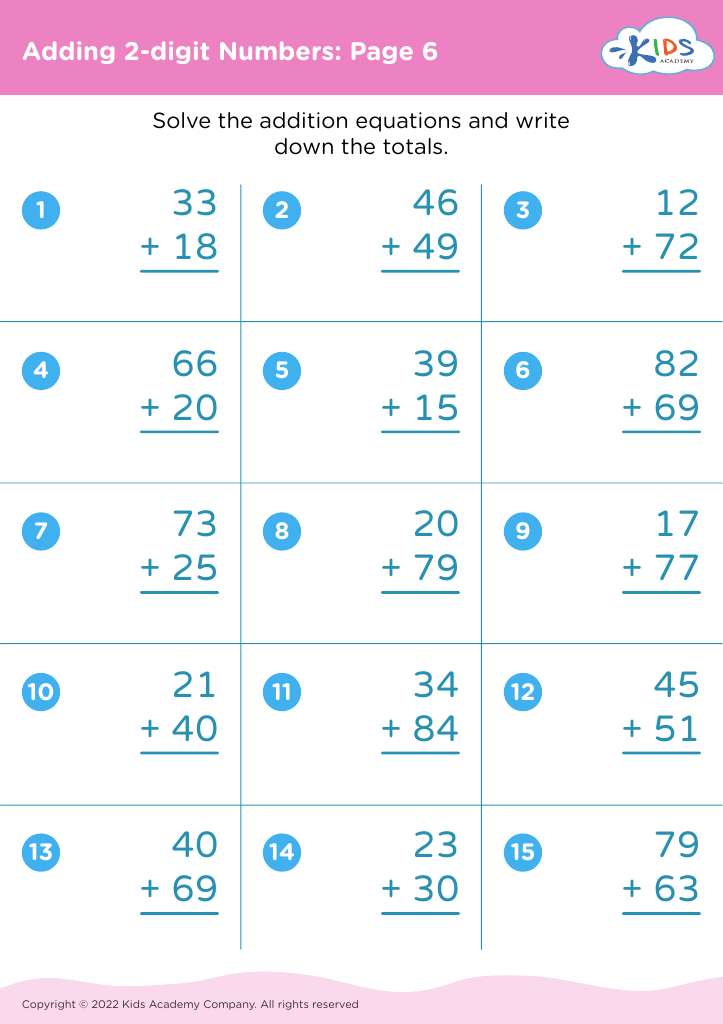








Parents and teachers should prioritize developing critical thinking in 7-year-olds, especially when it comes to adding 2-digit numbers, for several crucial reasons. Firstly, critical thinking fosters problem-solving skills, allowing children to evaluate different approaches and strategies when tackling mathematical problems. Rather than rote memorization, children learn to understand the concept of numbers, making connections between addition and real-life situations.
Secondly, mastering 2-digit addition with a critical thinking approach helps build a strong foundation for more complex mathematics. As the curriculum advances, children who can think critically are better equipped to handle challenges such as subtraction, multiplication, and even word problems.
Moreover, critical thinking nurtures confidence and independence in learners. When children engage in activities that require logical reasoning and evaluation, they develop a sense of ownership over their learning process. This can lead to a positive attitude towards mathematics, reducing anxiety and enhancing motivation.
Finally, parents and teachers who emphasize critical thinking in math encourage a love for learning, not just in mathematics but across all subjects. Empowering children to think critically equips them not only for academic success but for future problem-solving in everyday life, fostering adaptable, lifelong learners.








