
Counting practice Coins Worksheets for 7-Year-Olds
5 filtered results
Difficulty Level
Grade
Age
-
From - To
Subject
Activity
Standards
Dive into our engaging collection of Counting Practice Coins Worksheets for 7-Year-Olds! Specially designed for first and second graders, these fun and interactive worksheets help children effortlessly master the skill of counting coins. By featuring vivid illustrations and real-world scenarios, our worksheets enhance both mathematical and critical thinking abilities. Perfect for developing a solid foundation in basic math, each worksheet allows young learners to practice identifying different coins and sums. These resources provide a great way for kids to boost their confidence and enthusiasm in handling money through hands-on learning. Grab yours today to turn counting coins into an enjoyable experience!
Favorites
With answer key
Interactive
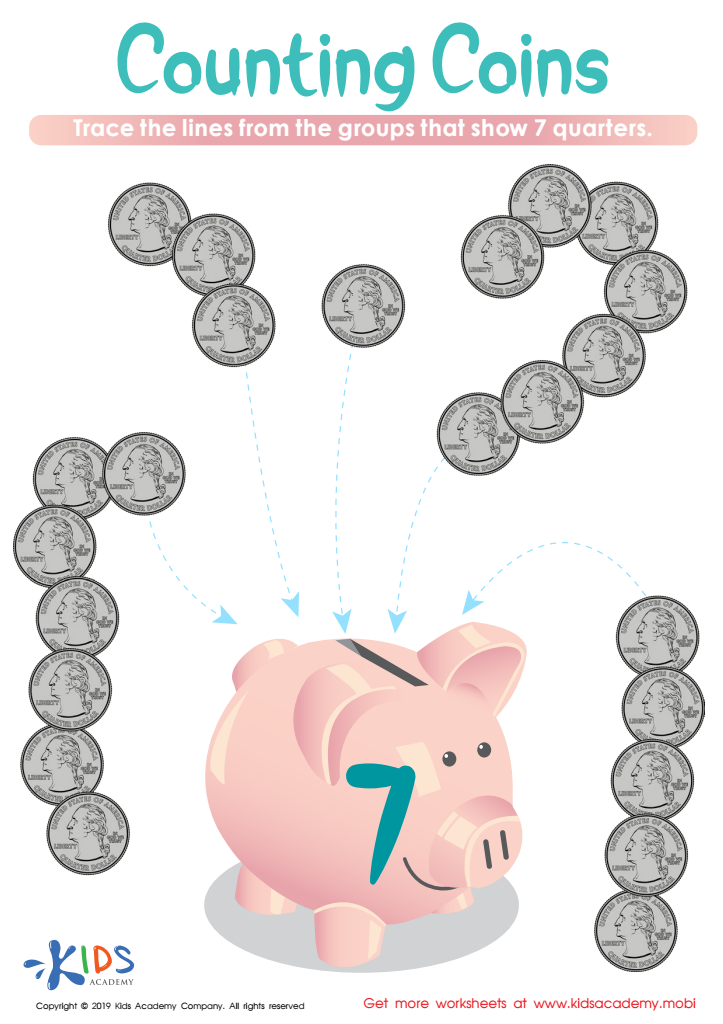
Counting Coins Worksheet
Help your students overcome their fear or aversion of counting and learning numbers with this fun worksheet! It features colorful pictures with four groups of coins. Ask the students to count each group, then trace the lines to the piggy bank. Show them it's easy to count and learn numbers!
 Assign to My Students
Counting Coins Worksheet
Worksheet
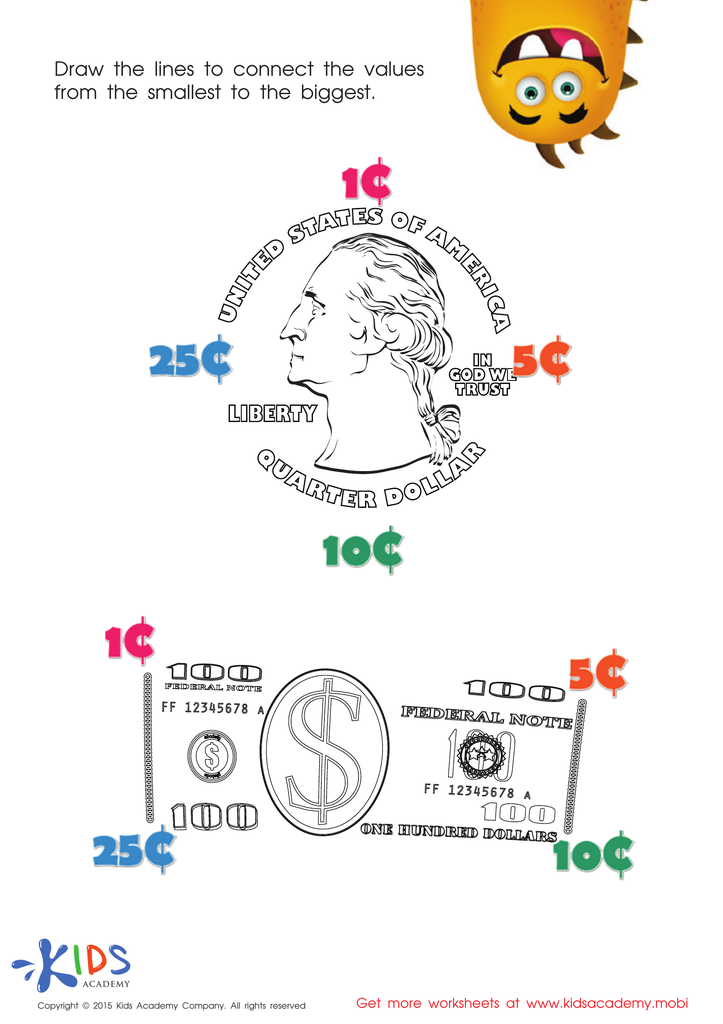
Connecting the Values Money Worksheet
Counting games are a fun way to teach kids about money and counting money. We've learnt the penny, nickel, dime and quarter - can you identify them from the pictures? Draw a line from the smallest to the biggest value and remember the order. Kids Academy has more fun and informative worksheets on counting money.
Connecting the Values Money Worksheet
Worksheet
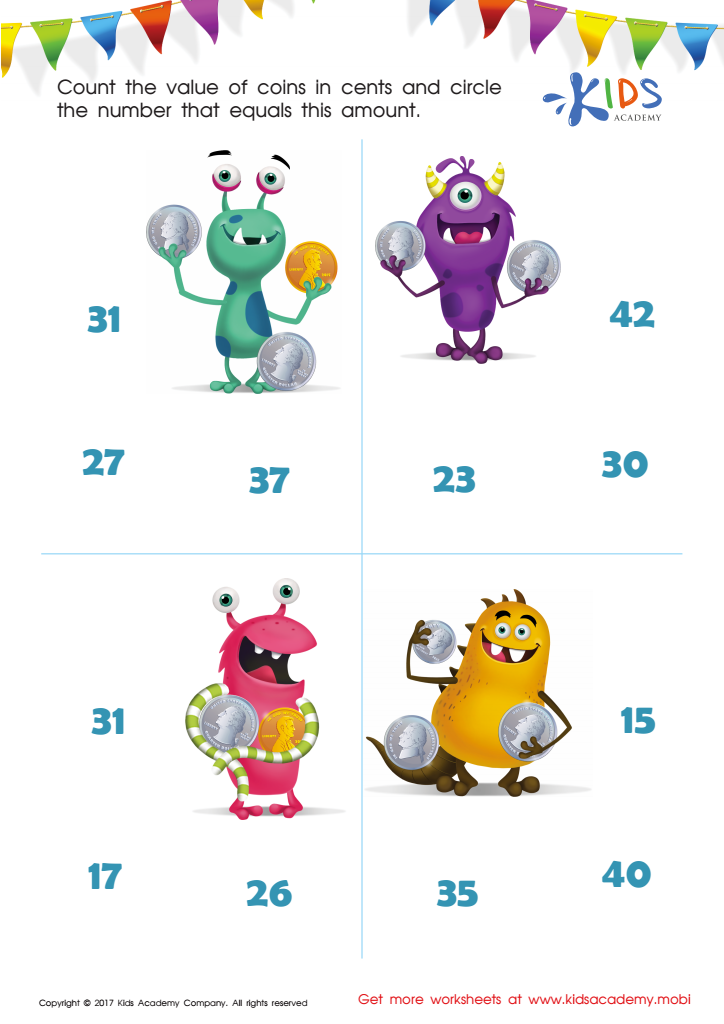
How Many Coins Money Worksheet
Have fun while counting coins: look at the monsters and count the coins in their hands. Challenge your little learners to count and write down the number of coins each one has. Enjoy the time together!
How Many Coins Money Worksheet
Worksheet
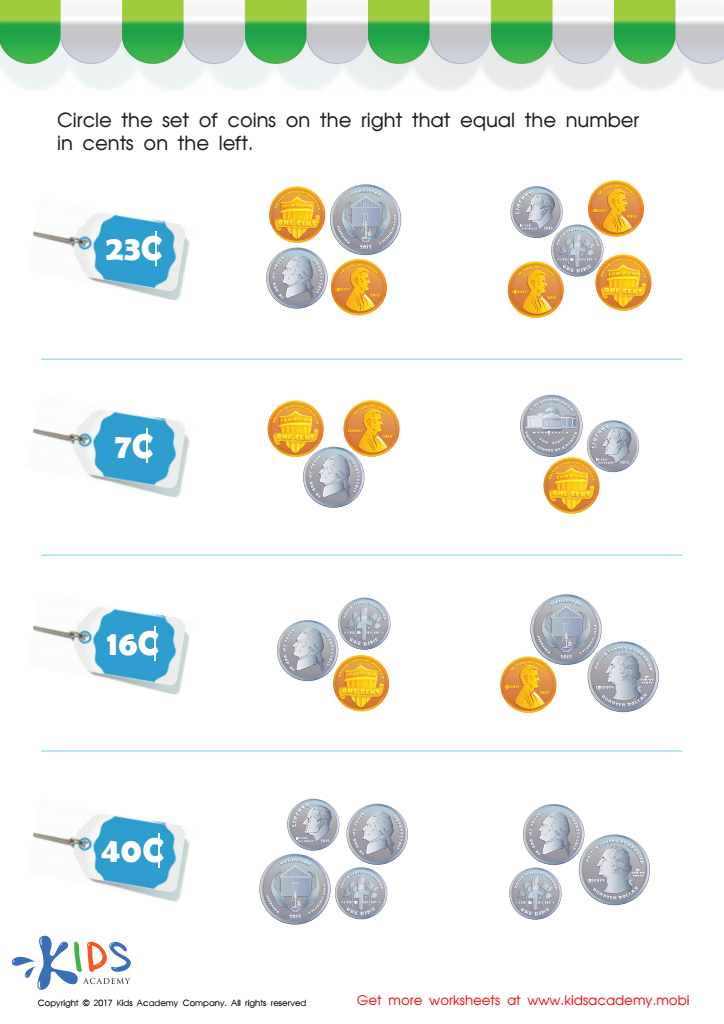
Picking the Coins You Need Money Worksheet
Let's learn to count money with Parents and Kids Academy! Investigate a real shop together: buy a globe, pencils, books, and a school bag using coins. Then, circle the coins you'll need. Visit our website for more free and fun money games for kids!
Picking the Coins You Need Money Worksheet
Worksheet
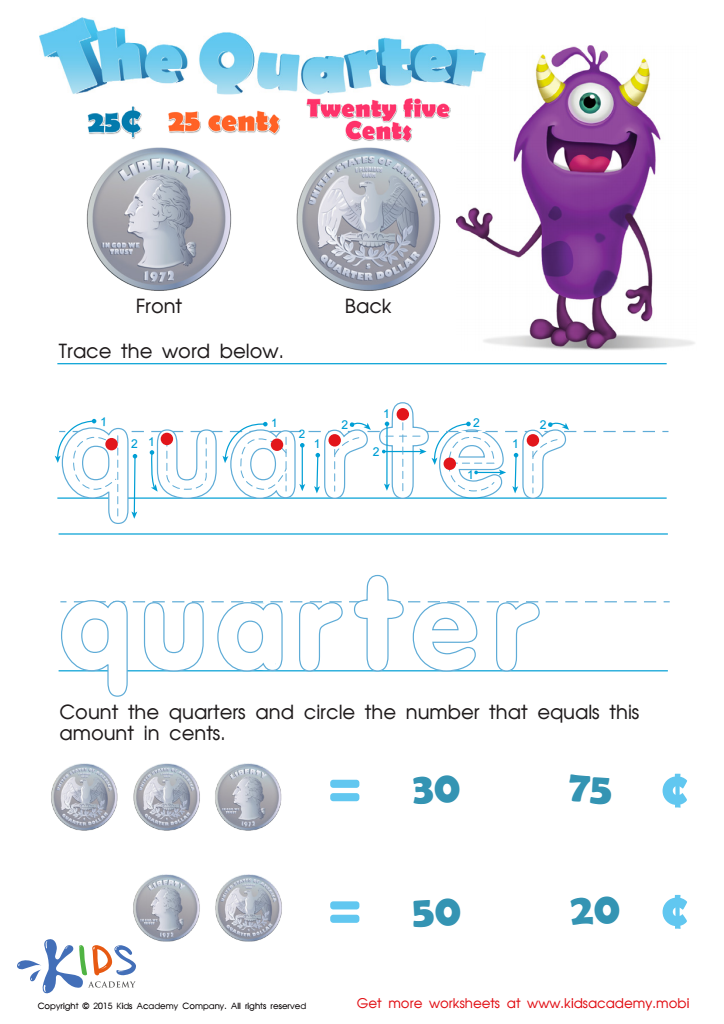
Twenty Five Cents or the Quarter Money Worksheet
Check out our new printable money games - learn to count money easily! With quarters, trace the word, count them and calculate the amount in cents. More worksheets at our website. Give it a try!
Twenty Five Cents or the Quarter Money Worksheet
Worksheet
Join Kids Academy for Free
Who is primarily going to use this learning content?








Counting practice with coins is a crucial exercise for 7-year-olds because it integrates several important educational objectives. Firstly, handling coins helps children understand the value and use of money, an essential life skill. When children count coins and learn their values, they begin to grasp basic arithmetic operations like addition and subtraction in a tangible way.
Secondly, counting coin practice enhances fine motor skills. Picking up and manipulating small coins can significantly improve hand-eye coordination and dexterity. This form of physical interaction with learning materials often leads to better retention and understanding.
Additionally, using coins in counting exercises introduces practical applications of math concepts. It moves arithmetic out of the abstract and roots it in real-world scenarios that children will encounter daily, such as buying small items or saving their allowance. This context-building fosters a sense of relevance and purpose in their studies, increasing engagement and enthusiasm.
Furthermore, for enhancing problem-solving skills, activities involving making change encourage children to think critically and strategize. Such skills are vital across all disciplines, not just mathematics. Therefore, incorporating counting practice with coins is a holistic educational strategy that nurtures numerical proficiency, motor development, and critical thinking. Parents and teachers should invest time in this engaging, enriching practice to develop well-rounded, capable learners.








