Building vocabulary Math Worksheets for 7-Year-Olds
3 filtered results
-
From - To
Welcome to our "Building Vocabulary Math Worksheets for 7-Year-Olds" page, designed to enhance your child's mathematical language and comprehension. Our engaging worksheets introduce essential math vocabulary through fun exercises, promoting confidence in problem-solving and critical thinking. Children will explore key terms while practicing addition, subtraction, shapes, and measurement, all tailored to their age group. By incorporating vocabulary-building activities into math lessons, we aim to foster a love for learning and help young learners make meaningful connections between words and numbers. Discover the joy of learning with our interactive resources that support both academic growth and language development!
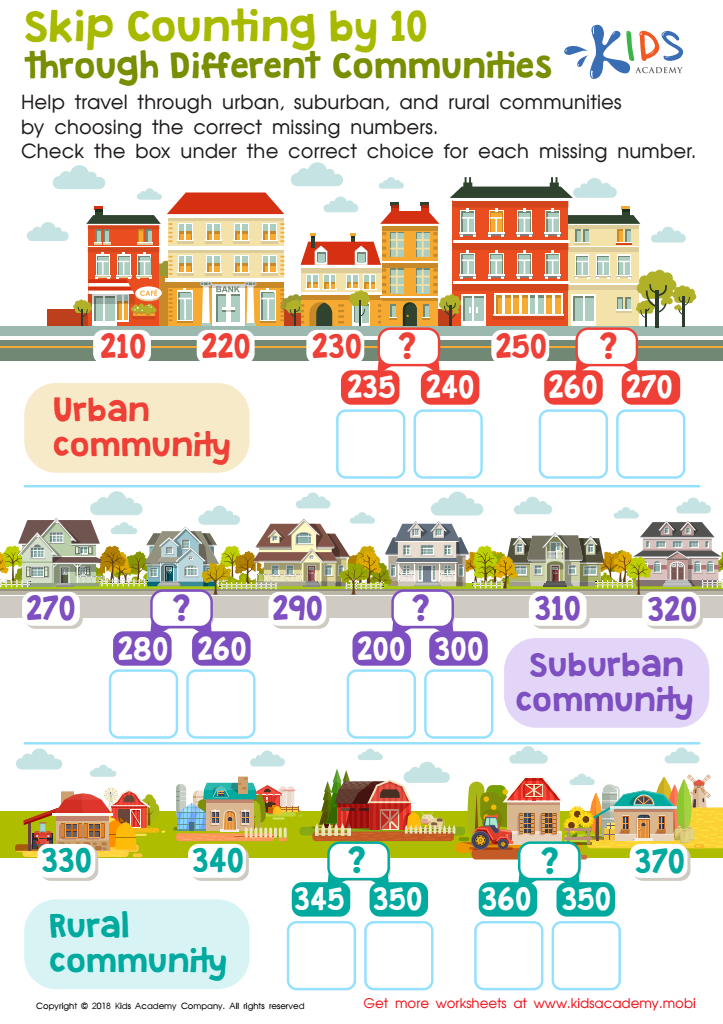
Skip Counting by 10 through Different Communities Worksheet
 Assign to My Students







Building vocabulary in math for 7-year-olds is crucial for their overall academic success and cognitive development. At this age, children are beginning to grasp complex mathematical concepts, and having a strong math vocabulary can significantly enhance their understanding. When children learn specific terms such as “add,” “subtract,” “sum,” and “difference,” they not only comprehend the operations better but also communicate their thoughts and reasoning more effectively.
Parents and teachers should care about this foundational vocabulary because it fosters confidence and encourages a positive attitude towards math. A rich math vocabulary helps children articulate their problem-solving processes, leading to deeper cognitive engagement. Furthermore, strong vocabulary skills can bridge the gap between understanding and application, equipping children to tackle real-world math problems.
Additionally, fostering a math vocabulary opens the door to exploring higher-level concepts in later grades. It can support literacy development as many math terms are also found in other subjects and everyday scenarios, reinforcing the interconnectedness of learning.
By prioritizing vocabulary development in math, parents and teachers play a pivotal role in helping children become proficient communicators and critical thinkers, setting the stage for lifelong learning in mathematics and beyond.








