
Understanding adjectives Math Worksheets for 7-Year-Olds
5 filtered results
Difficulty Level
Grade
Age
-
From - To
Subject
Activity
Standards
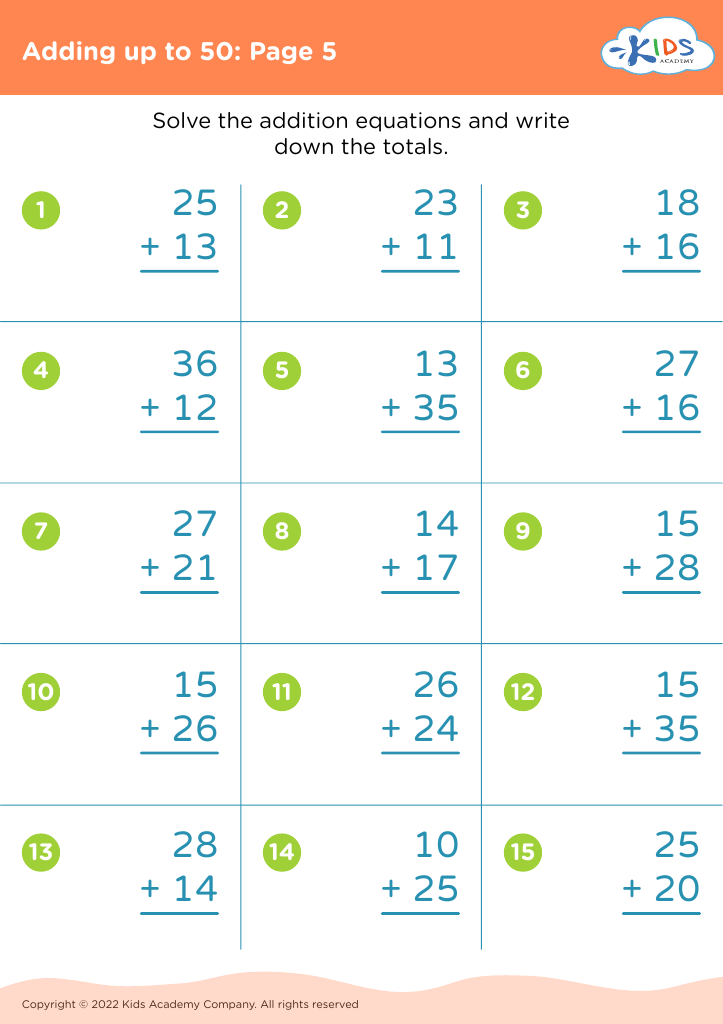
Explore our "Understanding Adjectives Math Worksheets for 7-Year-Olds," designed to blend language and math skills in an engaging way. These worksheets focus on identifying and using adjectives through fun math problems. Kids will enhance their vocabulary while learning to describe quantities, shapes, and sizes. Our resources encourage critical thinking as students interact with visual examples and solve real-world math scenarios. Each activity includes vibrant illustrations to keep young learners motivated and excited. Perfect for home or classroom use, these worksheets make learning both informative and enjoyable. Download them today to boost your child's language and math proficiency!
Favorites
With answer key
Interactive
Join Kids Academy for Free
Who is primarily going to use this learning content?







Understanding adjectives in math may not seem immediately relevant, but it plays a crucial role in developing foundational skills in young learners. For 7-year-olds, math is not just about numbers; it’s also about understanding concepts and the language that describes them. Adjectives help children articulate mathematical ideas, enhancing their communication skills.
When students describe shapes, patterns, or quantities using adjectives like "big," "small," "more," or "less," they deepen their comprehension of these concepts. This ability to use descriptive language helps them create connections between mathematical ideas and the real world, making learning more relatable and engaging.
Moreover, fostering a vocabulary-rich environment encourages critical thinking and problem-solving. A child who can describe a triangle as "equilateral" or a group of blocks as "greater than five" is not only more confident in their understanding but is also better equipped to tackle more complex math problems in the future.
Additionally, when parents and teachers emphasize the importance of language in math, they promote a holistic approach to learning that nurtures all facets of a child's cognitive development. By caring about how children understand and use adjectives in math context, adults are setting the stage for a lifetime love of learning and a solid foundation for future academic success.








