Visual perception development Math Worksheets for 7-Year-Olds
3 filtered results
-
From - To
Enhance your 7-year-old’s math skills with our engaging Visual Perception Development Math Worksheets! Designed to boost essential visual processing abilities, these worksheets use fun and interactive exercises to strengthen your child's cognitive development and math understanding. Through activities like pattern recognition, shape matching, and spatial reasoning, children will improve their focus and proficiency in mathematical concepts. Our curriculum-focused resources are perfect for supplemental learning at home or in the classroom. Watch as your child builds confidence and excitement about math while honing their visual perception skills. Download our worksheets now and support your child's educational journey with engaging and effective activities!
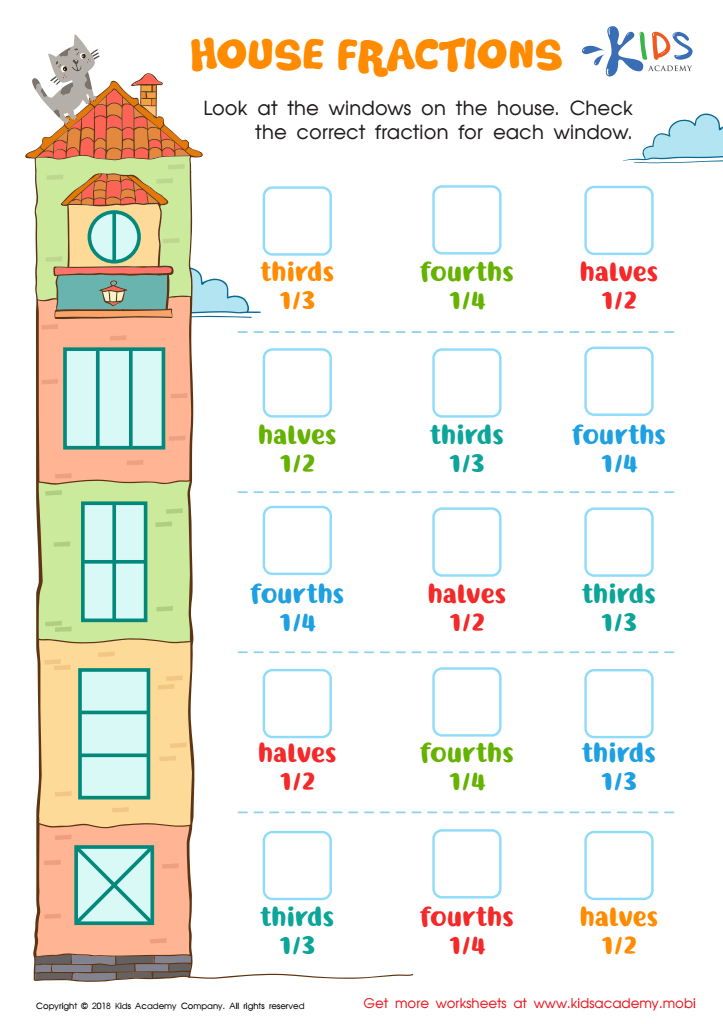
House Fractions Worksheet
 Assign to My Students



%20(1).jpg)




Visual perception development is crucial for 7-year-olds, especially in the realm of mathematics. At this age, children are refining skills that assist in understanding numerical concepts and solving problems. Effective visual perception allows them to interpret shapes, sizes, and spatial relationships—elements inherently tied to math learning, such as geometry and measurement.
When children excel in visual perception, they can efficiently identify patterns, which underpins arithmetic and algebraic reasoning. For instance, recognizing patterns aids in mastering addition and subtraction, while spatial awareness is critical for comprehending fractions and multi-dimensional problems.
Moreover, a strong foundation in visual perception fosters confidence. Children who can easily visualize problems can approach mathematical challenges with a positive mindset. Conversely, difficulties in this area may lead to frustration and aversion to math.
Parents and teachers should prioritize activities that bolster visual perception, such as puzzles, spatial reasoning games, and drawing exercises. Engaging in these activities not only enhances math skills but also supports overall cognitive development. By nurturing visual perception in early grade learners, adults empower children to develop a robust mathematical understanding that will serve them throughout their education and life.








