
Reading analog clocks Time Worksheets for 7-Year-Olds
3 filtered results
Difficulty Level
Grade
Age
-
From - To
Subject
Activity
Standards
Enhance your 7-year-old's time-telling skills with our engaging worksheet collection on reading analog clocks! Specially designed for young learners, these worksheets gradually teach the fundamentals of clock-reading, from recognizing hour and minute hands to understanding the concept of "o'clock," "half past," and more. With fun, colorful illustrations and a variety of exercises, our resources make learning to tell time an enjoyable and educational adventure. Your child will develop confidence and accuracy, turning time-reading into a delightful routine. Explore our printable worksheets today to give your little one a head start in mastering this essential life skill!
Favorites
With answer key
Interactive
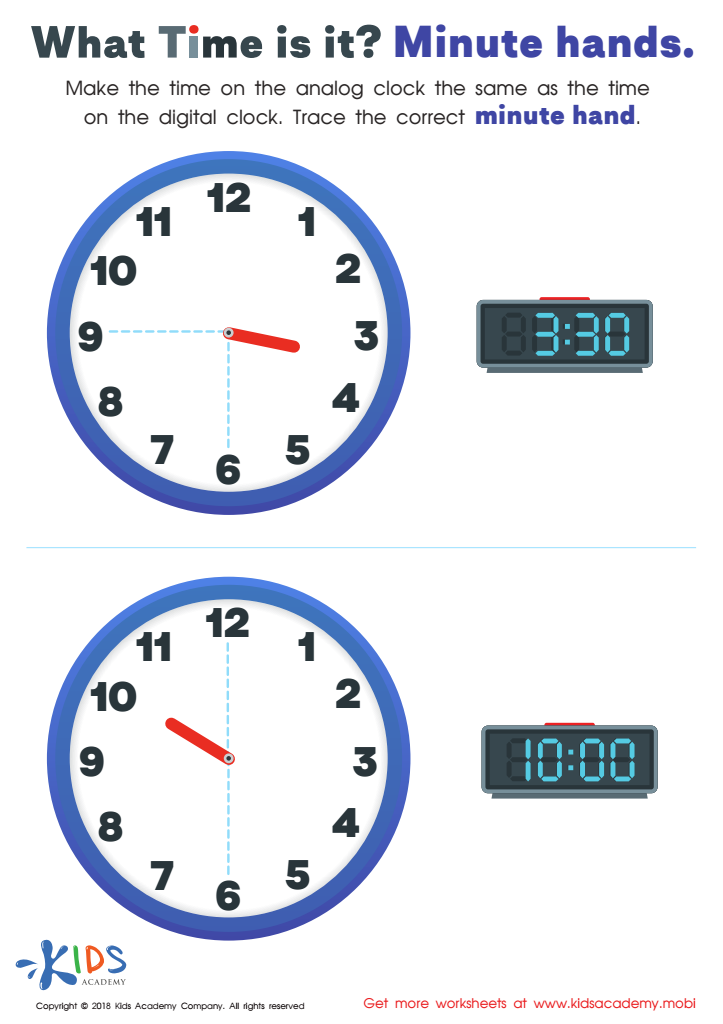
What Time Is it? Minute Hands Worksheet
Help your kids telling time with the minute hand correctly with this tracing sheet. Trace the correct minute hand to make the time on the analog clock the same as the time on the digital clock. Give them a pictured demonstration of how to do it and you'll be all set!
 Assign to My Students
What Time Is it? Minute Hands Worksheet
Worksheet
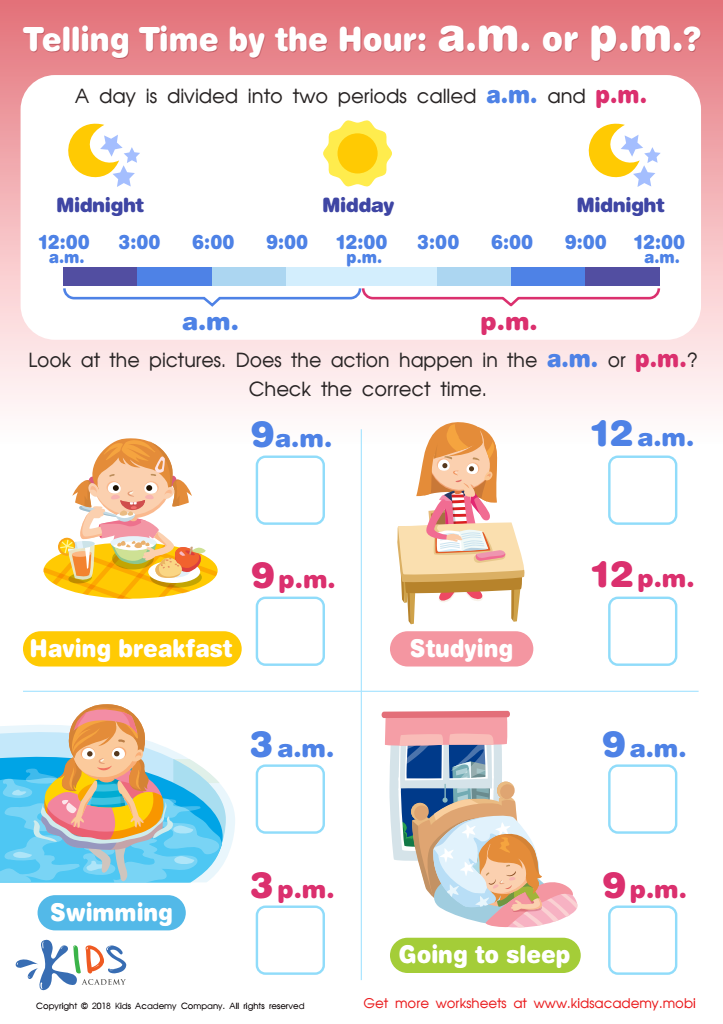
Tilling Time by the Hour: a.m. or p.m.? Worksheet
Can your child tell the time? This worksheet will help them learn. Explain a.m and p.m. and look at the pictures together. Ask your child if the activities happen in the a.m or p.m and help them check the correct time.
Tilling Time by the Hour: a.m. or p.m.? Worksheet
Worksheet
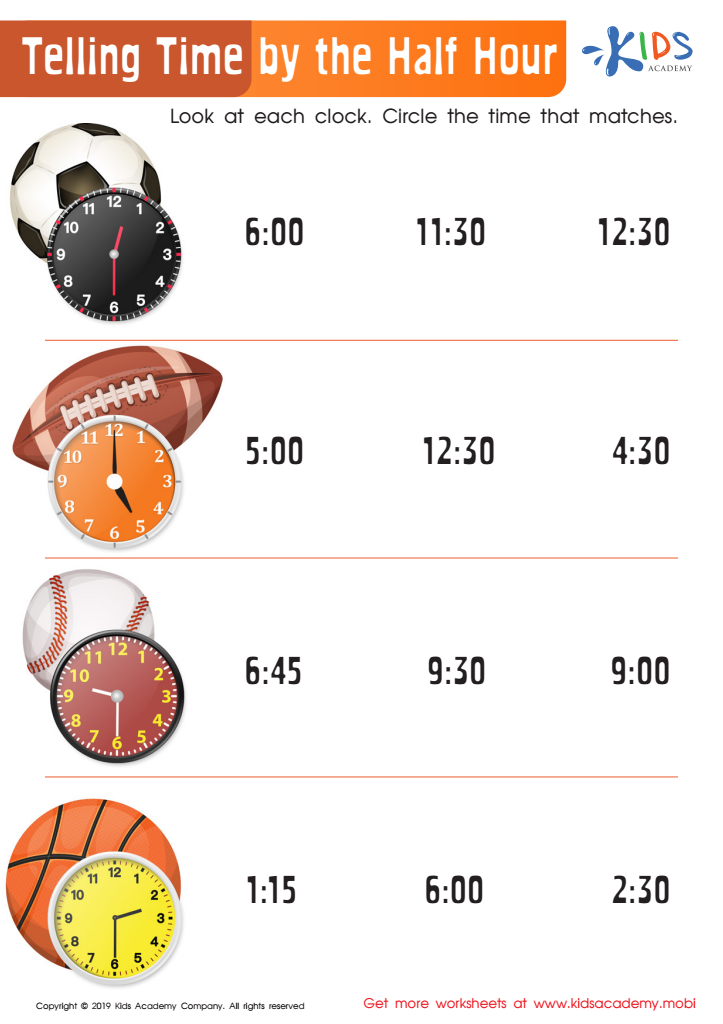
Telling Time by the Half Hour Worksheet
Teach kids to tell time with this worksheet! Four clocks are labeled with different times; help your child circle the right one. It's a great way to teach them to read analog and digital clocks, watches, and written times. Easy and fun learning!
Telling Time by the Half Hour Worksheet
Worksheet
Join Kids Academy for Free
Who is primarily going to use this learning content?







Understanding how to read an analog clock is a crucial skill for 7-year-olds, providing multiple benefits that can significantly support their growth. First, reading an analog clock helps children develop a strong sense of time. This is fundamental for establishing routines, understanding durations, and managing their daily activities. By mastering this skill, children can begin to grasp abstract concepts like the passage of time, which are vital for planning and completing tasks.
Secondly, reading an analog clock enhances mathematical abilities. Children need to understand fractions and counting by fives to read the clock accurately. These skills are foundational in other areas of mathematics, including division and multiplication. It connects practical math with real-life applications, reinforcing their learning and making math more engaging.
Lastly, reading an analog clock aids in cognitive development. It requires kids to engage in problem-solving and pattern recognition, boosting their logical thinking and mental agility. These cognitive benefits translate into better academic performance across various subjects.
Parents and teachers play crucial roles in providing opportunities for children to practice reading analog clocks. Consistent practice at home and at school will not only empower kids with essential life skills but will also provide them with confidence in their abilities as they grow.








