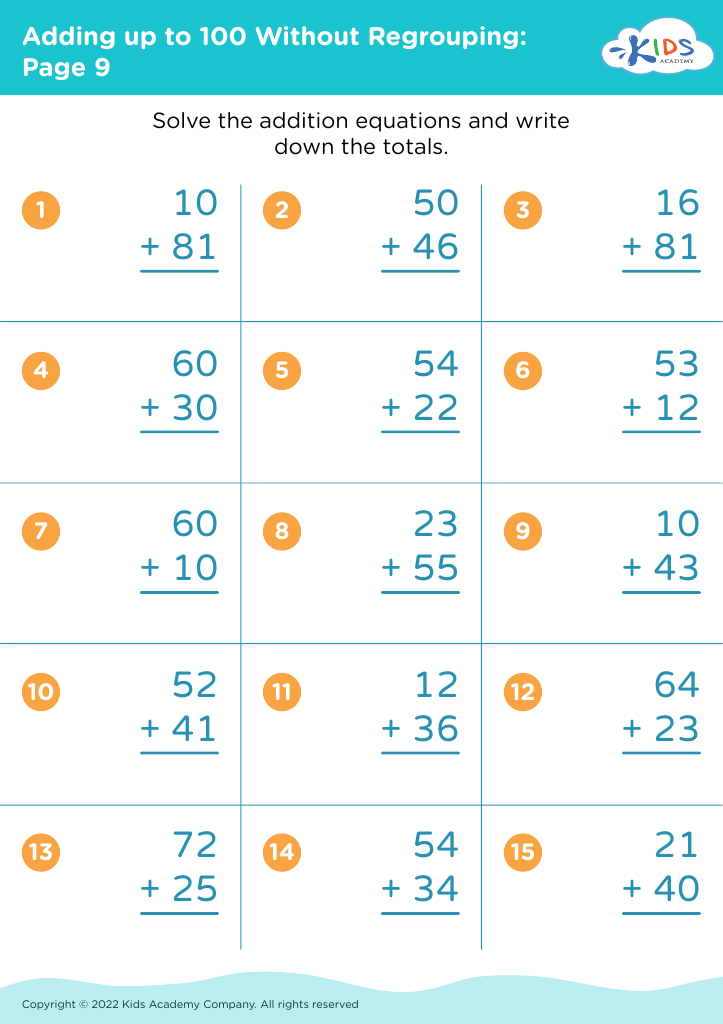
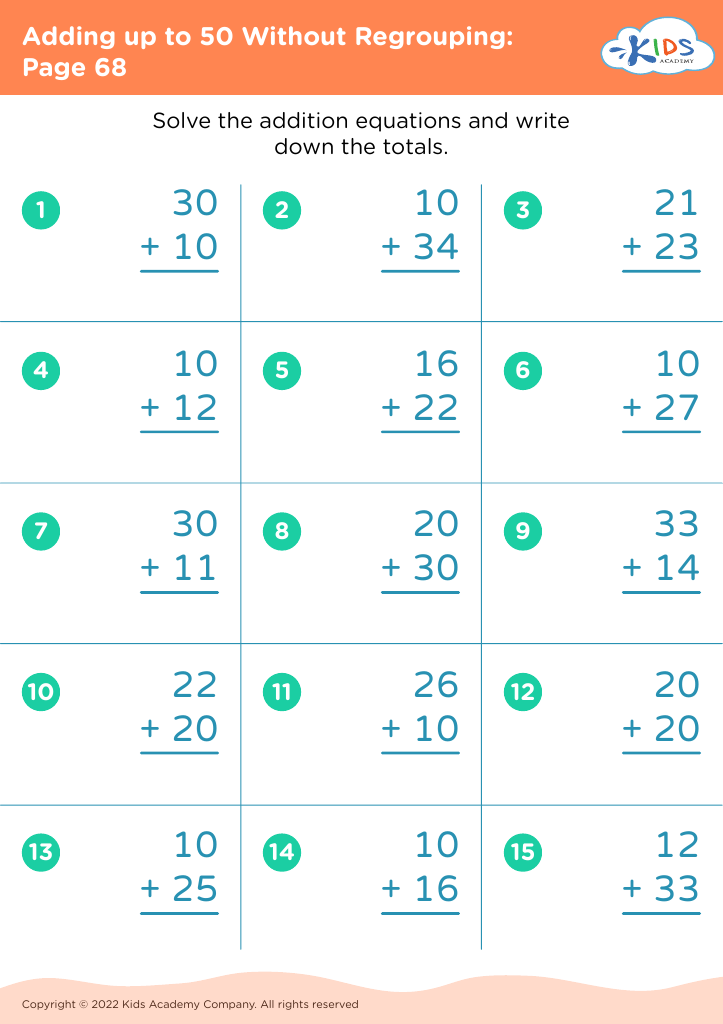








Basic addition skills are foundational to a child's mathematical understanding and overall academic success. For children aged 8-9, mastering these skills is particularly critical, as they are transitioning from concrete to abstract thinking. During this stage, children start to encounter more complex mathematical concepts, such as multiplication, division, and geometry, which build upon their addition skills.
Moreover, strong addition abilities enhance problem-solving skills across various subjects, not just math. They boost confidence in a child’s ability to engage with more challenging tasks and foster a positive attitude towards learning. When children struggle with addition, they may become frustrated and disengaged, risking a decline in their overall interest in school.
Additionally, these skills are daily life competencies. Understanding addition helps kids in practical situations, such as managing money, understanding time, and making calculations in real-world problems. By ensuring that children master basic addition, parents and teachers lay a crucial foundation for lifelong learning and critical thinking. Ultimately, investing in these foundational skills empowers children, giving them the tools they need for future academic challenges and life situations. Educators and caregivers have a responsibility to promote and support the development of these essential skills.








