Comparing weights Worksheets for Ages 8-9
3 filtered results
-
From - To
Discover engaging Comparing Weights Worksheets designed for ages 8-9 at Kids Academy! Perfect for young learners, these worksheets support the development of essential math skills by introducing concepts of weight and measurement. Through fun and interactive activities, children learn to compare and contrast different objects, enhancing their understanding of heavier and lighter weights. These printables provide a clear, visual approach to learning, helping kids build confidence and improve critical thinking. Ideal for classroom use or homeschooling, our worksheets make learning enjoyable. Start exploring and watch your child excel in math!
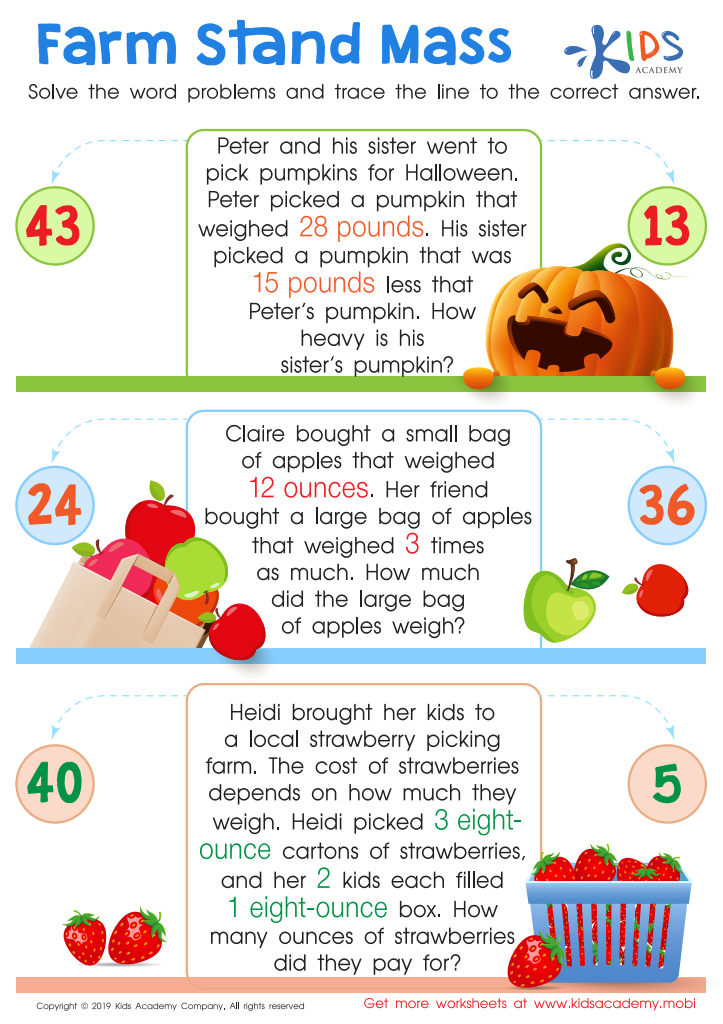
Farm Stand Mass Worksheet
 Assign to My Students
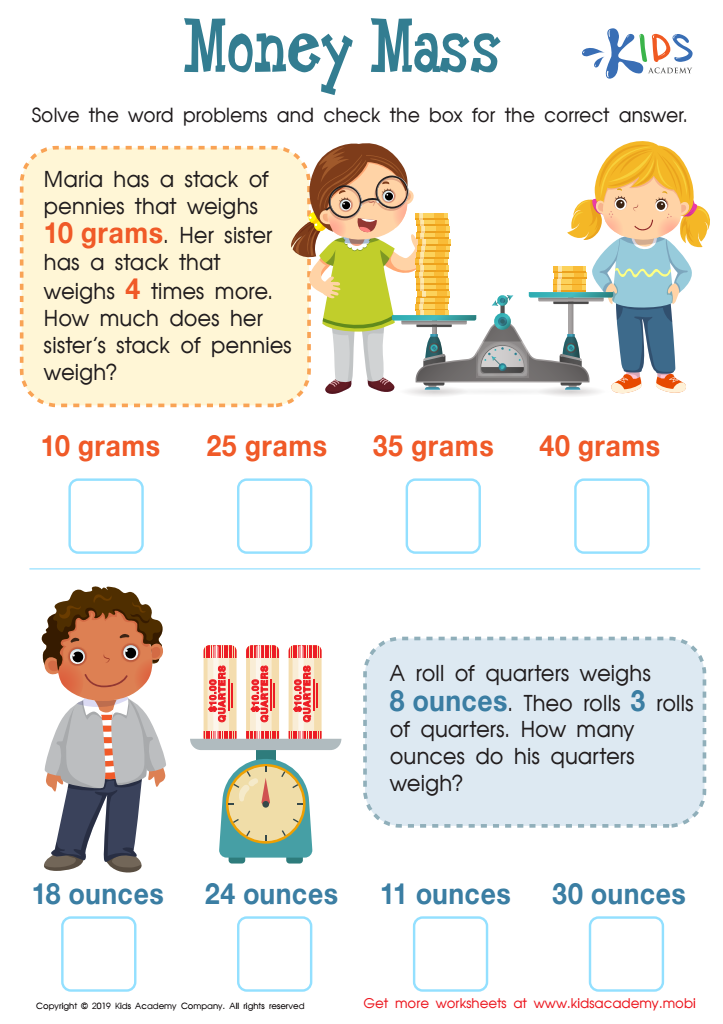
Money Mass Worksheet






Understanding the concept of comparing weights is fundamental for children aged 8-9 because it lays the groundwork for essential mathematical and scientific skills. Recognizing and comparing weights help children develop critical thinking and problem-solving abilities, which are crucial for their cognitive development. By learning to differentiate between heavier and lighter objects, children begin to understand the properties of materials and the practical aspects of physical science.
Additionally, mastering weight comparison aids in mathematical comprehension, particularly in measurement skills. It integrates aspects of addition, subtraction, and basic arithmetic, instilling a deeper understanding of numbers and operations. Teachers and parents should encourage activities involving weights, like using a balance scale or comparing everyday objects, to create meaningful and hands-on learning experiences.
Moreover, these skills are applicable in real-life situations, such as cooking, packing, or even shopping. Children who comprehend weights are better equipped to make informed decisions and develop spatial awareness. Fostering these skills at an early age builds a foundation for advanced mathematical concepts and scientific inquiry, promoting a more intuitive grasp of the world around them. Thus, emphasizing weight comparison in the curriculum and at home contributes significantly to a child's well-rounded development.








