Fraction comparison Worksheets for Ages 8-9 - Page 2
37 filtered results
-
From - To
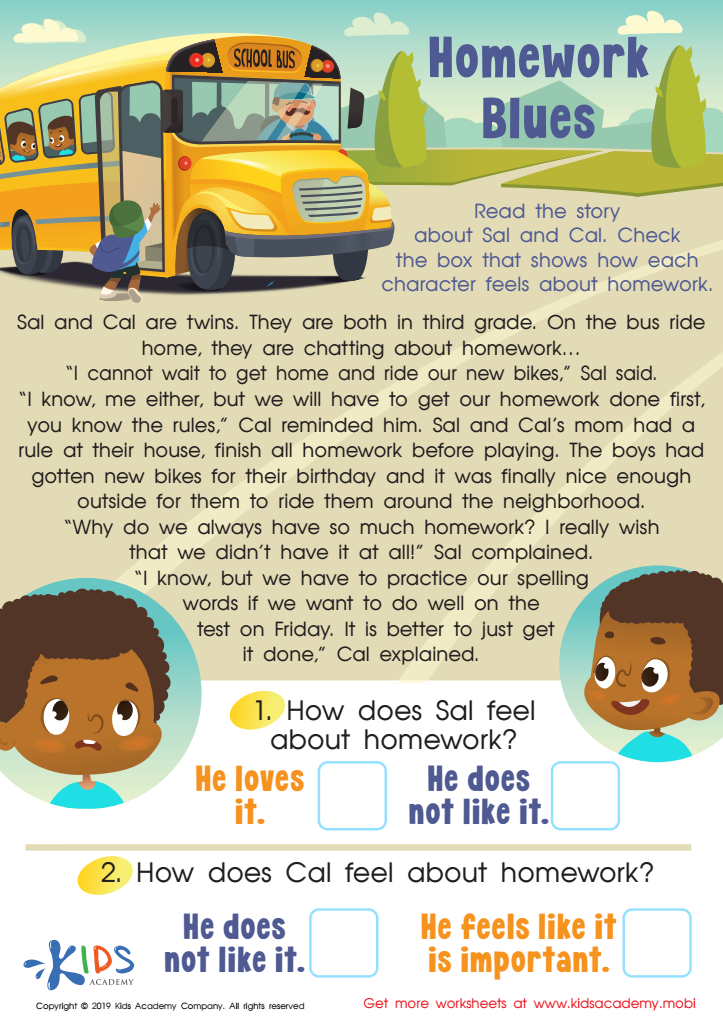
Homework Blues Worksheet
 Assign to My Students






Understanding fraction comparison is crucial for children ages 8-9 because it lays a foundational skill in mathematics that they will use throughout their education and daily lives. At this stage, children begin to encounter more complex mathematical concepts, and mastering fractions allows them to make sense of ratios, proportions, and percentages in future studies.
Learning to compare fractions helps develop critical thinking skills. Children learn to analyze, reason, and articulate their thought processes when determining which fraction is larger or smaller. This skill nurtures their ability to approach problem-solving in a more logical manner.
Additionally, fraction comparison is relevant in real-world situations, such as cooking, budgeting, or filling out graphs, where different quantities need to be assessed against one another. By understanding how to compare fractions, children enhance their mathematical fluency, boosting their confidence in math skills that are often perceived as challenging.
Finally, positive reinforcement and support from parents and teachers can inspire a lifelong appreciation for mathematics. This knowledge not only aids in academic success but also fosters a resilient mindset toward facing future mathematical challenges. In summary, nurturing these skills supports both immediate learning and long-term personal and academic development.








