Fraction identification Worksheets for Ages 8-9
6 filtered results
-
From - To
Discover our engaging Fraction Identification Worksheets for ages 8-9! Designed to make learning fun, these worksheets help young students grasp the concept of fractions through various interactive activities. Each worksheet features vibrant illustrations and practical exercises that promote hands-on learning, enhancing comprehension and retention. Our carefully crafted tasks challenge students to identify, compare, and classify different fractions, fostering critical thinking skills. Ideal for classroom use or at-home practice, these resources are perfect for reinforcing math skills in a delightful way. Start building your child's confidence in fractions today with our user-friendly and effective worksheets tailored for this developmental stage!
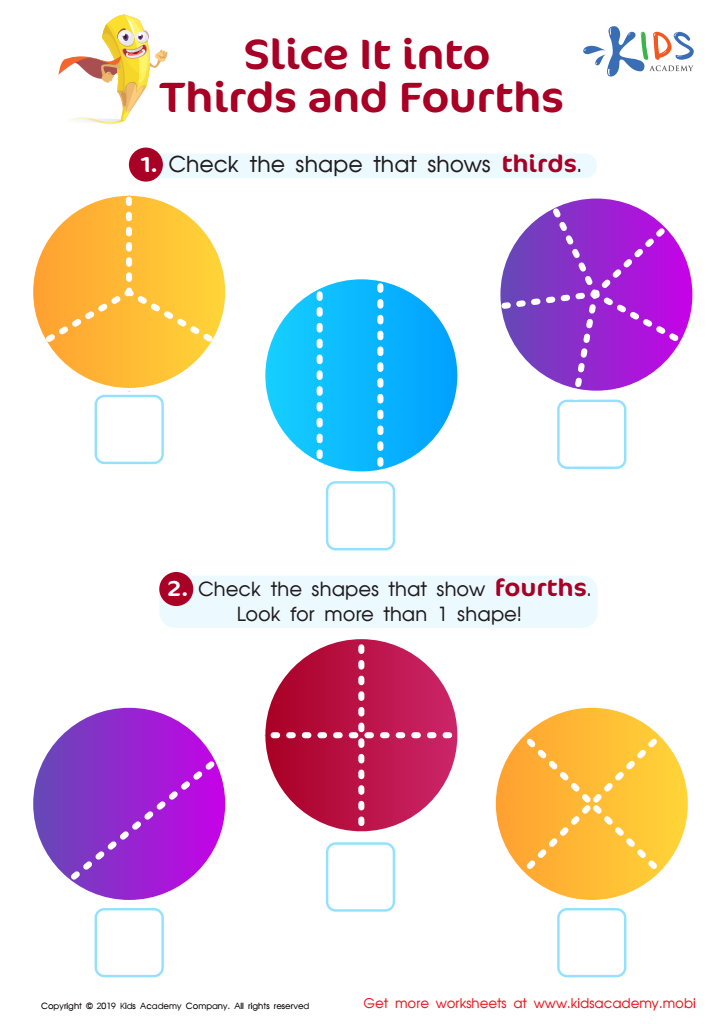
Slice in Thirds Fourths Worksheet
 Assign to My Students








Understanding fraction identification is crucial for children aged 8-9 as it lays the foundation for their mathematical literacy. At this developmental stage, children are transitioning from concrete to more abstract reasoning, making fraction concepts pivotal in enhancing their problem-solving skills.
First, fractions are an essential part of real-world applications—think cooking, budgeting, and sharing. By grasping how to identify and work with fractions, children can better navigate these practical scenarios, promoting independence and confidence.
Second, mastering fraction identification fosters critical thinking. It encourages children to recognize parts of a whole, compare quantities, and understand relationships between numbers. These skills not only apply to mathematics but also support logical reasoning in various subjects.
Additionally, a solid grasp of fractions is essential for future academic success, as they serve as a building block for more advanced topics, including decimals, percentages, and algebra. If children struggle with fractions, they may encounter difficulties in higher-level mathematics, potentially leading to anxiety and disengagement.
Finally, when parents and teachers invest in their children's understanding of fractions, they empower them to participate actively in collaborative learning experiences, paving the way for a lasting love of math and learning in general.








