Fractions understanding Worksheets for Ages 8-9
3 filtered results
-
From - To
Explore our engaging Fractions Understanding Worksheets designed for ages 8-9! These interactive resources provide a fun and effective way for children to grasp essential fraction concepts, including identifying, comparing, and manipulating fractions. With a variety of activities, including visual aids and real-life examples, our worksheets cater to diverse learning styles and help strengthen math skills. Perfect for at-home learning or classroom use, these worksheets aim to build confidence and gradually develop students’ understanding of fractions through practice and repetition. Equip your young learners with the tools they need to thrive in math and deepen their comprehension of this foundational topic!
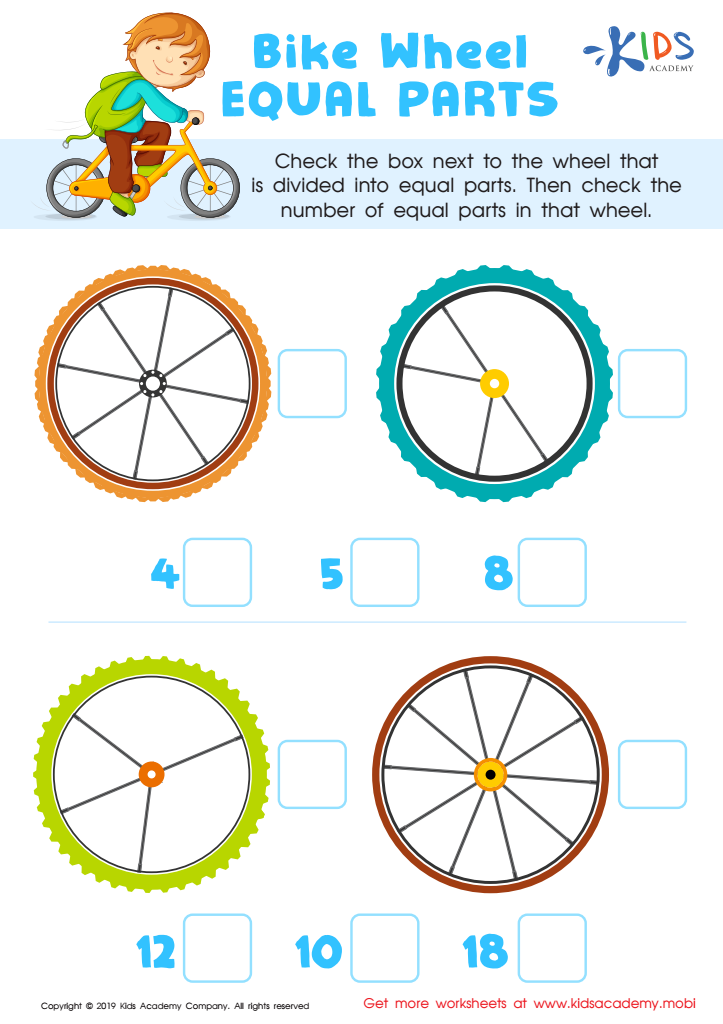
Bike Wheel Equal Parts Worksheet
 Assign to My Students
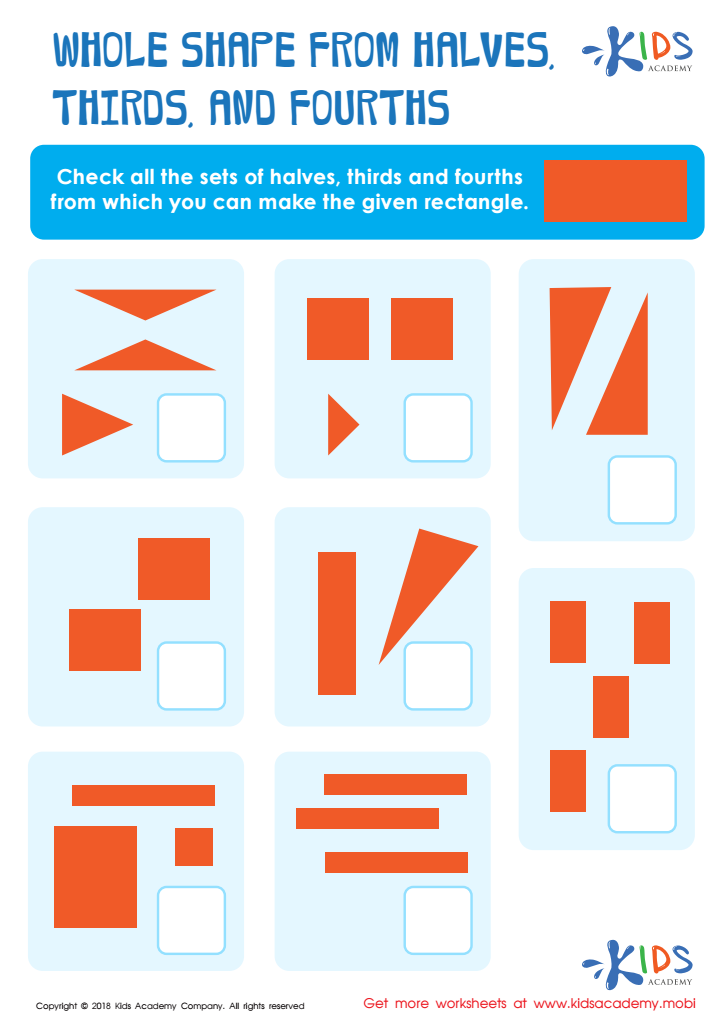
Whole Shape from Halves, Thirds and Fourths Worksheet






Understanding fractions is crucial for children aged 8-9, as it forms the foundation for many essential mathematical concepts they will encounter later in their education. At this age, children are transitioning from concrete operational stages to more abstract thinking, making it an ideal time to solidify their grasp of fractions.
First, fractions are an integral part of daily life—whether measuring ingredients in cooking, understanding portions in sharing, or interpreting graphs and statistics. A strong understanding of fractions promotes mathematical literacy, enabling children to navigate real-world situations effectively.
Additionally, fractional learning enhances critical cognitive skills. It encourages children to engage in problem-solving, logical reasoning, and the ability to analyze and compare different values. Teachers and parents play a pivotal role in providing engaging activities that explore fractions, helping to demystify the subject and reduce math anxiety.
Moreover, early mastery of fractions sets the stage for algebraic thinking, a key skill in advanced mathematics. Without a solid foundation in fractions, students may struggle with later concepts like ratios, proportions, and percentages. Thus, investing time and resources in developing fraction understanding ensures children are better prepared for future challenges and fosters a positive attitude towards math.








