
Number comparison Worksheets for Ages 8-9
7 filtered results
Difficulty Level
Grade
Age
-
From - To
Subject
Activity
Standards
Discover our "Number Comparison Worksheets" designed specifically for ages 8-9 at Kids Academy! These engaging and educational worksheets help children enhance their math skills by focusing on comparing numbers. Perfectly aligned with school curriculums, our worksheets offer various exercises that make learning fun and effective. Your child will confidently tackle greater than, less than, and equal to concepts through interactive and visually appealing activities. These printable resources are excellent for both classroom and home use. Empower your child’s mathematical journey with our meticulously crafted number comparison worksheets today!
Favorites
With answer key
Interactive
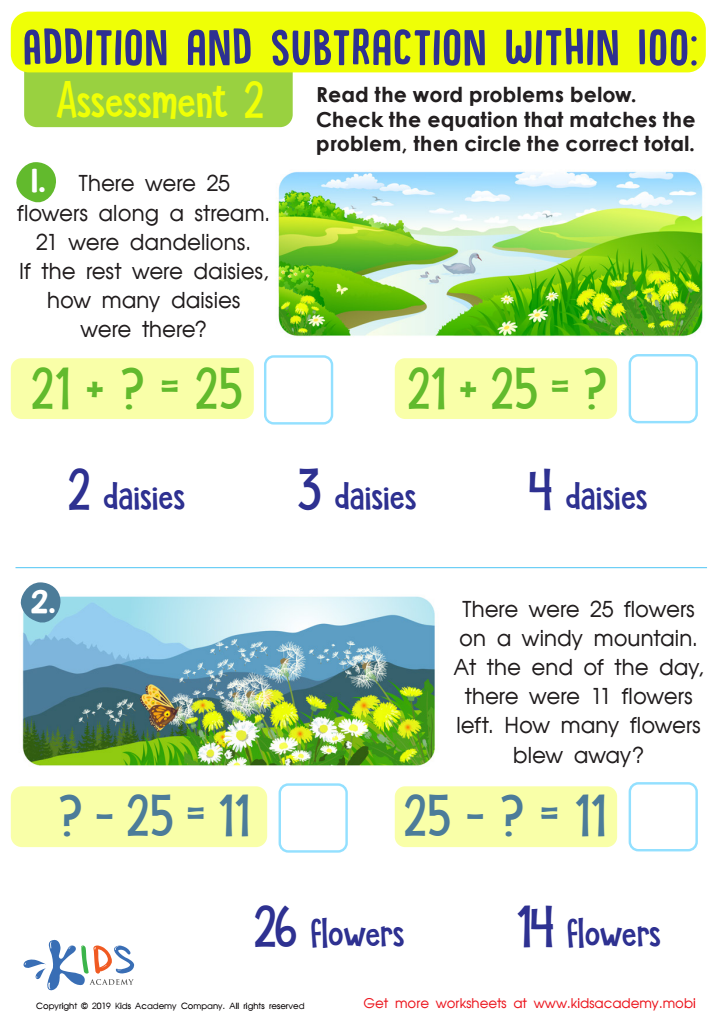
Assessment 2 Math Worksheet
Using fun exercises and pictures, you can get kids excited about math. With practice and reminders of what they've learnt, they'll be solving simple addition and subtraction equations with ease. Read the word problems in the picture to them, then help them check the equation and choose the correct answer.
 Assign to My Students
Assessment 2 Math Worksheet
Worksheet
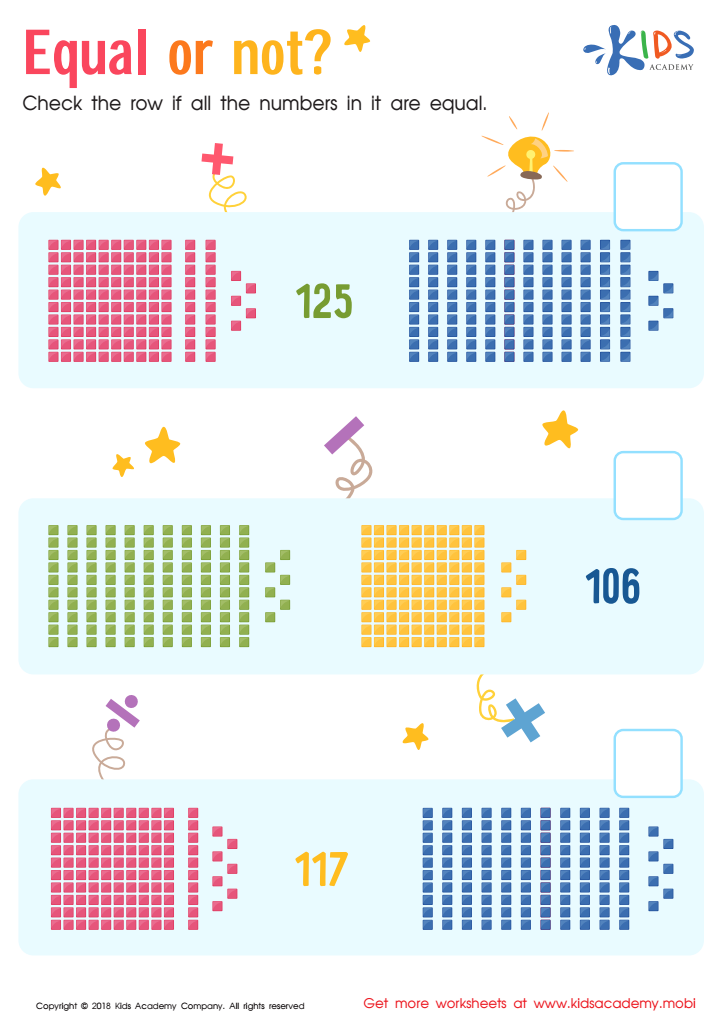
Equal or not Worksheet
To grow your child's learning, challenge them with new tasks. Stimulate their brains with activities that will build their knowledge and thinking skills. Take advantage of this worksheet exercise: ask your child to check the rows where all the numbers are equal. This simple exercise will improve their learning.
Equal or not Worksheet
Worksheet
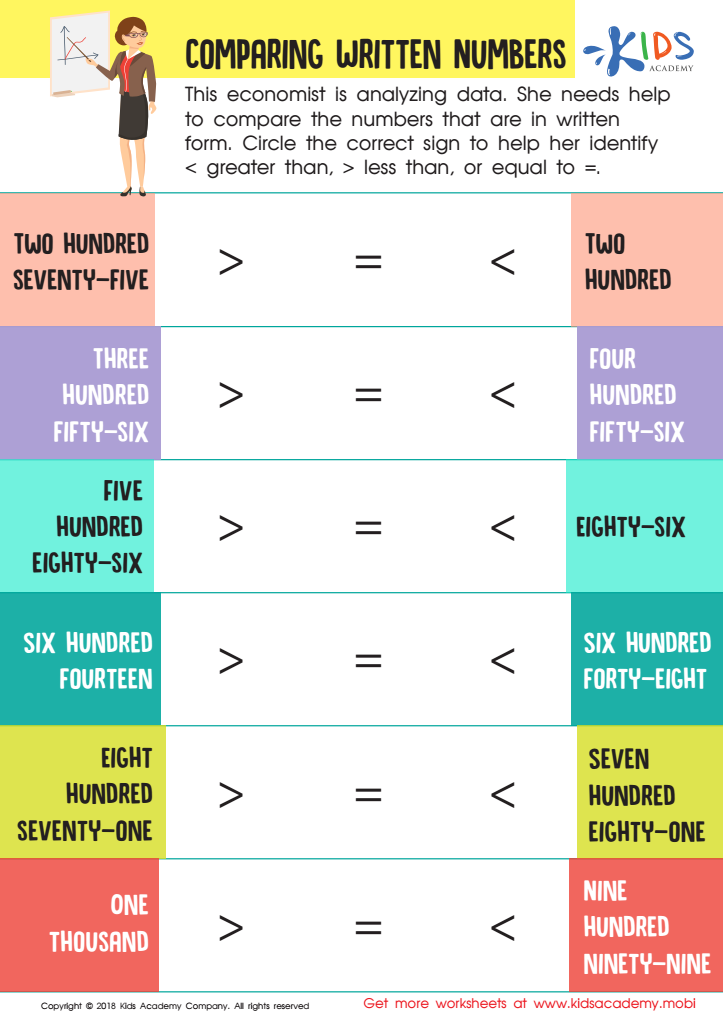
Comparing Written Numbers Worksheet
Children need to grasp that numbers come in different forms. This exciting PDF provides practice for comparing values written as words. Young economists can analyze the number pairs, then circle the sign (<, =, or >) to make comparisons true.
Comparing Written Numbers Worksheet
Worksheet
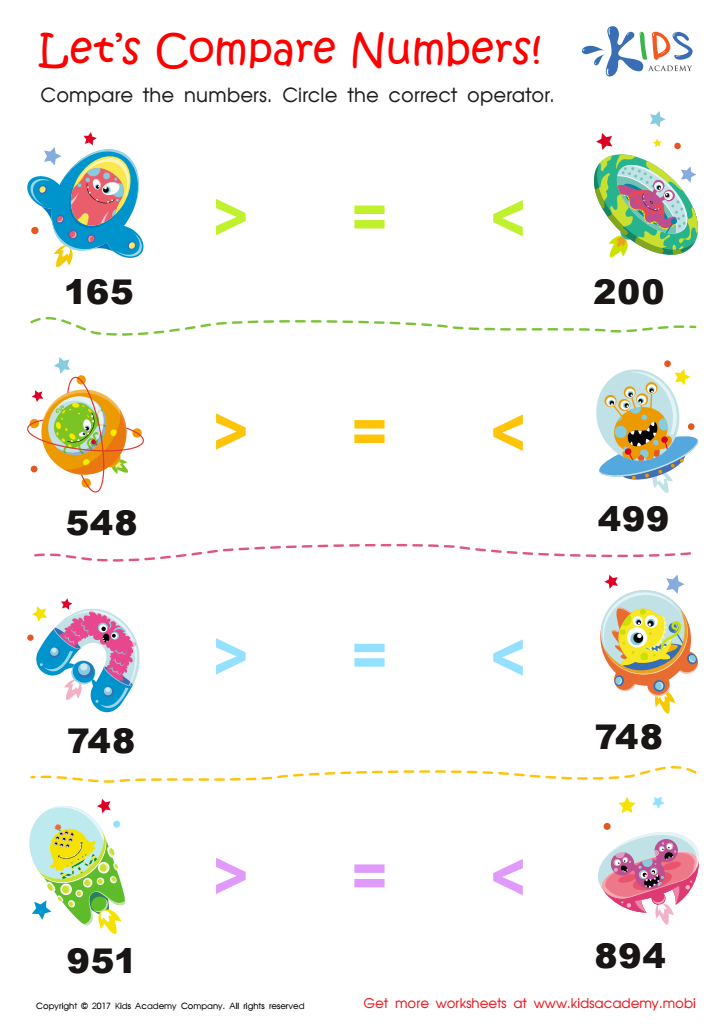
Comparing Numbers Worksheet for 2nd Grade
Alien friends are back to help your child learn to compare numbers using >, < and = symbols. This 2nd grade worksheet will challenge them with larger numbers!
Comparing Numbers Worksheet for 2nd Grade
Worksheet
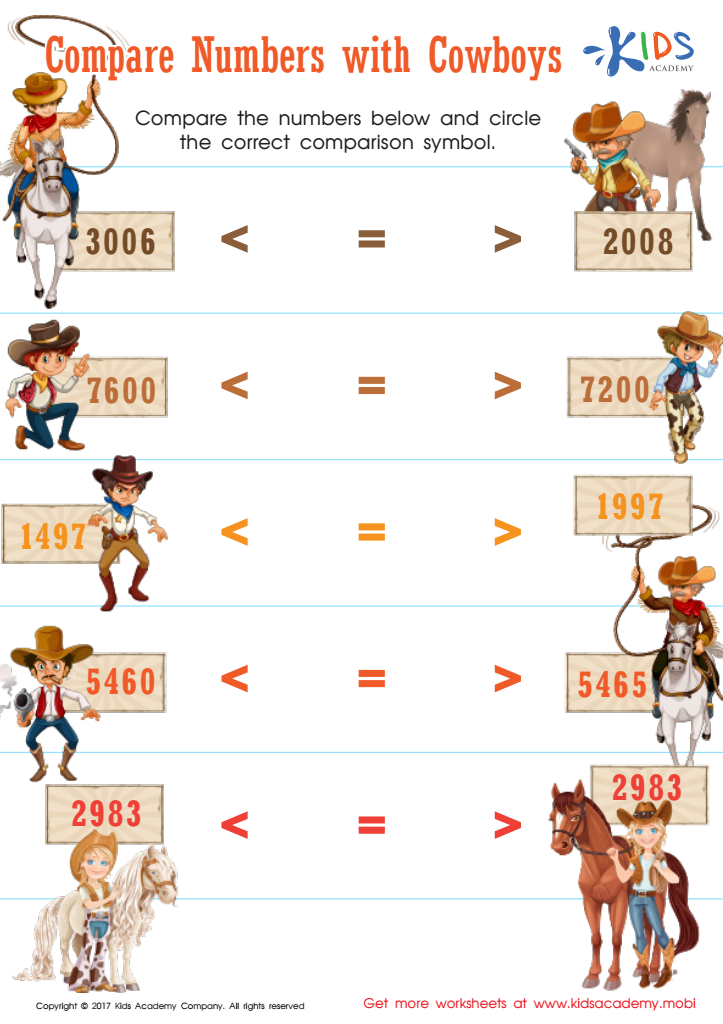
Compare Numbers Worksheet for 3rd Grade
Time to get a roundup on big numbers! Help your 3rd grader practice comparing thousands with this compare numbers worksheet. They'll use >, <, and = symbols for tricky numbers. Jump in and join the cowboys!
Compare Numbers Worksheet for 3rd Grade
Worksheet
Join Kids Academy for Free
Who is primarily going to use this learning content?






.jpg)
Understanding number comparison is foundational for children aged 8-9 because it directly impacts their proficiency in more advanced math skills, like addition, subtraction, multiplication, and division. At this age, children transition from merely recognizing numbers to understanding their relative values, which is critical for performing calculations accurately.
When kids grasp concepts like greater than, less than, and equal to, they build a solid mathematical foundation. This knowledge is not only essential in solving arithmetic problems but also in real-world situations, like measuring ingredients in a recipe or managing their pocket money.
Moreover, strong number comparison skills enhance logical thinking and decision-making. Children learn to analyze numerical information, fostering critical thinking skills. For instance, comparing test scores or game statistics can lead children to make informed assessments about their progress or strategies.
Additionally, early competence in these areas positively affects students' self-confidence and attitudes towards math. By fostering these skills, parents and teachers enable children to tackle math-related challenges with a positive mindset, making future mathematical learning less intimidating and more approachable.
In summary, focusing on number comparison for children aged 8-9 is an investment in their holistic academic development and critical thinking abilities, ultimately setting them up for long-term success in both academics and everyday life.








