
Pattern identification Worksheets for Ages 8-9
3 filtered results
Difficulty Level
Grade
Age
-
From - To
Subject
Activity
Standards
Enhance your child's critical thinking and analytical skills with our engaging Pattern Identification Worksheets designed for ages 8-9! These worksheets provide a fun and interactive way for children to recognize, analyze, and complete various patterns in different formats, including shapes, numbers, and colors. By challenging young minds, these activities promote cognitive development and boost confidence in problem-solving. Suitable for both classroom use and at-home practice, the worksheets feature colorful illustrations and diversity in patterns to keep kids motivated. Visit our website to access these invaluable resources and support your child’s mathematical journey while making learning enjoyable!
Favorites
With answer key
Interactive
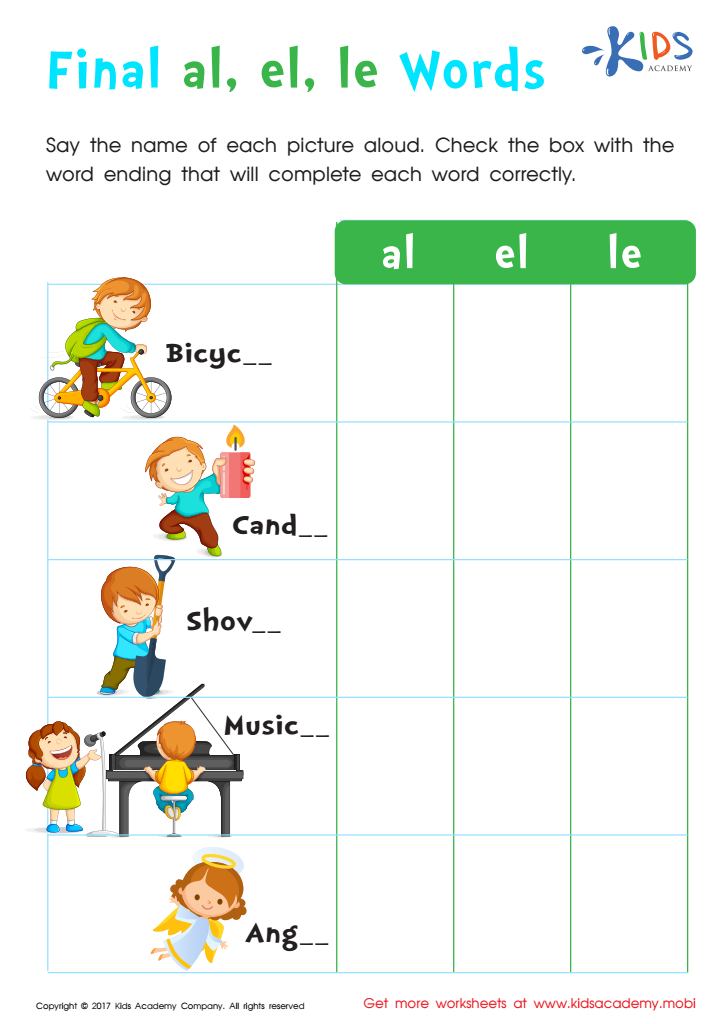
Spelling Words Ending with –le, –el and –al Worksheet
Spelling tricky words with the same ending sounds can be fun with this worksheet! Kids learn to spell -le, -el, and -al words while enjoying colorful pictures. It's a great way to refine their usage of tricky word endings.
 Assign to My Students
Spelling Words Ending with –le, –el and –al Worksheet
Worksheet
Join Kids Academy for Free
Who is primarily going to use this learning content?








Pattern identification is a vital skill for children aged 8-9 that significantly impacts their cognitive development. At this stage, children are transitioning from concrete thinking to more abstract reasoning. Recognizing patterns helps them understand and predict outcomes based on observed regularities, which is foundational in subjects like mathematics and science. For example, recognizing numerical patterns prepares students for multiplication and division and enhances problem-solving skills.
Additionally, pattern identification extends beyond academics; it nurtures critical thinking, creativity, and logical reasoning. When parents or teachers help children identify patterns in their surroundings—such as in art, nature, or daily routines—they foster observational skills and encourage curiosity. This skill also aids in language development as students begin to identify linguistic patterns in storytelling and reading.
Moreover, enhancing pattern recognition can boost confidence. Students who master this skill often excel in standardized tests and discover a passion for subjects that rely heavily on analytical reasoning. Ultimately, by prioritizing pattern identification, parents and teachers equip children with essential tools for lifelong learning, setting the stage for future academic success and personal growth. Recognizing the significance of this skill can make a lasting difference in a child's educational journey.








