
Understanding mass Worksheets for Ages 8-9
3 filtered results
Difficulty Level
Grade
Age
-
From - To
Subject
Activity
Standards
Welcome to our "Understanding Mass Worksheets" designed specifically for children aged 8-9! These engaging and interactive worksheets help young learners grasp the concept of mass through fun exercises and real-life applications. Our materials incorporate a variety of problems, including comparisons of weight, unit conversions, and practical examples that make learning about mass enjoyable. Each worksheet aims to build confidence and mathematical skills in young students, preparing them for more advanced concepts. Ideal for classroom or home use, these worksheets provide a solid foundation in understanding mass, ensuring your child develops essential measuring skills. Download now and inspire learning!
Favorites
With answer key
Interactive
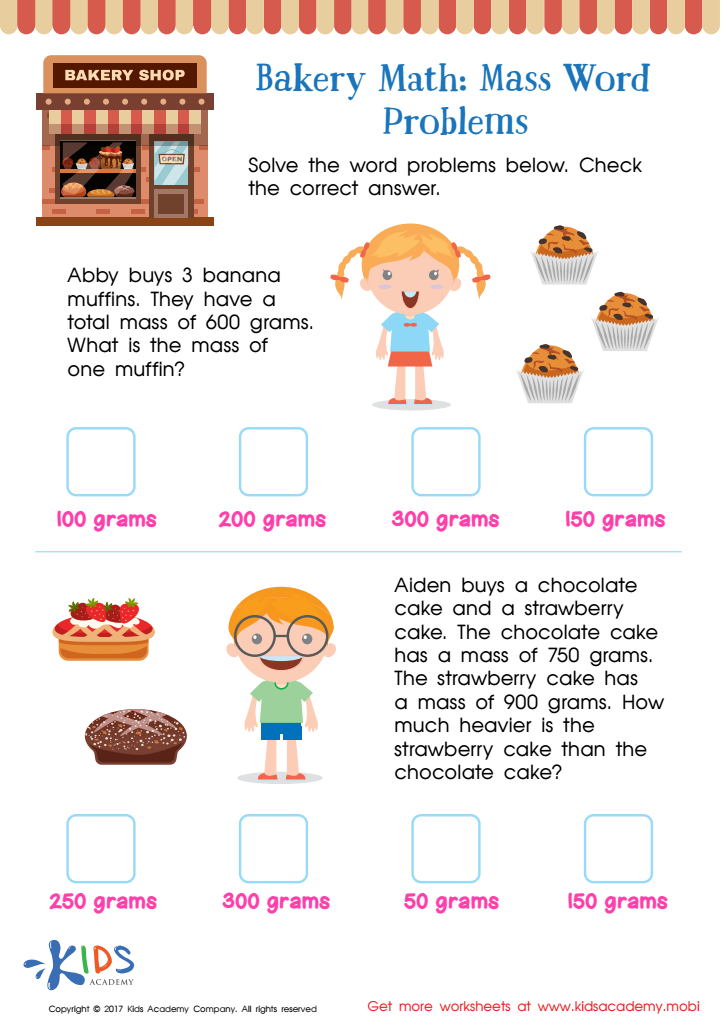
Mass Word Problems Worksheet
This worksheet challenges kids with tricky mass word problems. It offers valuable practice with grams. Through division and subtraction, children gain experience handling mass.
 Assign to My Students
Mass Word Problems Worksheet
Worksheet
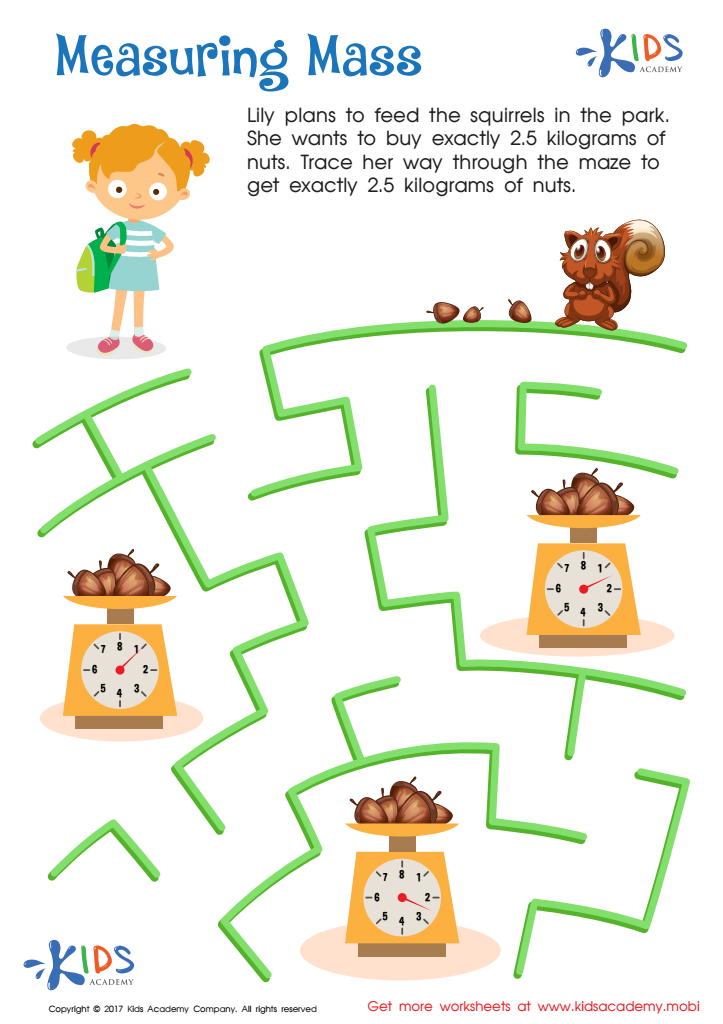
Measuring Mass Worksheet
Lily needs your child's help to find the right number of nuts to feed the squirrels. Ideal for 3rd grade!
Measuring Mass Worksheet
Worksheet
Join Kids Academy for Free
Who is primarily going to use this learning content?








Understanding mass is crucial for children aged 8-9 as it forms the foundation for scientific reasoning and critical thinking. At this age, children are naturally curious about the world around them. Teaching them about mass—essentially the measure of the amount of matter in an object—help them grasp important concepts in physics, chemistry, and even everyday life.
From a practical perspective, grasping mass enables students to comprehend measurements and comparisons. For instance, they learn how to weigh objects when cooking, understand the importance of balances in experiments, and make sense of scales in shopping. This knowledge fosters independence and enhances problem-solving skills.
Moreover, mass-related concepts deepen children’s understanding of physical properties, promoting scientific thinking. As they explore the relationship between mass and gravity, for instance, they’re equipped to draw connections between abstract ideas and the real world.
Engaging in discussions about mass also encourages teamwork and collaboration during laboratory activities. Supporting these learning experiences nurtures their analytical skills, ultimately preparing them for future STEM (Science, Technology, Engineering, and Mathematics) endeavors. For parents and teachers, investing time in teaching mass not only equips children with essential skills but ignites their passion for learning.








