
Understanding number sequences Worksheets for Ages 8-9
4 filtered results
Difficulty Level
Grade
Age
-
From - To
Subject
Activity
Standards
Introduce your child to the exciting world of numbers with our "Understanding Number Sequences Worksheets for Ages 8-9". These expertly designed learning tools help children grasp numeric patterns, enhancing their critical thinking and problem-solving skills. Through engaging activities and fun exercises, kids build a strong foundation in recognizing and predicting number sequences. Perfect for classroom use or at-home practice, these worksheets make math enjoyable and accessible. Support your 8-9 year-old's math journey and watch their confidence grow as they master essential skills, setting the stage for future academic success. Explore and download our collection today!
Favorites
With answer key
Interactive
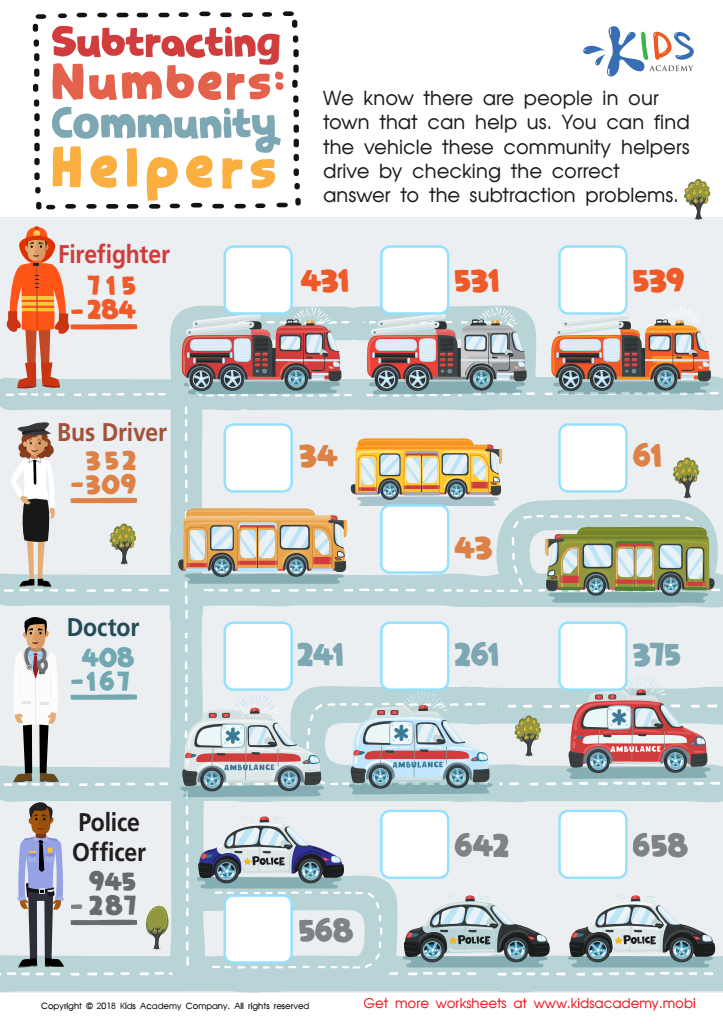
Subtracting Numbers: Community Helpers Worksheet
A community is an area of different people, buildings and other elements. People in a community have varied roles and work together to make it thrive. Ask your child what community helpers they know and how they help. Match the helpers to their vehicles by solving subtraction problems!
 Assign to My Students
Subtracting Numbers: Community Helpers Worksheet
Worksheet
Join Kids Academy for Free
Who is primarily going to use this learning content?








Understanding number sequences is crucial for children aged 8-9 because it significantly impacts their mathematical and cognitive development. At this stage, children are transitioning from simple arithmetic to more complex concepts, and grasping number sequences lays a foundational skill critical for their future math learning.
Number sequences help children recognize patterns, an essential skill in math and science. For example, understanding even and odd numbers, skip counting, or predicting the next number in a sequence enhances their logical thinking and problem-solving abilities. These skills are not only pertinent in math but are transferable across various subjects and everyday situations.
Additionally, familiarity with number sequences bolsters mental arithmetic capabilities. When children practice sequences like 2, 4, 6, 8, they are essentially engaging in repeated addition. This repetition helps in memorization and quicker, more efficient calculations in their heads, which will be beneficial as they advance in their education.
Moreover, mastering number sequences builds confidence in young learners, fostering a positive attitude towards math. Early success in these tasks encourages a sense of achievement, motivating them to tackle more challenging mathematical concepts with enthusiasm.
In essence, focusing on number sequences at ages 8-9 equips children with critical analytical tools, ensuring they are well-prepared for continued academic success.








