
Visual fraction representation Worksheets for Ages 8-9
3 filtered results
Difficulty Level
Grade
Age
-
From - To
Subject
Activity
Standards
Enhance your child’s understanding of fractions with our Visual Fraction Representation Worksheets for Ages 8-9! Designed to make learning fun and engaging, these interactive worksheets feature colorful visuals and creative activities that help kids grasp the concept of fractions intuitively. With games, illustrations, and relatable examples, children will develop essential skills in identifying, comparing, and simplifying fractions. Perfect for classroom use or homework, these worksheets aim to boost confidence and foster a solid mathematical foundation. Help your child flourish in their learning journey about fractions while enjoying a hands-on and visually stimulating experience. Explore our collection and inspire math success today!
Favorites
With answer key
Interactive
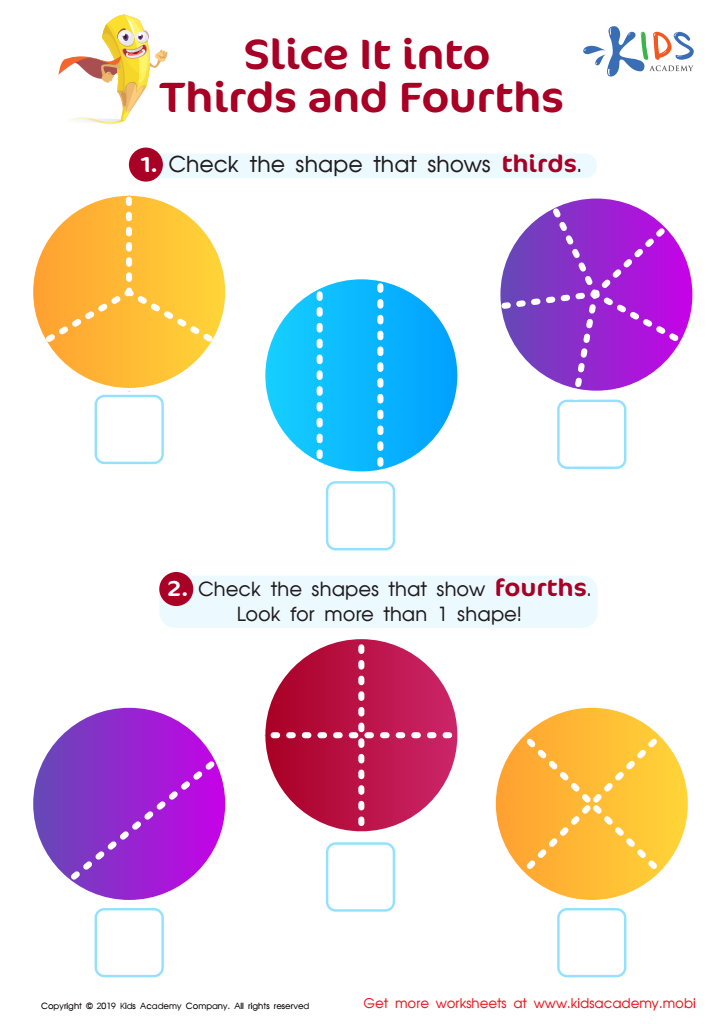
Slice in Thirds Fourths Worksheet
This worksheet helps kids learn fractions visually by dividing circles into thirds and fourths. They will learn that fractions must be equal parts, not just sets, by choosing the right colorful circles. It's an easy way to master fractions and have fun doing it!
 Assign to My Students
Slice in Thirds Fourths Worksheet
Worksheet
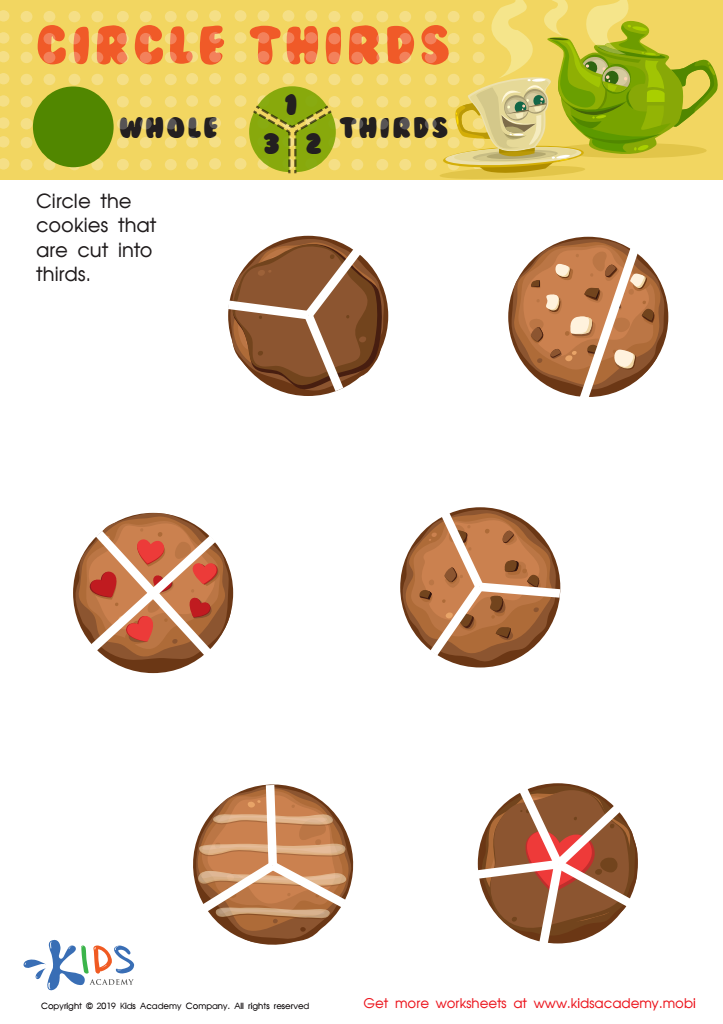
Circle Thirds Worksheet
Remind your kids of the different ways shapes can be divided: wholes, halves, thirds, and fourths. Now, look at the shapes in the worksheet and have them circle the cookies cut into thirds.
Circle Thirds Worksheet
Worksheet
Join Kids Academy for Free
Who is primarily going to use this learning content?







Visual fraction representation is crucial for children aged 8-9 as it lays the foundation for their understanding of fractions, a key concept in mathematics. At this age, children transition from basic arithmetic to more complex reasoning in math, and engaging with visual representations—such as fraction bars, pie charts, or number lines—enhances their conceptual understanding.
These visual tools help students intuitively grasp fractions as parts of a whole. They can visualize the size and relationship between fractions, making comparisons and operations, such as addition and subtraction, more comprehensible. This tangible connection is particularly beneficial, as it demystifies abstract concepts and fosters critical thinking.
Additionally, understanding fractions is not just an academic skill; it's a vital life skill. Everyday activities, like cooking or shopping, often rely on fractions, so having a solid foundation can build confidence and practicality in real-world situations.
For parents and teachers, prioritizing visual fraction representation is essential. It not only supports a child's mathematical journey but also cultivates a positive attitude towards learning. By facilitating this understanding now, they are helping students develop the skills necessary for more advanced math in the future and promoting lifelong learners.








