Recognizing Patterns Adding 2-digit Numbers Worksheets for Ages 8-9
3 filtered results
-
From - To
Enhance your child's math skills with our "Recognizing Patterns Adding 2-digit Numbers" worksheets designed for ages 8-9. These engaging resources help students master the addition of two-digit numbers by identifying patterns in arithmetic operations. Through a variety of fun exercises, children will develop a deeper understanding of number relationships, fostering both confidence and competence in math. Our worksheets promote critical thinking and problem-solving abilities, making learning enjoyable and effective. Perfect for classroom use or at-home practice, these worksheets will provide valuable support in preparing young learners for more advanced mathematical concepts. Start your child's journey to math mastery today!
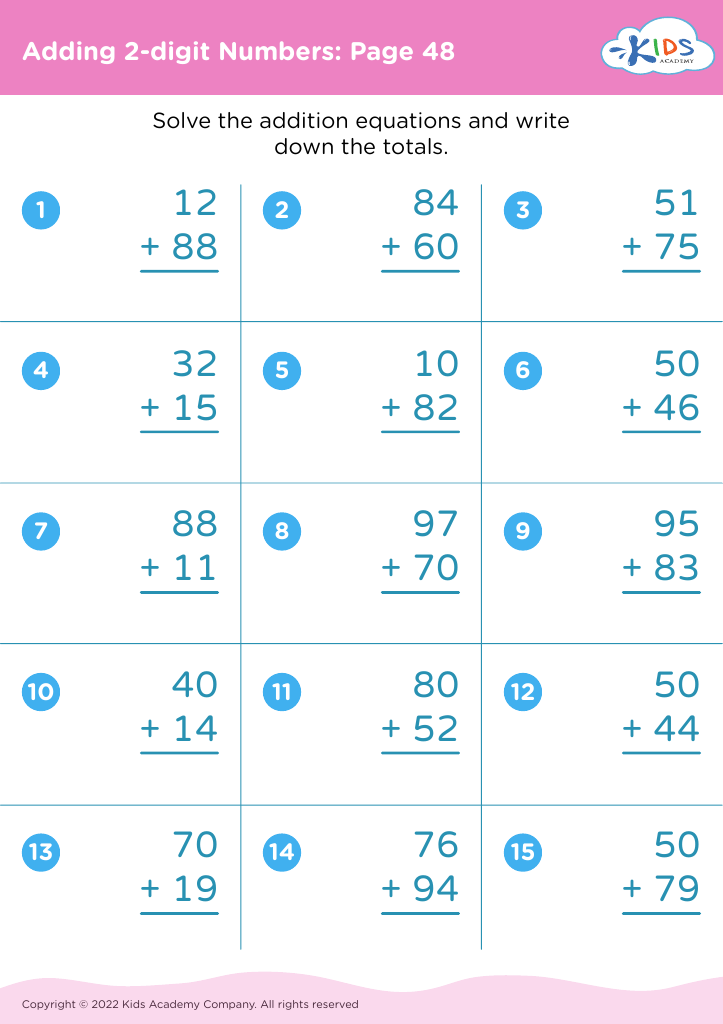
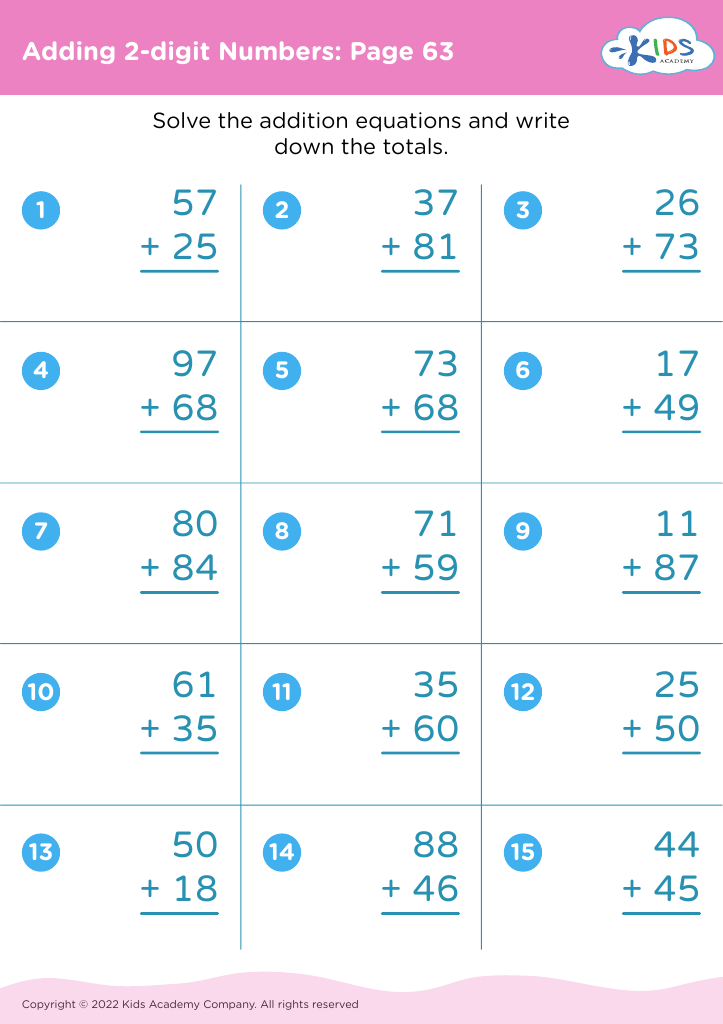
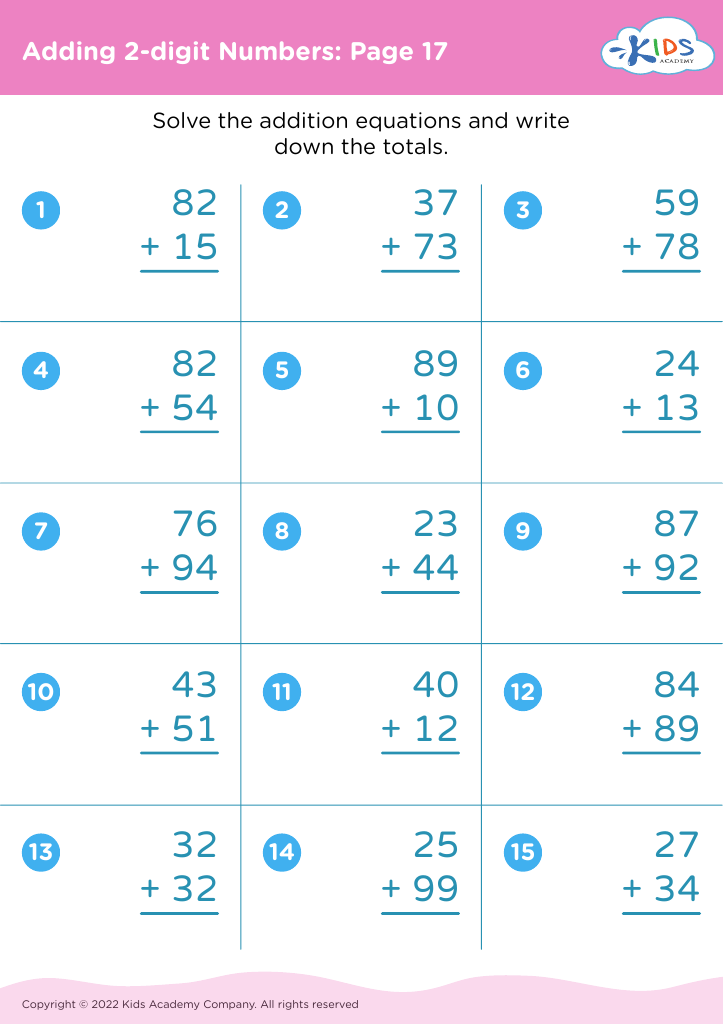








Recognizing patterns in adding 2-digit numbers is a fundamental skill that plays a vital role in developing a child's mathematical understanding. For children aged 8-9, mastering this skill paves the way for more complex mathematical concepts and operations. By recognizing patterns, students can make connections between numbers, which enhances their problem-solving abilities and boosts their confidence in mathematics.
Parents and teachers should care about this skill for several reasons. Firstly, pattern recognition fosters critical thinking; children learn to anticipate outcomes and solve problems more efficiently. This not only benefits their current math abilities but also sets the stage for future learning in algebra and beyond.
Additionally, understanding patterns can help students perform mental math, which is a valuable life skill. When they extract commonalities in numbers (e.g., adding 30 + 29 differently compared to 20 + 21), they improve their speed and accuracy in basic addition. This can lead to greater enthusiasm for math.
Moreover, recognizing patterns encourages persistence; as students encounter challenges, they learn to identify strategies that work, building resilience. By facilitating this understanding, parents and teachers contribute to a solid foundation in mathematics, fostering a lifelong appreciation for the subject.








