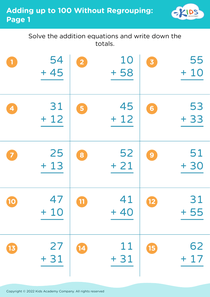
Basic Addition Skills Adding up to 100 with Regrouping Worksheets for Ages 8-9
3 filtered results
-
From - To
Unlock your child’s potential with our engaging "Basic Addition Skills: Adding up to 100 with Regrouping" worksheets, designed for ages 8-9. These meticulously crafted resources will help young learners grasp essential addition concepts, including regrouping, which is vital for mastering larger sums. Through fun and interactive exercises, children will build confidence in their math abilities while enhancing problem-solving skills. Each worksheet is tailored to reinforce understanding and encourage practice, making learning both effective and enjoyable. Perfect for classroom use or home practice, our worksheets are an excellent tool to support and strengthen your child’s mathematical foundation. Get started today!
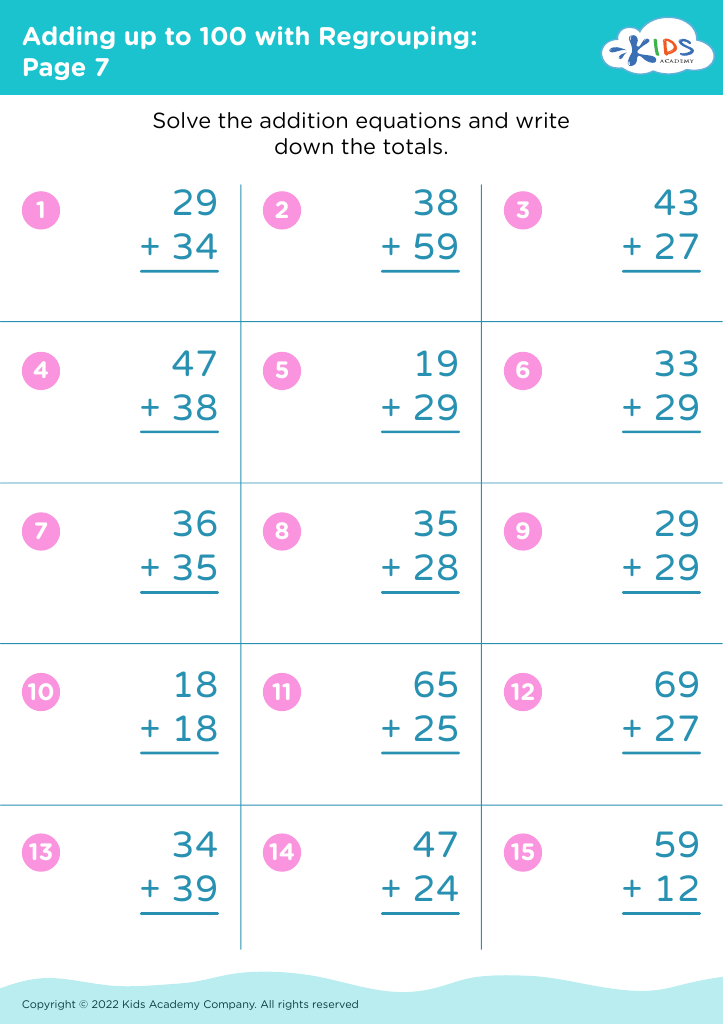
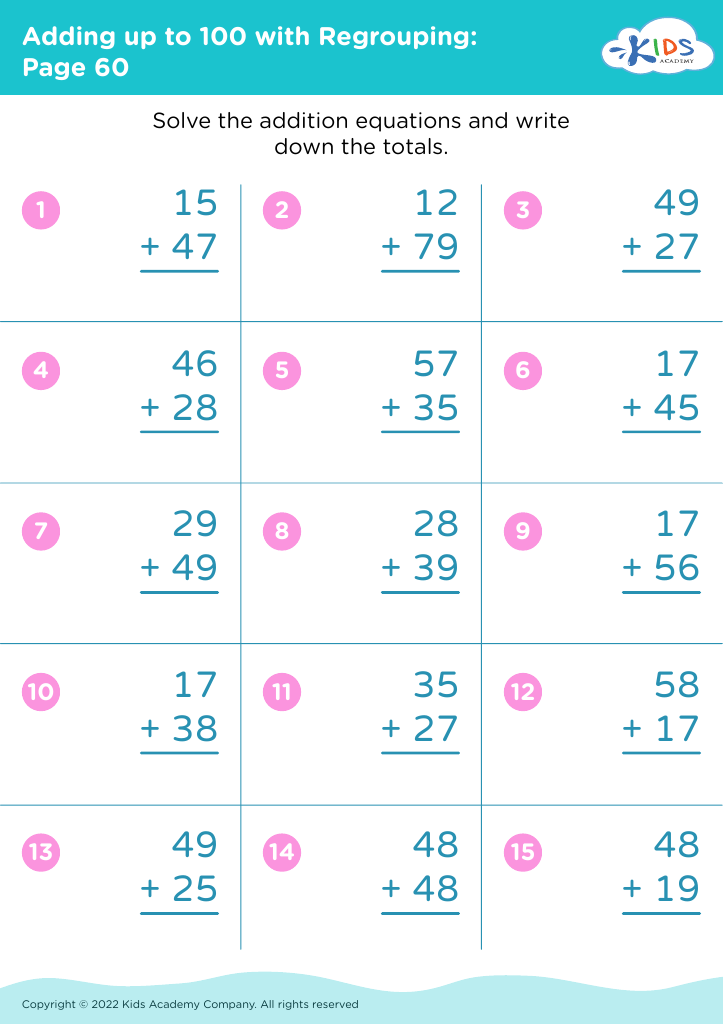
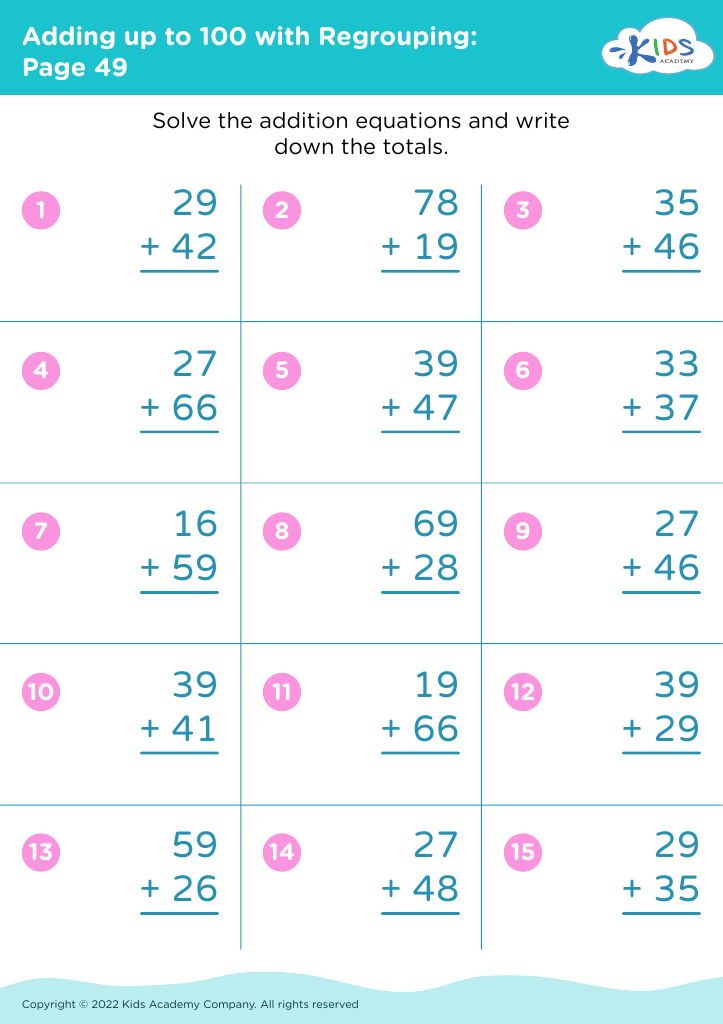




Basic addition skills, especially adding up to 100 with regrouping, are foundational to a child's mathematical development. For children aged 8-9, mastering these skills fosters confidence and sets the stage for more complex arithmetic. Understanding regrouping not only enhances accuracy but also promotes problem-solving abilities.
As students encounter multi-digit addition, regrouping helps them efficiently handle larger numbers. This skill is critical for daily life applications, such as budgeting or planning, ensuring students develop practical numeracy skills. Educators and parents should prioritize these lessons because they encourage logical thinking and mental math flexibility.
Moreover, without a solid grasp of these concepts, children may struggle with later mathematical topics like multiplication and division, leading to gaps in understanding that can affect their overall academic performance.
Furthermore, fostering a supportive learning environment where children feel encouraged to practice and ask questions enhances their engagement. In a technology-driven age, mathematical literacy remains crucial. Thus, focusing on basic addition, particularly with regrouping, equips children with the necessary tools to succeed as they progress in their education and build a strong numerical foundation for years to come.