Develop critical thinking Adding up to 100 Without Regrouping Worksheets for Ages 8-9
3 filtered results
-
From - To
Enhance your child's critical thinking skills with our "Adding Up to 100 Without Regrouping" worksheets, specifically designed for kids aged 8-9. These engaging and interactive activities help young learners develop a strong foundation in basic arithmetic while fostering analytical skills. By practicing addition strategies that avoid regrouping, students will build confidence in their mathematical abilities and improve problem-solving techniques. Our worksheets encourage independent thinking and creativity, making math a fun and enjoyable subject. Explore our resources today to equip your child with essential math skills that will serve them well in their educational journey and beyond!
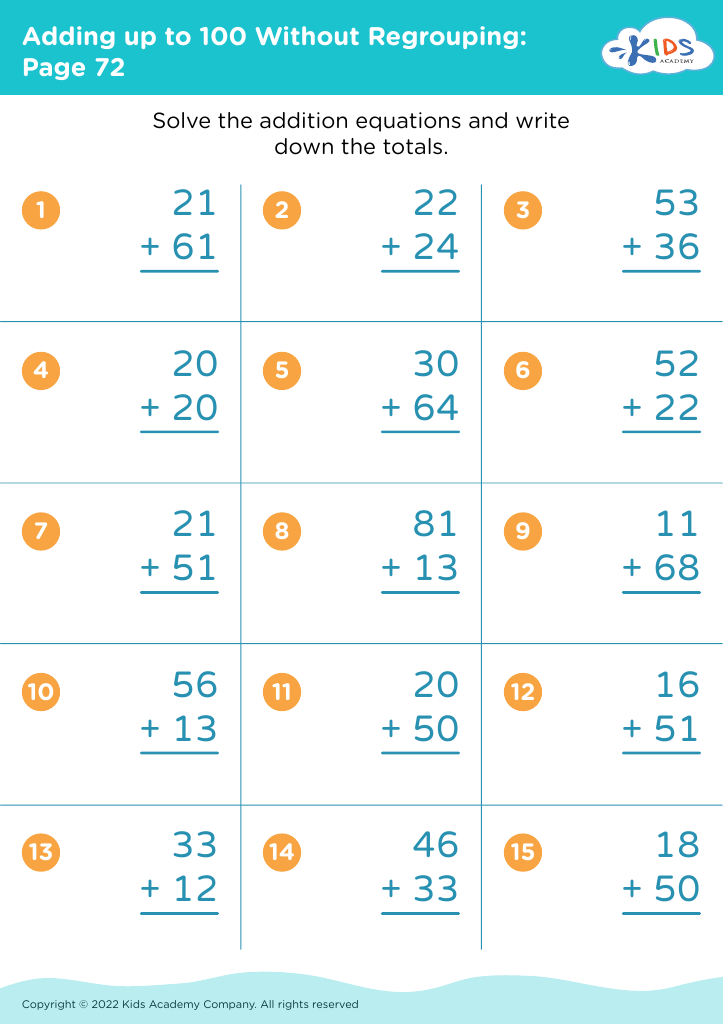
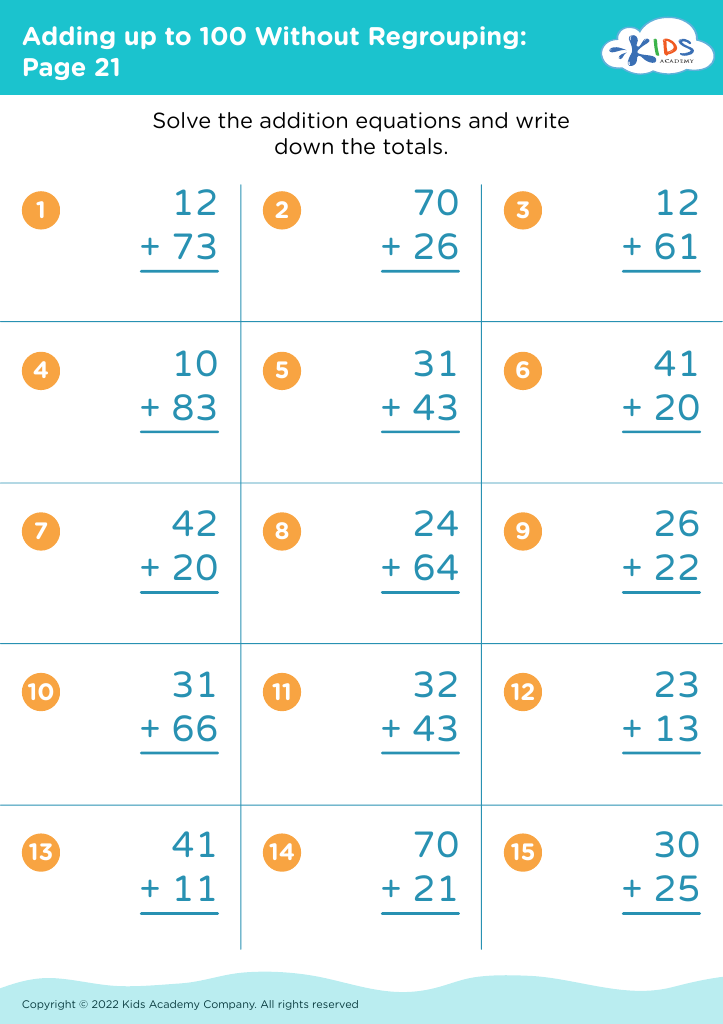
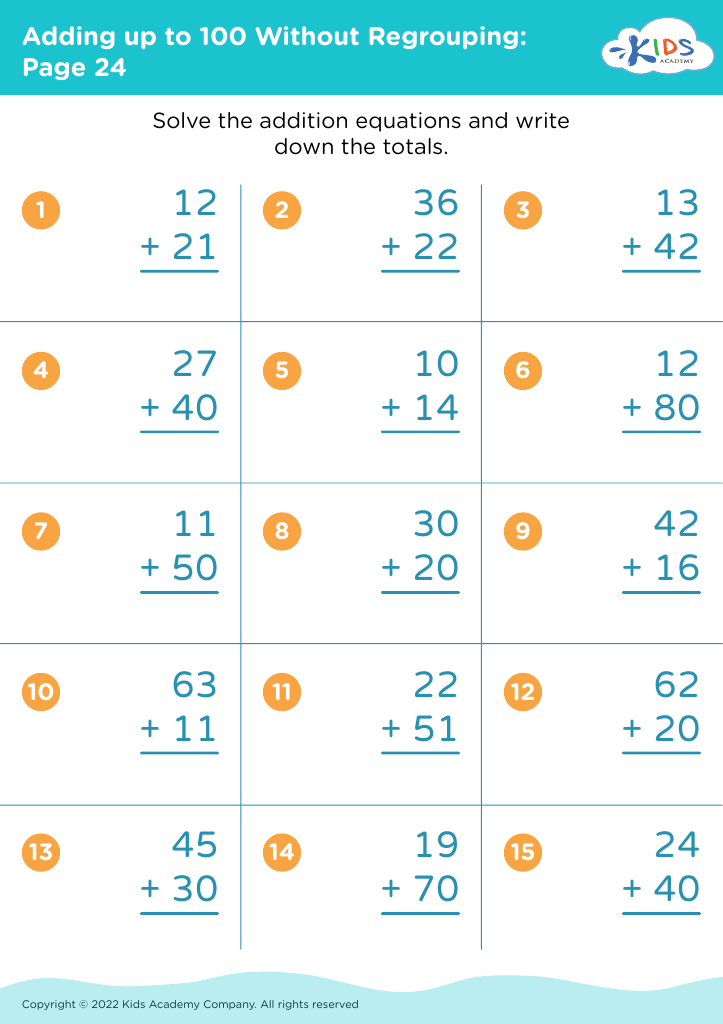




Parents and teachers should prioritize developing critical thinking skills in children aged 8-9, especially when teaching mathematical concepts like adding numbers up to 100 without regrouping. This age is a vital period for cognitive growth, where children begin to understand and analyze relationships and patterns in numbers. Encouraging critical thinking in this context helps students see beyond rote memorization and fosters a deeper understanding of mathematical concepts.
When children learn to add without regrouping, they practice breaking down numbers creatively and exploring different combinations. This process nurtures their problem-solving skills and teaches them to approach challenges methodically. By fostering critical thinking, educators can help children learn how to communicate their thought processes effectively, justify their answers, and explore multiple solutions.
Moreover, critical thinking is essential for future learning. As children develop these skills in mathematical contexts, they build a solid foundation that translates into higher-level reasoning and analytical skills in other subjects. Investing in the cultivation of critical thinking not only enhances their math proficiency but also prepares them for real-world applications, promoting lifelong learning and adaptability. In short, fostering critical thinking through age-appropriate math activities is crucial for holistic child development.