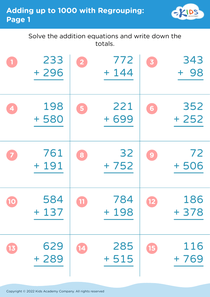
Enhance comprehension Adding up to 1000 Without Regrouping Worksheets for Ages 8-9
4 filtered results
-
From - To
Boost your child's math skills with our "Enhance Comprehension: Adding Up to 1000 Without Regrouping Worksheets" designed specifically for ages 8-9. These interactive worksheets focus on developing comprehension and fluency in addition, enabling students to solve problems confidently. Each activity reinforces foundational arithmetic concepts, helping kids to visualize numbers and understand place value without the complexity of regrouping. Encourage critical thinking and persistence as children tackle a variety of engaging exercises tailored to their learning needs. Ideal for both classroom settings and at-home practice, these worksheets build a strong numerical foundation essential for future math success. Get started today!
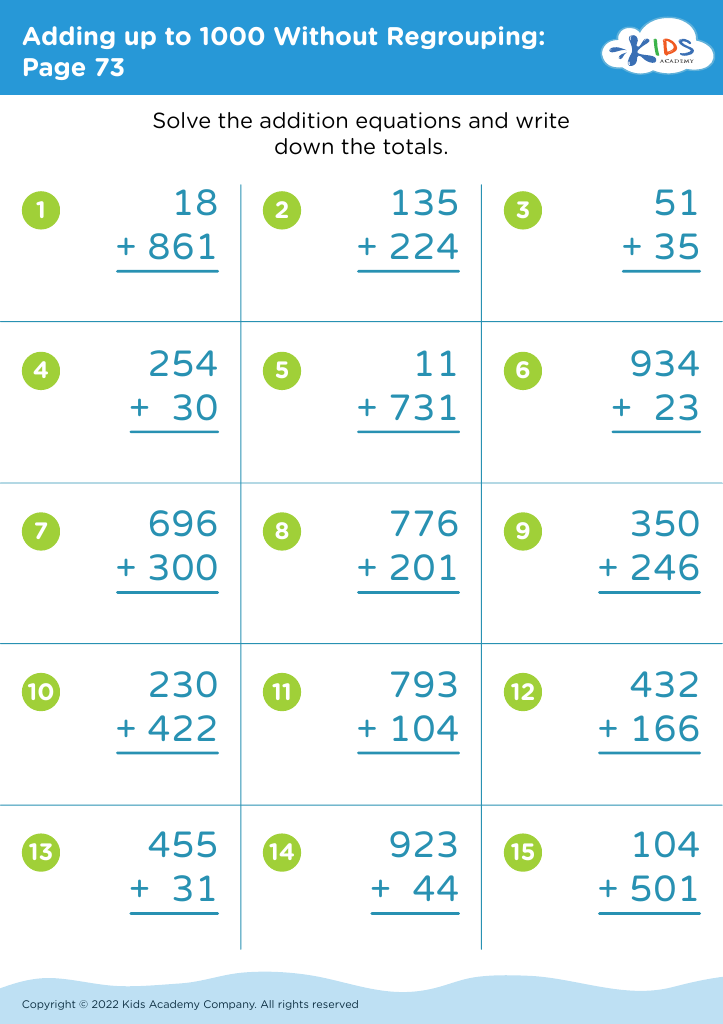
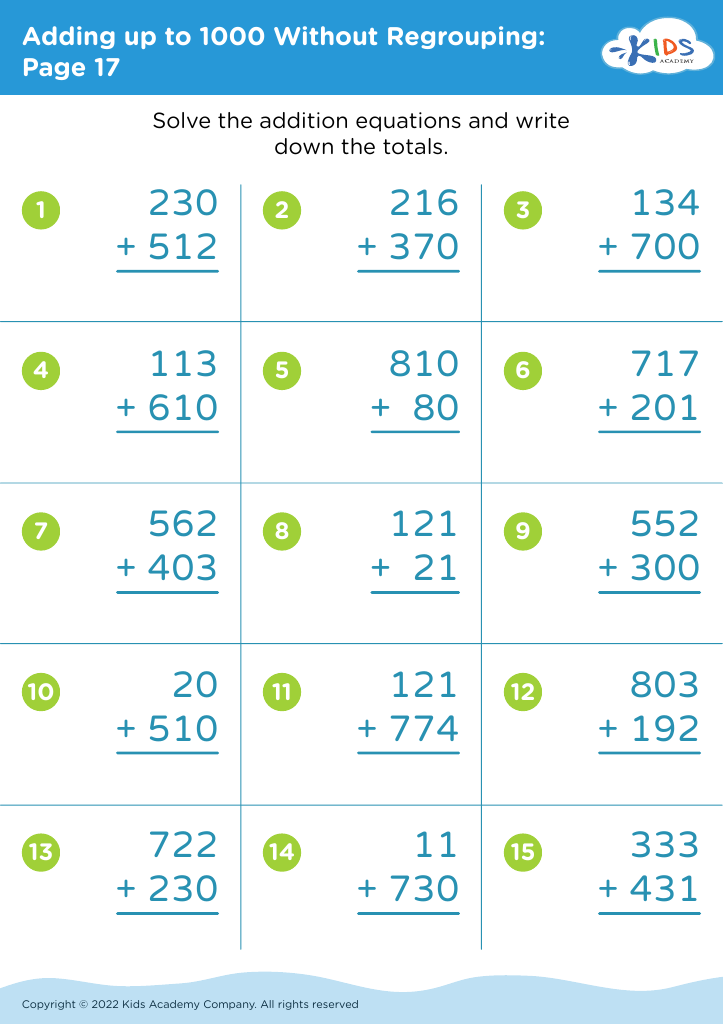
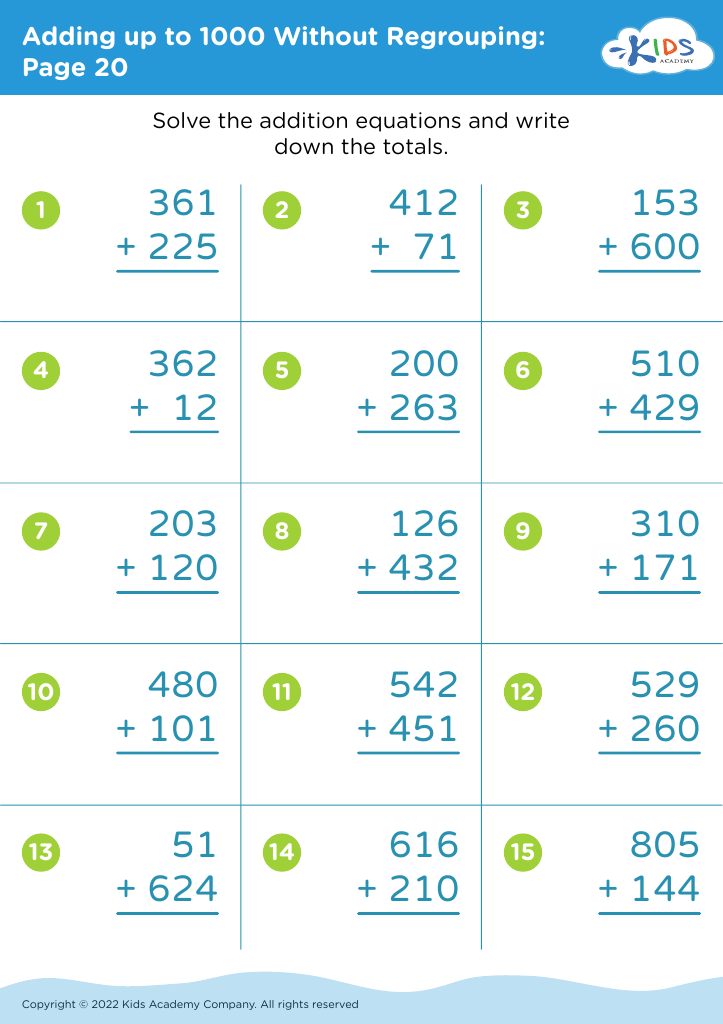
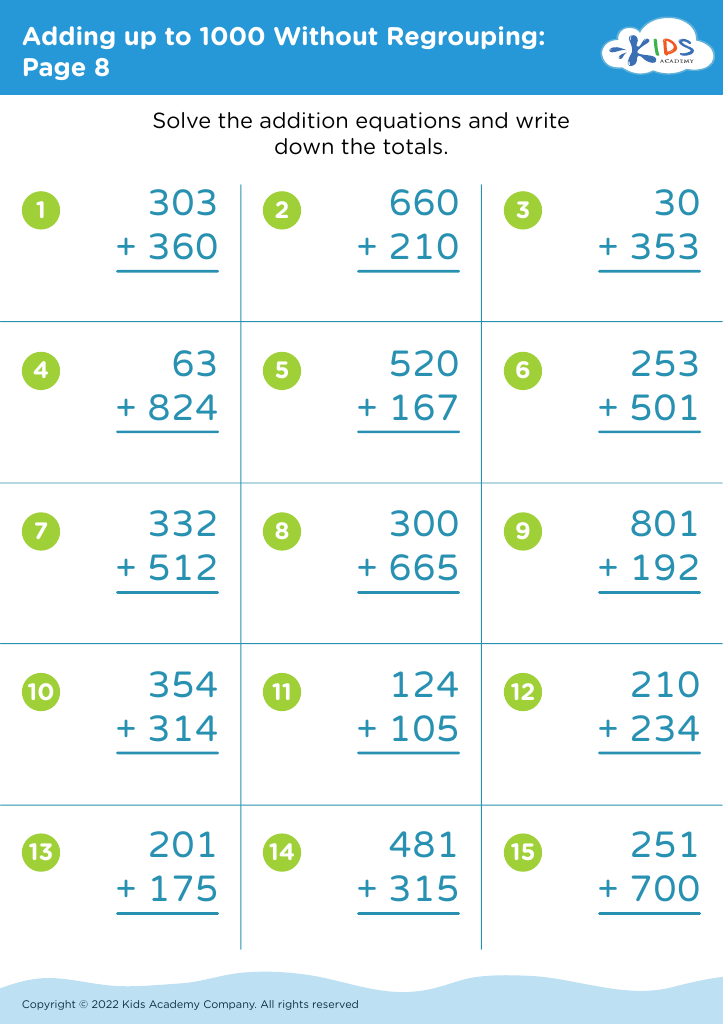


Enhancing comprehension in mathematics, especially regarding adding numbers up to 1000 without regrouping, is crucial for children aged 8-9, as it lays the foundation for more advanced mathematical concepts. At this age, children's cognitive abilities are rapidly developing, and they're beginning to understand abstract numerical relationships. Mastering addition without regrouping boosts their confidence since it allows for quick and accurate calculations, essential in everyday situations and more complex problems in the future.
Additionally, this skill encourages strong problem-solving and critical-thinking abilities. When children grasp how to add large numbers seamlessly, they develop a sense of numerical fluency, which is essential not just in math but also in subjects such as science and economics later in life. This kind of proficiency enhances their ability to understand and analyze data, comparison, and other critical quantitative concepts.
For parents and teachers, supporting children in this area helps cultivate a positive attitude toward math, reducing anxiety and resistance as they progress to more challenging topics. Engaging students during this learning phase with relevant, practical applications makes mathematics relatable and interesting, creating lifelong learners who value computational skills in their everyday lives. Therefore, nurturing comprehension in this early mathematically formative stage is imperative for holistic academic growth.