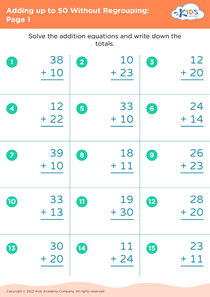
Addition skills Adding up to 50 with Regrouping Worksheets for Ages 8-9
3 filtered results
-
From - To
Enhance your child's addition skills with our engaging "Adding Up to 50 with Regrouping Worksheets" designed for ages 8-9. These worksheets provide a structured and fun approach to mastering addition that requires regrouping, helping young learners build confidence in their math abilities. Raising proficiency in essential math concepts, our resources support various learning styles through vibrant visuals and clear instructions. Whether at home or in the classroom, these printable activities encourage practice that promotes critical thinking and problem-solving skills. Perfect for reinforcing math lessons, these worksheets are a vital tool in fostering a love for learning and a solid foundation in arithmetic.
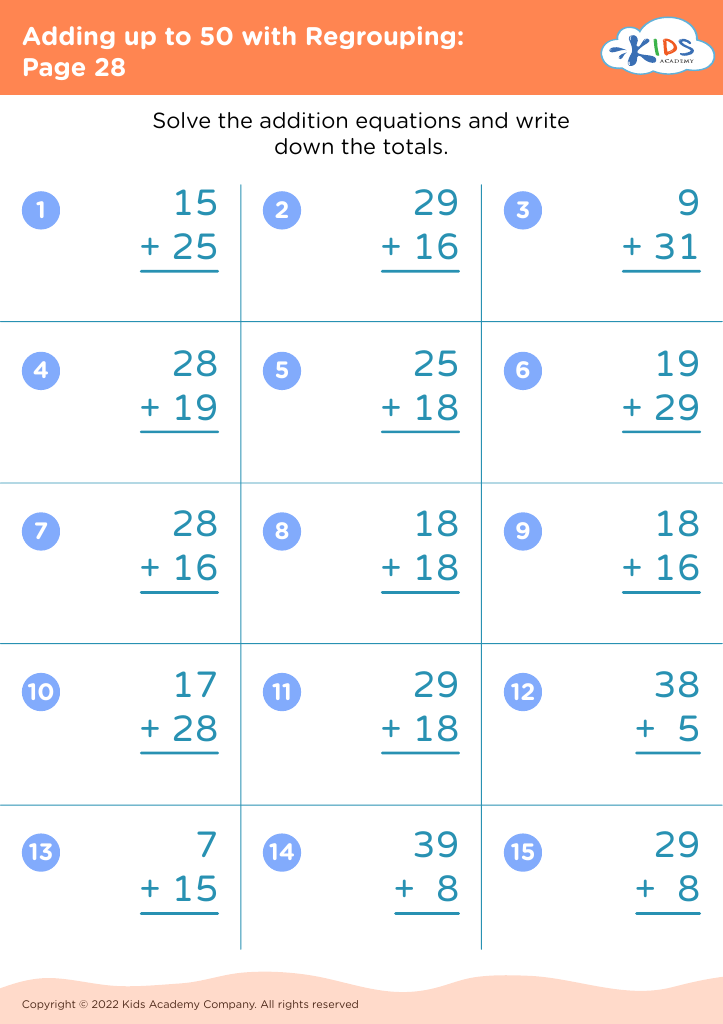
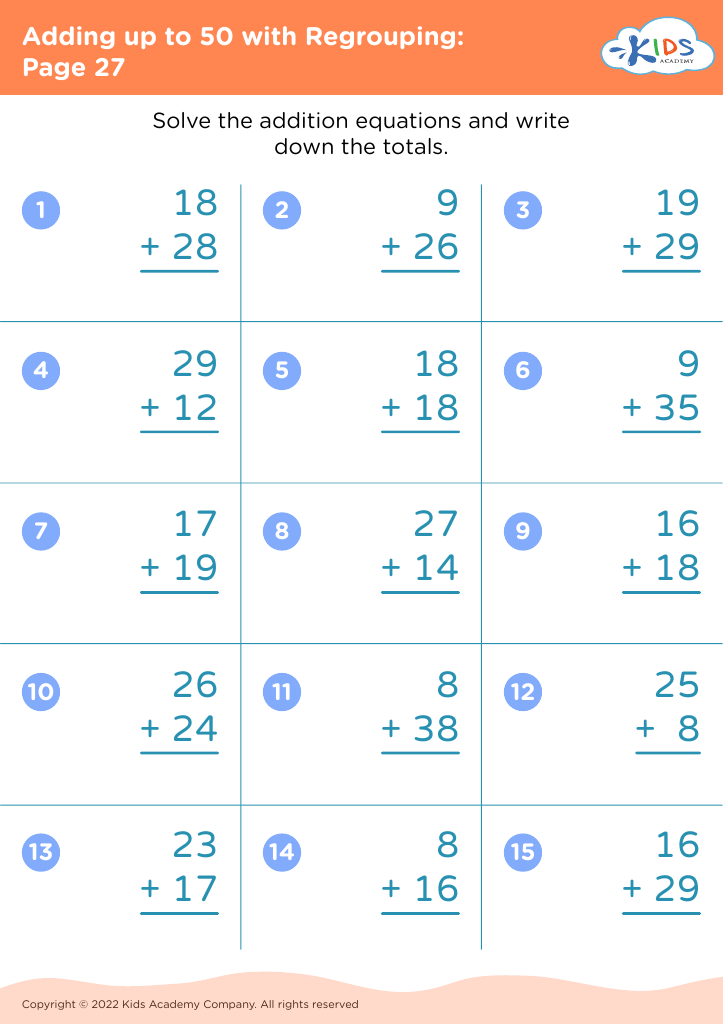
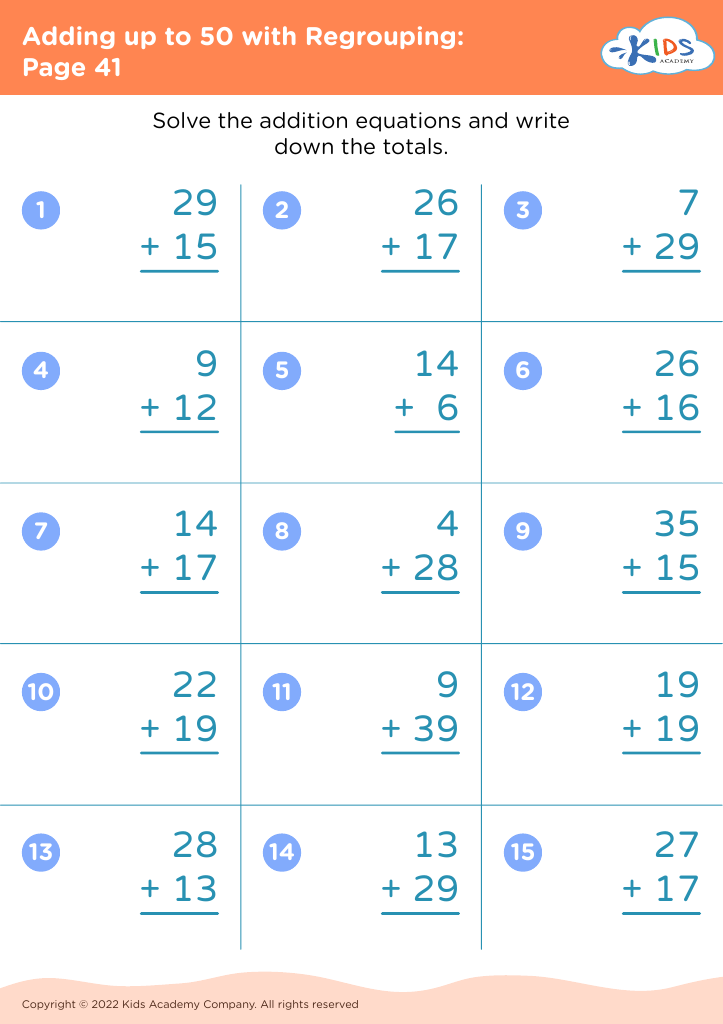


Parents and teachers should prioritize addition skills, specifically adding up to 50 with regrouping, for children aged 8-9 because these skills form a foundational element of their mathematical understanding. By mastering addition with regrouping, children learn to manage numbers beyond simple calculations, which enhances their problem-solving abilities and builds confidence in handling more complex math in the future.
At this age, kids transition from concrete to more abstract reasoning in mathematics. Mastery of regrouping lays the groundwork for understanding larger numbers and operations, supporting their progression into multiplication, division, and ultimately, algebra. It's also essential for real-life applications like budgeting, shopping, and time management.
Additionally, proficiency in addition with regrouping fosters cognitive skills such as critical thinking and numerical fluency. When children can quickly and efficiently solve addition problems, they are more likely to participate actively in classroom activities, fostering a positive attitude toward learning.
Furthermore, children develop patience and perseverance, key traits for overcoming challenges not just in math, but in all areas of learning. Thus, parents and teachers play a critical role in cultivating these essential skills through engaging activities that reinforce math comprehension, ensuring children are well-prepared for future academic success.