Problem Solving Adding up to 50 Worksheets for Ages 8-9
3 filtered results
-
From - To
Discover engaging "Problem Solving Adding up to 50 Worksheets" designed for ages 8-9, perfect for strengthening math skills! These worksheets offer a fun way for young learners to practice addition while tackling real-world problems. Each activity encourages critical thinking and helps children understand how to apply math concepts in everyday situations. With a focus on problem-solving, these resources promote independent learning and boost confidence in math abilities. Ideal for classrooms or at-home practice, our worksheets are aligned with educational standards and are easy to use. Enhance your child’s understanding of addition with these motivating, skill-building worksheets!


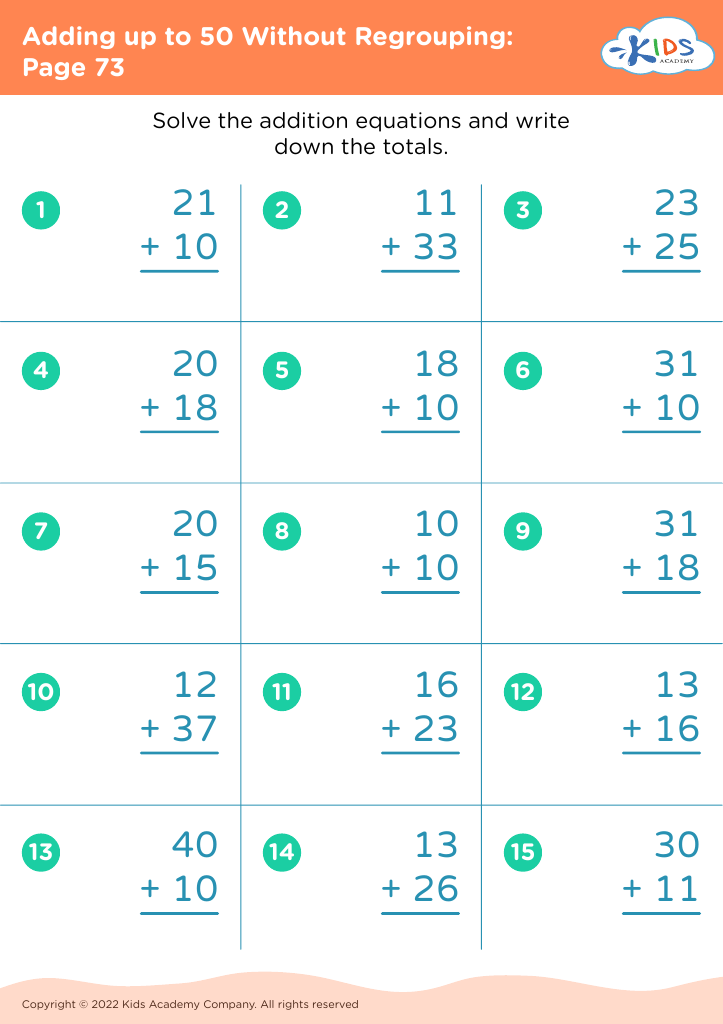




Problem Solving with addition up to 50 is an essential skill for children ages 8-9, and both parents and teachers play a vital role in fostering this ability. At this age, children are transitioning from basic arithmetic to more complex problem-solving tasks. Mastering these skills not only strengthens their mathematical foundation but also develops critical thinking and reasoning skills necessary for daily life.
By focusing on problem-solving, children learn to analyze situations, identify solutions, and justify their reasoning. This cultivates a mindset that values exploration and curiosity, encouraging them to approach challenges with confidence. Moreover, strong problem-solving skills in mathematics are linked to increased academic performance across various subjects, as they teach children to apply logical thinking in diverse contexts.
For parents and teachers, engaging children in problem-solving exercises can create meaningful, supportive learning experiences. These activities present opportunities for collaboration and communication, essential components of a child's social development. Additionally, being involved in their child’s problem-solving process allows adults to recognize individual learning styles and needs, ensuring targeted support. Ultimately, investing time in developing these skills lays the groundwork for lifelong learning, resilience, and a positive attitude toward challenges.








