
Developing critical thinking Addition & Subtraction Worksheets for Ages 8-9
3 filtered results
Difficulty Level
Grade
Age
-
From - To
Subject
Activity
Standards
Enhance your child's math skills with our "Developing Critical Thinking Addition & Subtraction Worksheets" designed for children ages 8-9. These engaging worksheets not only reinforce essential arithmetic skills but also promote critical thinking and problem-solving abilities. Each activity challenges students to think creatively, analyze information, and apply their knowledge to real-world scenarios. Aligned with educational standards, our worksheets provide a fun and dynamic learning experience that encourages independent thinking. Help your child build confidence and competence in math while fostering essential cognitive skills that will benefit their overall education. Explore our collection and watch your child thrive!
Favorites
With answer key
Interactive
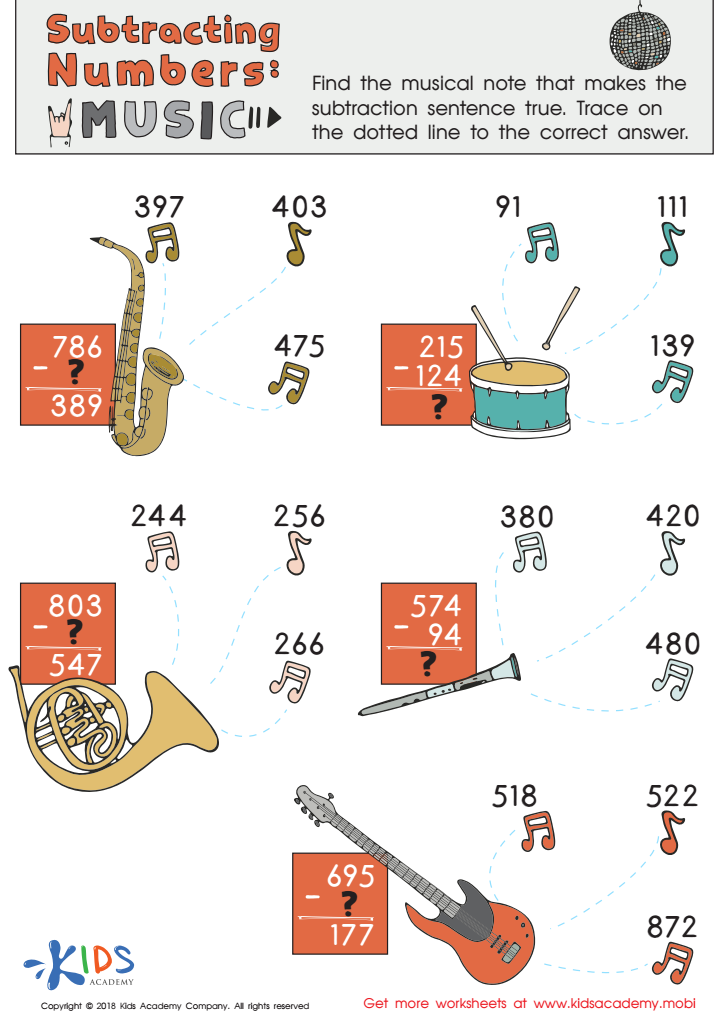
Subtracting Numbers: Music Worksheet
Enroll your kids in a music class and let them express their feelings via music! This worksheet challenges them to identify the musical note that makes the subtraction sentence true. Help them solve the problem and trace the dotted line to the correct answer. Let their appreciation for music grow!
 Assign to My Students
Subtracting Numbers: Music Worksheet
Worksheet
Learning Skills
Join Kids Academy for Free
Who is primarily going to use this learning content?








Developing critical thinking skills in addition and subtraction for children ages 8-9 is essential to laying a strong mathematical foundation. At this stage, children's cognitive abilities are expanding, and fostering critical thinking helps them understand not just how to solve problems, but why methods work. This comprehension encourages them to explore multiple ways to arrive at a solution, rather than relying solely on rote memorization of facts.
When parents and teachers focus on critical thinking in basic math operations, they empower children to engage in deeper problem-solving, producing greater confidence and resilience in facing challenges. For instance, encouraging students to explain their reasoning fosters communication skills and reinforces their understanding. Furthermore, embracing critical thinking paves the way for enhanced reasoning skills and the capability to draw connections between math and real-world situations, making learning more relevant and engaging.
Incorporating critical thinking strategies during this crucial developmental stage prepares children for more complex mathematical concepts in the future and equips them with necessary life skills, such as analytical thinking, decision-making, and persistence, which are invaluable beyond the classroom setting. Therefore, cultivating critical thinking in addition and subtraction should be a priority for parents and teachers alike.








